Spiritual Meaning of Mountains in the Bible: Revelation
In the Bible, mountains represent profound spiritual symbolism, ranging from divine revelation to covenantal promises. Mount Sinai embodies the giving of divine law and moral order, while Mount Zion symbolizes God’s eternal presence and kingdom.
Mount Ararat stands for renewal and divine promise following Noah’s Ark. Mount Moriah reflects faith and obedience, as seen in the story of Abraham and Isaac.
The Sermon on the Mount encompasses Christian ethical teachings, and Mount Tabor marks Jesus’ divine revelation. Finally, the Mount of Olives is central to eschatological prophecies.
Each mountain enriches biblical narratives with complex theological and ethical dimensions. Explore further for deeper insights.
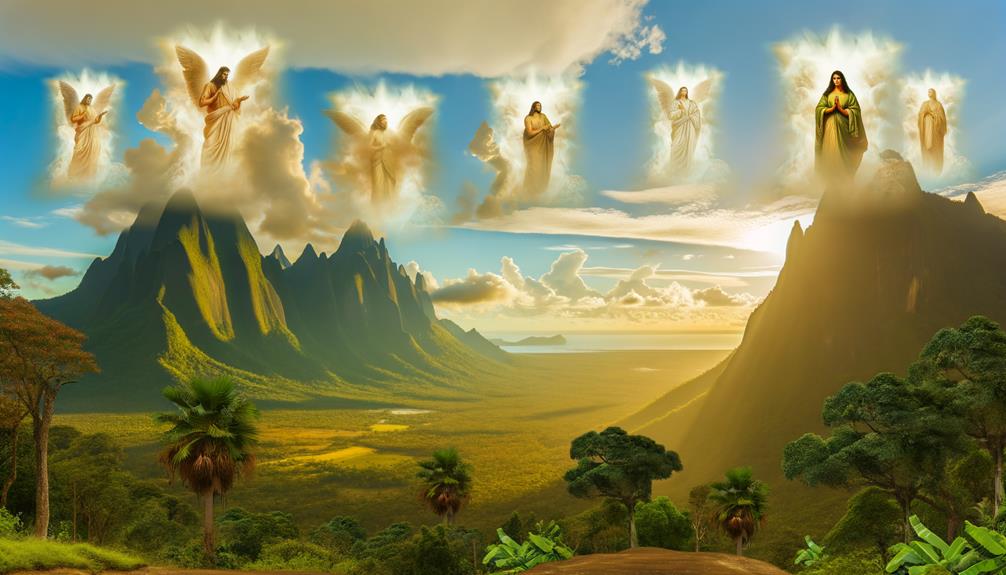
Spiritual Meaning of Mountains in the Bible: Divine Encounter, Strength, and Revelation
| Aspect | Description | Spiritual Significance |
|---|---|---|
| Divine Encounter | Exodus 19:20 (Mount Sinai) | Mountains are sacred places where God meets His people |
| Revelation | Matthew 5:1 (Sermon on the Mount) | Symbol of spiritual instruction and higher truth |
| Strength & Stability | Psalm 125:1-2 | Represents God’s steadfastness and eternal presence |
| Prayer & Worship | Luke 6:12 | Jesus often prayed on mountains, showing intimacy with God |
| Transformation | Matthew 17:1–2 (Mount of Transfiguration) | Mountains are places of glory, change, and divine revelation |
Symbolism of Mount Sinai

Mount Sinai, a pivotal site in biblical narratives, symbolizes divine revelation and covenant, marking the profound encounter between God and Moses. This mountain’s significance is deeply etched in the collective consciousness of Abrahamic faiths, representing the moment when the Ten Commandments were bestowed upon humanity.
The theophany at Sinai, with its awe-inspiring thunder, lightning, and divine voice, underscores the mountain as a locus of sacred communication. Sinai emerges as a symbol of divine law and moral order, where the covenantal relationship between God and the Israelites is solemnized.
This episode not only shapes theological constructs but also influences ethical frameworks, illustrating the mountain’s enduring impact on spiritual and communal life.
Significance of Mount Zion
While Mount Sinai is revered for its association with divine law, Mount Zion holds profound significance as the symbolic heart of spiritual and communal identity in biblical tradition.
This sacred elevation is frequently referenced in the Psalms and prophetic literature, representing God’s eternal dwelling place and the center of His divine kingdom.
As a metaphoric city of God, Zion epitomizes the ultimate reunion between the divine and humanity, underscoring themes of redemption and covenantal promises.
| Aspect | Description |
|---|---|
| Location | Jerusalem |
| Symbolism | Divine presence, spiritual center |
| Biblical References | Psalms, Isaiah, Micah |
| Theological Themes | Covenant, redemption, eternal kingdom |
| Liturgical Role | Central in Jewish worship and eschatological visions |
Mount Zion’s enduring legacy continues to inspire faith and unity, embodying the hope for a restored and holy community.
Lessons From Mount Ararat

Mount Ararat, known as the resting place of Noah’s Ark, serves as a profound symbol of renewal and divine promise in biblical narratives.
This mountain represents a pivotal moment of shift from destruction to regeneration, emphasizing themes of hope and new beginnings.
Reflecting on Mount Ararat allows for deeper understanding of the spiritual implications of restoration and faith in divine providence.
Noah’s Ark Resting Place
The resting place of Noah’s Ark on Mount Ararat serves as a profound symbol of divine salvation and renewal in biblical theology. This location is not merely a geographical landmark but a representation of God’s covenantal faithfulness.
The ark, having withstood the cataclysmic flood, rests on the heights of Ararat, signifying the cessation of divine judgment and the dawn of a reconstituted world. Reflecting on this narrative, scholars perceive Ararat as a divine altar of preservation where humanity is given a second chance.
The mountain therefore embodies both the end of divine wrath and the beginning of divine mercy, offering a poignant reminder of God’s enduring commitment to the sanctity and continuity of life on Earth.
Symbol of New Beginnings
Scholars and theologians often interpret the resting of Noah’s Ark on Mount Ararat as emblematic of new beginnings, highlighting the mountain’s role as a beacon of hope and renewal in biblical narratives. This event signifies the end of the cataclysmic flood and the commencement of a restored creation.
Ararat, consequently, is not merely a geographical location but a profound symbol of divine grace and restoration. In theological discourse, it underscores the themes of redemption and the possibility of a fresh start after divine judgment.
This mountain stands as proof of God’s covenant with humanity, promising continuity and the opportunity for renewal, thereby serving as a powerful metaphor for spiritual rebirth and resilience in the face of adversity.
Insights From Mount Moriah
Revered for its profound historical and spiritual significance, Mount Moriah serves as the backdrop for pivotal biblical events that offer deep insights into faith, obedience, and divine providence.
The narrative of Abraham’s willingness to sacrifice Isaac, as commanded by God, underscores the ultimate test of faith and obedience. This event, laden with theological symbolism, epitomizes absolute trust in divine will and prefigures the concept of sacrificial love.
Additionally, Mount Moriah is traditionally identified as the location of Solomon’s Temple, signifying a place where divine presence and human devotion converge.
Consequently, Mount Moriah emerges as a monumental reflection of the interplay between divine command and human response, providing rich material for reflection on spiritual commitment and divine-human interaction.
Sermon on the Mount

Among the most significant teachings of Jesus, the Sermon on the Mount encapsulates core principles of Christian ethics, offering profound insights into spiritual and moral conduct.
Delivered on a mountainside, this sermon emphasizes humility, compassion, and righteousness, setting a blueprint for Christian behavior.
The Beatitudes, which open the discourse, highlight virtues such as mercy and peacemaking, promising divine blessing.
In addition, Jesus’ teachings on love for enemies, the Lord’s Prayer, and the Golden Rule underscore a radical redefinition of righteousness, contrasting it with mere legalistic observance.
This sermon’s elevated setting symbolizes spiritual elevation, signifying the transformative potential of adhering to these divine precepts.
Ultimately, the Sermon on the Mount remains central to Christian theology, continually inspiring ethical reflection and spiritual growth.
Transfiguration on Mount Tabor
The Transfiguration on Mount Tabor represents a pivotal moment in the New Covenant, where the divine nature of Jesus is vividly revealed to Peter, James, and John.
This event underscores the intersection of the temporal and the eternal, highlighting Jesus’ celestial glory and reinforcing His divine mission.
| Element | Symbolism | Significance |
|---|---|---|
| Radiance of Jesus | Divine revelation | Jesus’ glory is made manifest |
| Presence of Moses | Law | Connection to Old Scripture |
| Presence of Elijah | Prophets | Fulfillment of prophetic traditions |
| Disciples’ Reaction | Awe and fear | Human response to divine encounters |
Reflecting on this, the Transfiguration emphasizes the continuity between Old and New Covenants, and the divine approval of Jesus’ forthcoming sacrifice.
Prophecies on the Mount of Olives
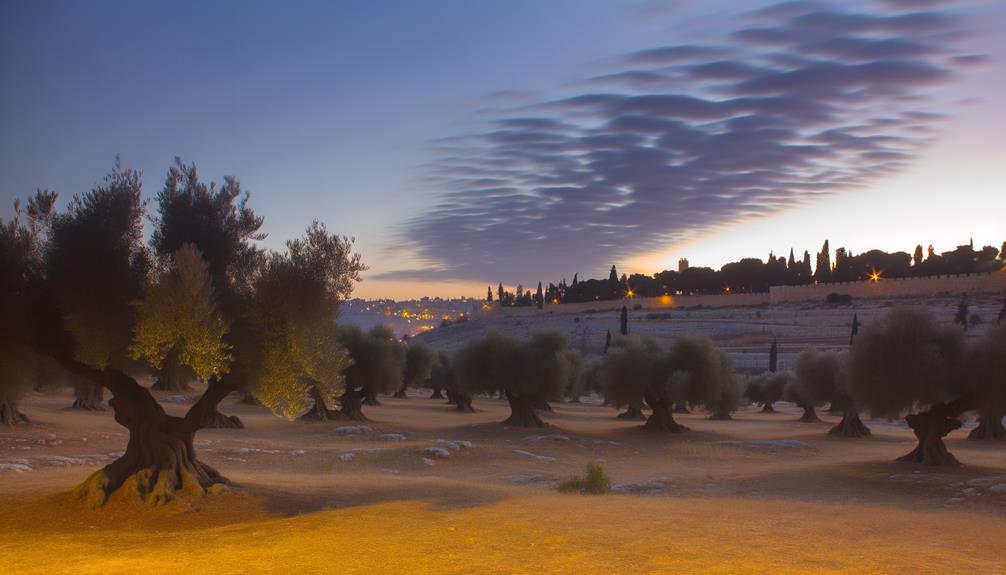
Following the profound revelation of Jesus’ divine nature on Mount Tabor, the Mount of Olives serves as another significant biblical location where Jesus delivers prophecies that foretell pivotal events in Christian eschatology.
This mount, located east of Jerusalem, is the setting for the Olivet Discourse, a sermon found in the synoptic Gospels. In this discourse, Jesus speaks of the destruction of the Temple, the end of the age, and His second coming.
The Mount of Olives therefore becomes a symbol of both judgment and hope, encapsulating the dual themes of divine retribution and ultimate redemption. These prophecies underscore the mount’s enduring spiritual significance, as they resonate deeply within the Christian anticipation of future fulfillment.
Conclusion
Mountains in biblical narratives manifest multifaceted meanings, symbolizing divine encounters, spiritual elevation, and prophetic revelations.
From Mount Sinai’s sacred stipulations to Mount Zion’s zealous centrality, each elevation elucidates essential theological tenets.
Mount Ararat and Mount Moriah offer lessons in loyalty and legacy, while Mount Tabor and the Mount of Olives illuminate transformative teachings and transcendent prophecies.
These mountainous metaphors magnify the manifold mysteries and moral mandates embedded within scriptural contexts.
Fundamentally, biblical mountains encapsulate epochs of enlightenment and epochs of eschatological expectation.