Spiritual Meaning of Sycamore Tree: Strength and Transformation
The sycamore tree, a timeless symbol of life, death, and rebirth, bridges dimensions with its deep roots and sky-reaching branches. Ancient Egyptians revered it as the ‘Tree of Life,’ while Greeks and Celts saw it as a beacon of transformation and wisdom.
Native American traditions celebrated its protective essence. This sacred tree’s resilience, shelter, and eternal connection nourish the soul, offering a sanctuary for meditation and spiritual growth.
Biblical references accentuate its role in divine interaction and faith. Revealing the sycamore’s mystical meanings uncovers deeper spiritual truths and timeless wisdom waiting to be explored further.

Spiritual Meaning of Sycamore Tree: Transformation, Protection, and Divine Opportunity
| Aspect | Spiritual Meaning |
|---|---|
| Spiritual Transformation | Represents growth, renewal, and the shedding of old patterns |
| Divine Opportunity | Symbolizes new beginnings and moments of spiritual clarity |
| Protection and Shelter | Offers symbolic refuge and divine covering during trials |
| Biblical Significance | Known from the story of Zacchaeus as a place of spiritual awakening (Luke 19:4) |
| Connection to Purpose | Encourages aligning with divine timing and embracing life’s calling |
Historical Significance

Throughout history, the sycamore tree has stood as a potent symbol in various cultures, deeply intertwined with spiritual and mystical beliefs.
Ancient Egyptians revered it as the ‘Tree of Life,’ a conduit between the domains of the living and the dead. Its expansive branches provided shelter to the soul’s journey, embodying the essence of eternal life.
In Greek mythology, the sycamore was sacred to deities, symbolizing transformation and rebirth.
Celtic traditions also held the tree in high esteem, associating it with wisdom and divination.
The sycamore’s timeless presence in sacred texts and mythologies reveals a tree that bridges human existence with the divine, inviting reflection on life’s deeper mysteries and the unseen forces that guide us.
Symbol of Protection
Embodying ancient wisdom and divine connections, the sycamore tree also serves as a powerful symbol of protection, offering a sacred canopy under which one can find solace and refuge.
This majestic tree has been revered across cultures for its protective qualities, creating a haven for those seeking shelter from life’s storms. The mystical presence of the sycamore extends beyond the physical dimension, providing metaphysical safeguards that nurture the soul.
- Ancient Egyptians believed the sycamore was a gateway to the heavens.
- Native Americans used its bark and leaves in protective rituals.
- Early Christians saw it as a symbol of divine shelter.
In its protective embrace, one can truly reconnect with the divine.
Strength and Resilience

The sycamore tree stands as a symbol of enduring strength and resilience through the ages.
Its historical roots and symbolic interpretations reveal a profound connection to growth and adaptability.
Like a silent guardian, it embodies the spirit’s unwavering ability to withstand life’s storms and flourish anew.
Historical Significance
Ancient civilizations often revered the sycamore tree for its unyielding strength and remarkable resilience, seeing it as a symbol of endurance through time.
From the Egyptian Pharaohs to the ancient Greeks, this majestic tree has been a silent witness to history’s unfolding. Its deep roots provided stability, even in the harshest conditions, allowing it to flourish where others could not.
Its broad canopy offered protection from the elements, serving as shelter and refuge for both people and animals. Many cultures included the sycamore in sacred rituals, believing it was a gateway to the divine.
Additionally, the leaves and bark of the sycamore were utilized in traditional healing practices, showcasing its medicinal uses.
The sycamore tree has also been embraced as a cultural icon, appearing in myths and legends across various societies.
The sycamore tree’s historical significance is a reflection of its strength, a beacon of resilience across ages.
Symbolic Interpretations
Through the ages, people have looked to the sycamore tree as a symbol of unwavering strength and resilience, drawing inspiration from its ability to thrive in adversity.
This majestic tree, with its deep roots and robust trunk, embodies the essence of enduring spirit. In times of hardship, the sycamore stands tall, its branches reaching skyward, offering a silent, yet powerful symbol of the human capacity for perseverance.
It whispers ancient wisdom, reminding us that true strength lies not in avoiding life’s storms, but in weathering them with grace.
The sycamore’s presence in sacred texts and folklore further amplifies its role as a beacon of hope and fortitude, guiding souls toward inner resilience and unwavering faith.
Growth and Adaptability
In observing the sycamore’s journey from seedling to towering giant, one witnesses a profound demonstration of growth and adaptability, reflecting life’s ever-changing nature and the boundless resilience within every soul.
The sycamore’s ability to thrive in diverse environments and its remarkable longevity symbolize:
- Strength amid adversity: Its roots dig deep, anchoring it firmly.
- Adaptability: It flourishes in both wet and dry conditions.
- Endurance: It withstands harsh weather and time’s ravages.
Each characteristic sings a silent hymn of perseverance and transformation, urging all who behold it to embrace their own capacity for change and endurance. The sycamore stands as a living proof of the tenacity residing in every being.
Connection to Eternity
The sycamore tree, with its enduring presence and majestic stature, serves as a living bridge to the infinite, symbolizing humanity’s timeless connection to the eternal.
Its deep roots and expansive canopy reflect the soul’s journey through the cycles of life, death, and rebirth.
Observers find solace in its unwavering strength, feeling an ancient wisdom that transcends generations.
The sycamore’s longevity whispers secrets of the cosmos, encouraging souls to ponder their place in the grand tapestry of existence.
Its leaves, ever reaching towards the heavens, remind us of our inherent connection to something greater than ourselves.
This sacred tree becomes a symbol of continuity and eternal life, offering a profound reminder of humanity’s unbroken link to the divine.
Egyptian Mythology
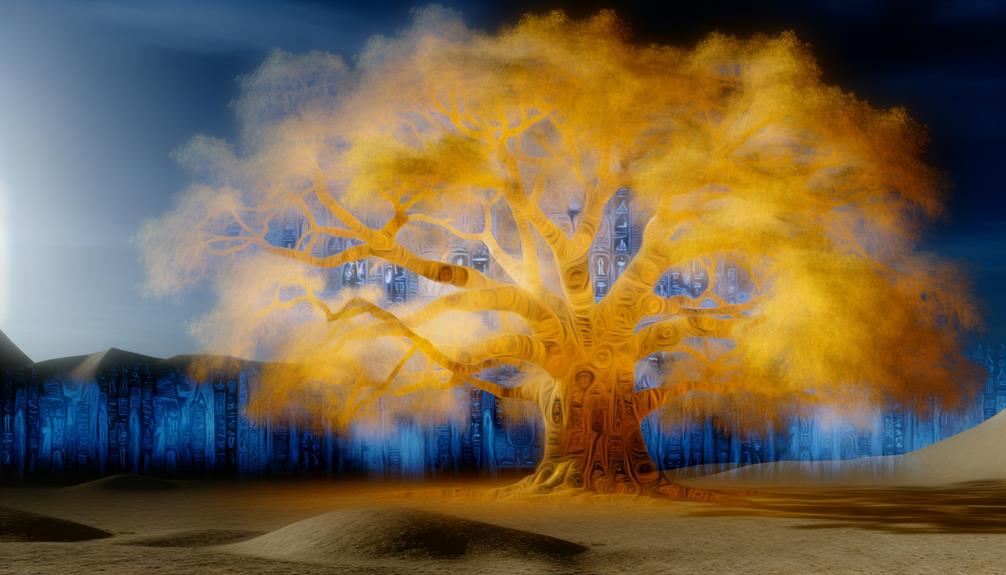
Amidst the sands of ancient Egypt, the sycamore tree emerges as a sacred symbol intertwined with the spheres of gods and the afterlife.
Ancient Egyptians revered the sycamore for its connection to Hathor, the goddess of love and motherhood, who was often depicted emerging from its boughs. This majestic tree also served as a celestial bridge, linking the earthly domain with the heavens.
Its spiritual importance included:
- Protection: Believed to guard souls on their journey to the afterlife.
- Nourishment: Provided sustenance for both the living and the dead.
- Rebirth: Symbolized regeneration and eternal life.
Thus, the sycamore tree stood as a mystical emblem of life’s cyclical nature and divine protection.
Biblical References
Just as the sycamore tree held profound significance in ancient Egyptian mythology, its presence within biblical texts reveals deep layers of spiritual symbolism and divine interaction.
In the Bible, the sycamore tree is a living symbol of faith, transformation, and God’s watchful presence. It is particularly mentioned in the story of Zacchaeus, who climbed a sycamore to see Jesus, symbolizing the quest for divine connection and personal change.
| Scripture | Reference | Meaning |
|---|---|---|
| Luke 19:4 | Zacchaeus climbs | Seeking spiritual elevation |
| Amos 7:14 | Shepherds prune | Humility and divine service |
| 1 Kings 10:27 | Abundance | Prosperity and divine provision |
| Isaiah 9:10 | Restoration | Renewal and resilience |
| Psalm 78:47 | Judgment | Divine power and authority |
In these verses, the sycamore tree stands as a symbol of sacred encounters, growth, and divine grace.
Cultural Symbolism

Across various cultures, the sycamore tree emerges as a potent emblem of mystical wisdom and sacred connection. Ancient Egyptians revered it as a link between life and the afterlife, believing it to be the home of deities.
Native Americans saw it as a symbol of protection and longevity. In Celtic traditions, it was considered a guardian of ancient knowledge and a portal to other dimensions.
- Ancient Egyptians: link between life and afterlife
- Native Americans: symbol of protection and longevity
- Celts: guardian of ancient knowledge
These cultural narratives weave a rich tapestry, suggesting that the sycamore tree holds a universal resonance, whispering secrets of the cosmos to those who seek its wisdom. Its presence invites reflection and connection to the sacred.
Spiritual Growth
Drawing upon its deep roots in myth and legend, the sycamore tree serves as a powerful catalyst for spiritual growth, inspiring those who seek enlightenment to explore their innermost selves.
Its towering presence and expansive canopy symbolize the journey from earthly existence to higher consciousness. The sycamore’s resilience mirrors our own potential for inner transformation and renewal.
| Aspect | Sycamore Symbolism | Spiritual Growth Impact |
|---|---|---|
| Roots | Deep connection to Earth | Grounding and stability |
| Trunk | Strength and endurance | Personal resilience |
| Branches | Reaching towards the sky | Aspiring to higher wisdom |
| Leaves | Renewal and growth | Continuous learning |
| Bark | Shedding old layers | Letting go of past burdens |
In essence, the sycamore tree beckons us to grow spiritually, reaching ever higher while staying firmly rooted.
Modern Interpretations

In today’s world, the sycamore tree continues to captivate the spiritual imagination, embodying timeless wisdom and modern mysticism. Its presence inspires a deeper connection to nature and the divine, symbolizing spiritual renewal and transformation.
Modern interpretations of the sycamore’s spiritual meaning often reflect a blend of ancient traditions and contemporary insights.
- Symbol of resilience: Represents enduring strength and the ability to thrive amidst adversity.
- Bridge between worlds: Seen as a link between the physical and spiritual domains, fostering a deeper understanding of one’s place in the universe.
- Guardian of secrets: Holds ancient wisdom and mysteries, inviting introspection and inner growth.
These interpretations continue to inspire and guide those seeking spiritual enlightenment.
Conclusion
One intriguing statistic reveals that sycamore trees can live for over 600 years, embodying the timeless wisdom they symbolize.
This enduring presence invites reflection on life’s deeper mysteries, as their spiritual significance spans cultures and epochs.
Whether as a symbol of protection, resilience, or eternal connection, the sycamore tree beckons souls to explore their own spiritual growth.
Its ancient roots whisper tales of strength and eternity, offering a mystical guide through the journey of life.