
Forget Me Not Flower Spiritual Meaning: True Love
The Forget Me Not flower, known scientifically as Myosotis, holds profound spiritual meaning, symbolizing enduring love, unwavering remembrance, and deep emotional ties. Originating from 15th-century German folklore, it represents loyalty and constancy, historically worn by knights as tokens of fidelity.
Its vibrant blue hue embodies tranquility and emotional depth, making it a botanical emblem of eternal romantic connections. Additionally, its perennial nature reflects resilience and steadfast affection, themes echoed in literature and art over centuries.
Whether commemorating lost loved ones or symbolizing hope and renewal, the Forget Me Not poignantly bridges past and present emotional landscapes, offering more to discover.

Forget Me Not Flower Spiritual Meaning: Symbolism of Eternal Love and Remembrance
| Aspect | Spiritual Meaning |
|---|---|
| Eternal Love | Represents love that transcends time and distance |
| Remembrance | A symbol of keeping loved ones in memory, especially those departed |
| Loyalty and Fidelity | Reflects unwavering faithfulness and trust |
| Spiritual Connection | Signifies a soul bond that continues beyond physical presence |
| Compassion and Grace | Embodies gentle emotional strength and kindness |
Historical Significance
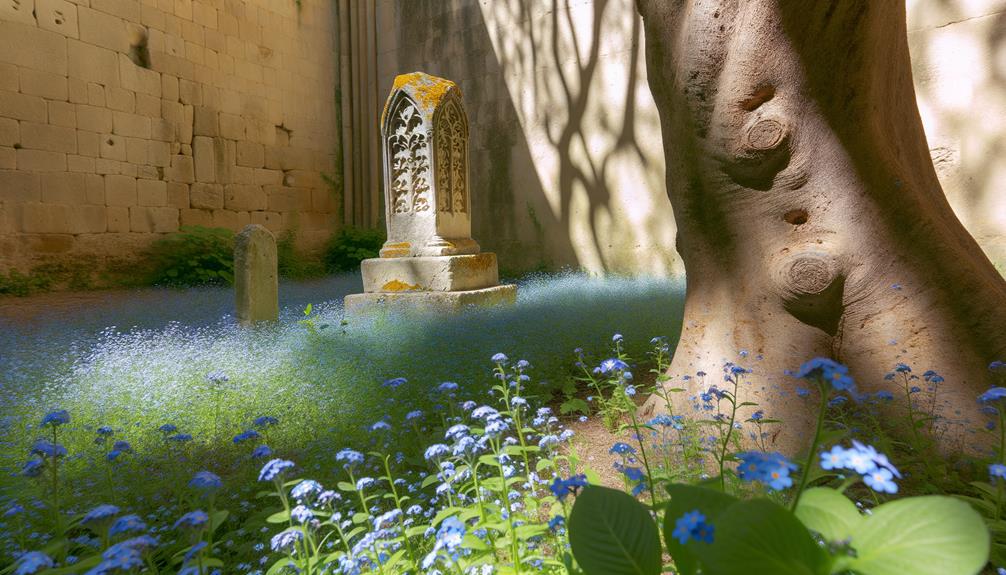
The historical significance of the forget-me-not flower is deeply rooted in its symbolic representation of remembrance and enduring love across various cultures.
Originating in Europe, its name first appeared in 15th-century German folklore, where a knight, drowning in a river, tossed the flower to his beloved, urging her to ‘forget me not.’
In medieval times, it was used to signify constancy and loyalty in literature and art. The Victorians further cemented its role in expressing genuine remembrance.
Scientifically classified as Myosotis, the flower’s perennial nature and resilience in diverse environments underscore its association with lasting memories.
The forget-me-not also played a role in World War I and II commemorations, symbolizing the enduring spirit of those who sacrificed their lives.
Symbolism in Love
In the context of love, the forget-me-not flower embodies the concept of an eternal romantic connection, symbolizing unwavering devotion.
This botanical emblem serves as a poignant reminder of love and remembrance, often evoking sentiments that transcend temporal boundaries.
Its presence in romantic literature and cultural traditions underscores its significance in representing enduring affection and loyalty.
Eternal Romantic Connection
Embodying the essence of unwavering devotion, the Forget Me Not flower serves as a powerful emblem of eternal romantic connection.
Scientifically known as Myosotis, this delicate bloom symbolizes a love that transcends time. Its persistent blooming cycle illustrates the resilience and continuity of romantic bonds.
Historically, lovers exchanged these flowers as tokens of faithfulness, signifying a promise to remember and cherish each other. The flower’s vibrant blue hue, often associated with tranquility and depth, further enhances its representation of a profound emotional connection.
Unwavering Devotion Symbolism
Forget Me Not flowers stand as a tribute to unwavering devotion, symbolizing a steadfast love that endures all trials and tribulations. These delicate blue blooms convey a profound significance in the domain of romantic and platonic relationships.
They embody a commitment that remains unshaken despite adversity, reflecting the psychological constructs of loyalty and constancy.
Scientifically, the flower’s perennial nature mirrors its symbolic meanings, with its ability to thrive year after year signifying enduring affection. Their morphology, including resilient stems and hardy petals, further underscores this symbolism.
This botanical resilience translates into a metaphor for human relationships—illustrating that true devotion, much like the Forget Me Not, can withstand the test of time and challenges.
Love and Remembrance
The myriad meanings of the Forget Me Not flower in the domain of love extend beyond mere aesthetics, encapsulating the essence of enduring affection and cherished memories. This small, delicate flower symbolizes a profound emotional connection that withstands the test of time.
Scientifically, it embodies:
- Enduring Devotion: Reflecting a love that remains steadfast despite life’s challenges.
- Memory Preservation: Acting as a botanical emblem of the memories held dear between loved ones.
- Unbroken Bonds: Signifying relationships where separation doesn’t diminish affection.
- Eternal Love: Representing a perpetual and unending emotional connection.
Analyzing its symbolism, one finds that the Forget Me Not flower serves as a poignant reminder of the significance of love and remembrance in human relationships.
Cultural References
Throughout history, the forget-me-not flower has served as a symbol in various cultures, often signifying remembrance and enduring affection.
In modern times, its interpretations have evolved, yet it continues to hold a significant place in literature, art, and social rituals.
Analyzing its historical symbolism alongside contemporary meanings provides a thorough understanding of its cultural impact.
Historical Symbolism
In various cultures, the forget-me-not flower has symbolized remembrance, love, and fidelity, often appearing in folklore and historical narratives to convey deeper emotional connections. The flower’s significance is deeply embedded in the cultural and historical fabric of many societies.
- Medieval Europe: Knights wore forget-me-nots in their armor, believing the flower would guarantee they weren’t forgotten by their loved ones.
- German Folklore: A tale tells of a knight who, while picking these flowers for his lady, fell into a river and threw the bouquet to her, shouting ‘Forget me not!’
- Victorian England: The flower was used in romantic literature and art to symbolize true love and longing.
- World War I: Soldiers wore forget-me-nots to remember fallen comrades, underscoring the flower’s association with memory and loss.
Modern Interpretations
Despite its ancient roots, the forget-me-not continues to find relevance in modern culture, serving as a poignant symbol in contemporary art, literature, and commemorative practices.
Artists use its delicate form to evoke themes of memory and enduring affection.
In literature, the flower frequently appears as a metaphor for remembrance and fidelity, often symbolizing characters’ enduring bonds.
Commemorative practices, such as those for Alzheimer’s awareness and war memorials, adopt the forget-me-not to honor and remember loved ones affected by loss and memory-related conditions.
Its vivid blue hue and historical connotations make it an enduring emblem in modern symbolism, seamlessly bridging past and present emotional landscapes.
Consequently, the forget-me-not remains a powerful cultural icon.
Folklore and Legends
Numerous cultures have woven rich tapestries of folklore and legends around the humble forget-me-not, imbuing it with deep symbolic meanings and poignant narratives. These stories often highlight themes of love, remembrance, and fidelity.
For instance:
- Medieval European Romance: Knights wore forget-me-nots as a symbol of their enduring love while starting on crusades.
- German Legend: A knight, attempting to pick the flowers for his lady, was swept away by a river. His last words were, ‘Forget me not.’
- Greek Mythology: The god Zeus named the flower to guarantee it wouldn’t be overlooked.
- Victorian Symbolism: Victorians exchanged forget-me-nots to convey messages of true love and remembrance.
These narratives underscore the flower’s enduring significance across diverse cultures.
Healing Properties

How do the traditionally overlooked healing properties of the forget-me-not contribute to its botanical significance and potential therapeutic applications?
The forget-me-not, Myosotis scorpioides, is known for its anti-inflammatory and astringent qualities. Historically, it’s been used in traditional medicine to treat respiratory ailments, including bronchitis and pulmonary issues.
The plant’s high tannin content aids in wound healing by promoting tissue contraction and reducing bleeding. Additionally, its mild sedative properties can help alleviate anxiety and stress.
Modern research is beginning to explore its potential in addressing skin conditions, such as eczema and acne, due to its soothing effects. These attributes underscore the plant’s multifaceted therapeutic potential, making it a valuable addition to herbal medicine.
Use in Art and Literature
The forget-me-not flower holds significant symbolic value in classic literature, frequently representing themes of love and remembrance.
Its delicate imagery has also been captured in various visual arts, from medieval manuscripts to contemporary paintings, highlighting its aesthetic appeal.
Additionally, poets have often used the flower as a metaphor, enriching their verses with its connotations of enduring memory and fidelity.
Symbolism in Classic Literature
Classic literature frequently harnesses the delicate beauty and enduring nature of the forget-me-not flower to symbolize themes of love, memory, and loyalty.
This floral emblem often appears in narratives where characters are separated by time or circumstance, serving as a poignant reminder of enduring bonds.
- Love: In many stories, the forget-me-not represents undying love between separated lovers.
- Memory: It symbolizes the persistence of memory, especially in tales of lost or distant loved ones.
- Loyalty: Characters often use the flower to signify unwavering loyalty to a cause or person.
- Remembrance: Authors employ it to evoke a sense of nostalgia and remembrance, linking past and present.
Thus, the forget-me-not enriches these texts with layers of emotional depth and historical resonance.
Representation in Visual Arts
Beyond literature, the forget-me-not flower also finds profound representation in visual arts, where artists meticulously incorporate its delicate form to convey themes of enduring love, memory, and loyalty.
Painters often utilize the flower’s vivid blue hue and petite structure to evoke a sense of nostalgia and emotional depth. In the domain of fine arts, it serves as a symbolic motif, resonating through various compositions to reinforce narratives of remembrance.
Art historians note its frequent appearance in Romantic and Victorian art, reflecting societal values of the time. Additionally, botanical illustrators capture its precise morphology, emphasizing its botanical accuracy while imbuing it with symbolic significance.
This dual function underscores the flower’s unique position in both scientific and artistic contexts.
Influence on Poetry
Poets frequently harness the symbolic power of the forget-me-not flower to explore themes of memory, loss, and enduring affection, weaving its delicate imagery into the fabric of their verses. This flower’s significance in poetry is multifaceted and rich in connotation.
- Memory: Poets use the forget-me-not to evoke nostalgia and the persistence of past experiences.
- Loss: The flower often symbolizes the pain of separation and the enduring impact of loss.
- Enduring Affection: Its presence in poetry underscores the idea of love that transcends time and distance.
- Hope: Despite its association with sorrow, the forget-me-not can also symbolize hope and the promise of reunion.
Religious Connections

In various religious traditions, the forget-me-not flower symbolizes the eternal connection between the divine and the human soul.
In Christianity, it represents God’s everlasting love and remembrance. The delicate blue petals are seen as a reminder of Christ’s compassion and the promise of eternal life.
Meanwhile, in Islamic culture, the forget-me-not signifies the importance of remembering one’s faith and duties to God.
Scientifically, the flower’s resilience and ability to thrive in diverse conditions are parallels to spiritual endurance.
Additionally, the forget-me-not’s botanical name, Myosotis, translates to ‘mouse’s ear,’ highlighting the humble nature of spirituality.
This multifaceted symbolism underscores the flower’s profound role in illustrating the unbreakable bond between the mortal and the divine across different belief systems.
Modern-Day Interpretations
As contemporary society continues to evolve, the forget-me-not flower has garnered new layers of meaning, reflecting themes of memory, love, and resilience in the face of modern challenges. This small yet vibrant flower serves as a potent symbol in various contexts:
- Memory Preservation: In an age of digital overload, the flower represents the importance of cherishing personal memories.
- Enduring Love: It signifies lasting emotional bonds amid transient social connections.
- Mental Health Awareness: It has become a symbol for mental health initiatives, emphasizing remembrance and support.
- Environmental Conservation: The flower is also linked to ecological mindfulness, encouraging the protection of natural habitats.
These interpretations underline its enduring relevance and adaptability in a rapidly changing world.
Planting and Care Tips
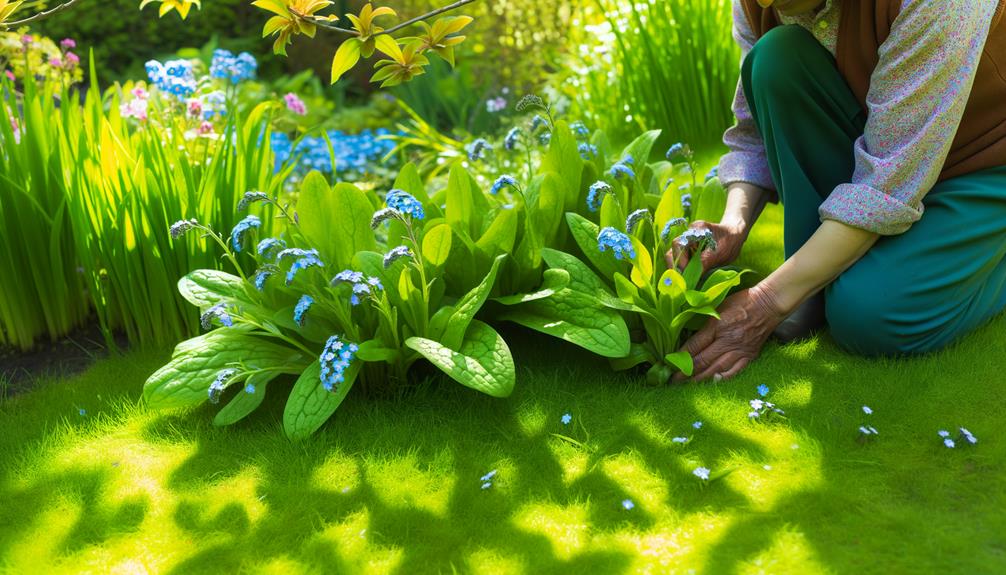
To successfully cultivate forget-me-not flowers, gardeners should focus on selecting a location with partial shade and well-draining soil. These conditions mimic the plant’s natural habitat, ensuring ideal growth.
They should sow seeds in early spring, pressing them lightly into the soil without covering them. Consistent moisture is essential; however, waterlogging can lead to root rot. Mulching helps retain moisture and control weeds.
Regularly deadheading spent blooms encourages continual flowering. These plants are biennial, meaning they complete their lifecycle in two years, so consider planting seeds each year to maintain a steady display.
Fertilization isn’t typically necessary, but a balanced, slow-release fertilizer can enhance blooming. Ensuring proper air circulation minimizes fungal diseases, promoting healthy, vibrant blossoms.
Gift-Giving Meaning
Forget-me-not flowers, with their delicate blue petals, symbolize remembrance and enduring affection, making them a poignant choice for heartfelt gifts. These flowers are scientifically known as Myosotis, a genus that thrives in temperate climates.
When given as a gift, they convey a multitude of meanings:
- Memory Preservation: They serve as a token to preserve cherished memories.
- Unwavering Loyalty: They symbolize steadfast loyalty and devotion in relationships.
- Hope and Optimism: Their perennial nature signifies hope and renewal.
- Sympathy and Compassion: They’re often used in sympathy arrangements, offering comfort and emotional support.
Understanding these symbolic meanings enriches one’s appreciation of the forget-me-not, making it an ideal choice for expressing nuanced, heartfelt emotions.
Conclusion
In summary, the forget-me-not flower‘s rich tapestry of meanings—from its historical significance to modern-day interpretations—reveals a deep-rooted symbolism in love, remembrance, and healing.
Scientifically, its vibrant blue petals draw pollinators, ensuring its survival, much like how its symbolic meanings endure through time.
By understanding its cultural and spiritual connections, one appreciates the flower’s profound impact.
Therefore, the forget-me-not isn’t just a botanical specimen but a living emblem of enduring human emotions and traditions.