Spiritual Meaning of Garments in the Bible: Identity
In the Bible, garments possess deep spiritual symbolism, reflecting themes of innocence, divine provision, and human transformation. From the fig leaves of Adam and Eve marking the loss of innocence to the intricate priestly garments signifying sacred authority, attire in scripture underscores profound theological principles.
Joseph’s coat of many colors reveals family dynamics and foreshadows Christ’s betrayal and exaltation. Sackcloth embodies repentance, while robes of righteousness indicate divine grace and transformation.
Symbols like Jesus’ seamless robe emphasize unity and priesthood. Exploring these themes further discloses the profound spiritual messages interwoven throughout these biblical narratives.
Spiritual Meaning of Garments in the Bible: Righteousness, Identity, and Transformation
| Aspect | Description | Spiritual Significance |
|---|---|---|
| Covering | Genesis 3:21 | God clothed Adam and Eve, symbolizing mercy and protection |
| Righteousness | Isaiah 61:10 | Garments as a metaphor for salvation and righteousness |
| Identity | Genesis 37:3 | Joseph’s coat represented favor and divine purpose |
| Transformation | Zechariah 3:4 | Removal of filthy garments symbolized cleansing and renewal |
| Holiness | Exodus 28:2 | Priestly garments reflected divine calling and sacred duty |
Garments of Adam and Eve

Examining the garments of Adam and Eve reveals profound symbolic significance related to humanity’s fall and subsequent need for divine intervention. Initially, Adam and Eve were clothed in innocence, symbolized by their nakedness in the Garden of Eden.
Following their disobedience, their newfound awareness of nakedness and the subsequent shame led them to fashion garments from fig leaves. However, these self-made coverings proved inadequate to restore their relationship with God.
In response, God crafted garments of skin for them, signifying the first act of divine grace and foreshadowing the necessity of sacrificial atonement. This pivotal moment underscores the theological premise that human efforts are insufficient for redemption, necessitating divine provision and intervention for spiritual restoration.
Joseph’s Coat of Many Colors
Joseph’s coat of many colors is a profound biblical symbol, representing both the overt favoritism of Jacob towards Joseph and the foreshadowing of Joseph’s future prominence and trials.
This garment, given uniquely to Joseph, incited jealousy among his brothers, setting the stage for subsequent pivotal events in his life.
Consequently, the coat serves as both a literal and metaphorical garment, encapsulating themes of divine providence and familial tension.
Symbol of Favoritism
The coat of many colors given to Joseph by his father, Jacob, serves as a profound symbol of favoritism, reflecting the deep familial tensions and divine providence within the narrative.
This garment not only signifies Jacob’s special love for Joseph but also sets the stage for sibling rivalry and discord.
The symbolism can evoke strong emotional reactions:
- Jealousy and Resentment: The coat ignites intense jealousy in Joseph’s brothers, leading to hostile actions.
- Injustice and Betrayal: It highlights the perceived injustice and the subsequent betrayal by his siblings.
- Divine Favor and Destiny: The coat foreshadows Joseph’s future role and the divine favor bestowed upon him.
Such themes underscore the complexities within familial relationships and the overarching divine plan.
Foreshadowing Future Events
Through the prism of Joseph’s coat of many colors, one can discern a prophetic narrative that extends beyond mere familial favoritism to foreshadow pivotal events in salvation history.
Joseph’s garment, symbolizing his father’s favor, prefigures the suffering and exaltation of Christ. Stripped and sold by his brothers, Joseph’s descent into Egypt mirrors Christ’s betrayal and crucifixion, while his eventual rise to power signifies resurrection and ascension.
| Event | Foreshadowed Element |
|---|---|
| Joseph’s favoritism | Christ as the Beloved |
| Stripping the coat | Christ’s Passion |
| Sold into slavery | Betrayal of Christ |
| Rise to power | Resurrection and Ascension |
Such profound correlations deepen our appreciation for the divine orchestration in biblical narratives.
Priestly Garments
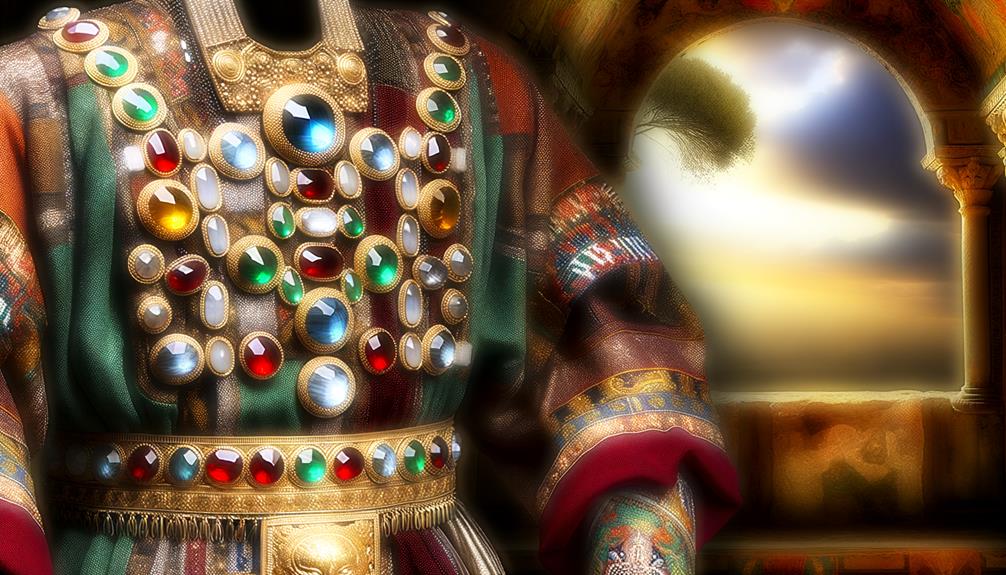
The priestly garments in the Bible carry profound sacred symbolism and are meticulously outlined through divine instructions.
These garments serve not only as a means of physical adornment but as a tangible representation of holiness, consecration, and the wearer’s intermediary role between God and His people.
Sacred Symbolism
Intricately designed with profound spiritual significance, priestly garments in the Bible symbolize the sanctity and divine authority bestowed upon the wearers. These sacred vestments are not merely ceremonial but embody deep theological meanings that reinforce the relationship between the divine and humanity.
The symbolism of priestly garments can be understood through several key elements:
- Holiness: The garments set priests apart, emphasizing their role as mediators between God and the people, instilling a sense of reverence and purity.
- Unity with God: The detailed craftsmanship and specific materials reflect a divine blueprint, signifying harmony with God’s will.
- Spiritual Leadership: Each piece, from the ephod to the breastplate, underscores the priest’s responsibility to lead and serve with divine wisdom and authority.
This sacred symbolism enhances our comprehension of biblical spirituality.
Divine Instructions
God’s meticulous instructions for the construction and use of priestly garments in the Bible underscore their profound spiritual and theological importance.
The intricate design and specified materials reflect divine holiness and the sanctity required of those serving in God’s presence.
Each element of the priestly attire, from the ephod to the breastplate, symbolizes aspects of the covenantal relationship between God and His people, serving as a conduit for spiritual communication and intercession.
| Garment | Symbolism | Reference |
|---|---|---|
| Ephod | Divine Service and Authority | Exodus 28:6-14 |
| Breastplate | Judgment and God’s Guidance | Exodus 28:15-30 |
| Robe | Holiness and Purity | Exodus 28:31-35 |
These garments are not mere attire but are imbued with rich theological significance, representing the sacred duties and responsibilities of the priesthood.
Sackcloth and Repentance
Frequently mentioned throughout the Bible, sackcloth serves as a poignant symbol of repentance and mourning.
This rough, coarse fabric, often made from goat’s hair, signifies a profound state of humility and contrition before God. Its use is deeply rooted in biblical tradition, representing a tangible expression of inner sorrow and a plea for divine mercy.
Consider the following:
- David’s Penitence: King David donned sackcloth to express his grief and repentance (2 Samuel 12:16).
- National Mourning: The Israelites wore sackcloth during times of collective lamentation and seeking forgiveness (Nehemiah 9:1).
- Prophetic Acts: Prophets like Daniel utilized sackcloth to intercede for the people’s sins (Daniel 9:3).
These instances underscore the sackcloth’s integral role in biblical repentance rituals.
Robes of Righteousness
The concept of ‘Robes of Righteousness‘ in biblical literature signifies a profound symbolism of purity, representing the moral and spiritual cleanliness bestowed upon believers through divine grace.
Additionally, these robes serve as a form of divine protection, shielding the faithful from spiritual adversities and affirming their sanctified status.
This dual symbolism underscores the transformative power of righteousness imparted by God, encapsulating both purification and preservation.
Symbolism of Purity
In biblical literature, garments often symbolize spiritual purity, with robes of righteousness representing the moral and ethical integrity bestowed upon individuals through divine grace.
These symbolic robes are not mere physical attire but profound representations of a transformative spiritual state. They signify the purification from sin and the sanctification of believers, emphasizing the shift from a state of spiritual impurity to one of divine acceptance.
The concept of robes of righteousness evokes deep emotional and spiritual resonance through:
- Transformation: Embracing a new identity in Christ.
- Redemption: Experiencing divine forgiveness and grace.
- Sanctification: Living a life aligned with divine principles.
These elements collectively underscore the profound symbolism of purity that robes of righteousness hold within biblical texts.
Divine Protection
Beyond symbolizing purity, garments in the Bible also represent divine protection, where robes of righteousness serve as a spiritual armor safeguarding believers against both physical and spiritual adversities.
Isaiah 61:10 declares, “For He has clothed me with garments of salvation; He has wrapped me with a robe of righteousness.” This metaphorical attire signifies God’s sanctifying power and His commitment to shield His faithful.
In Ephesians 6:11-17, Paul expands on this concept, urging believers to ‘put on the full armor of God.’ This spiritual attire includes the breastplate of righteousness, underscoring the protective nature of divine righteousness.
As a result, these garments are not mere symbols but active agents of divine providence, offering a fortress against life’s manifold perils.
Elijah’s Mantle
Elijah’s mantle, a symbol of prophetic authority and divine empowerment, plays a pivotal role in the biblical narrative, particularly in the transfer of his prophetic duties to Elisha. This garment encapsulates profound spiritual significance and serves as a tangible connection to God’s power.
Elijah’s act of passing the mantle to Elisha signifies:
- Continuation of Divine Mission: The transfer emphasizes the unbroken succession of God’s work through His chosen prophets.
- Empowerment and Anointing: Elisha’s reception of the mantle symbolizes his endowment with the same spiritual authority and miraculous capabilities as Elijah.
- Faith and Obedience: The mantle serves as a reminder of Elisha’s commitment to follow God’s call with unwavering faith.
Thus, Elijah’s mantle is an enduring exemplification of divine legacy and spiritual continuity.
Garments of the Redeemed

What profound spiritual significance do the garments of the redeemed hold within the biblical context?
In Scripture, these garments symbolize purity, righteousness, and divine favor, often depicted as white robes. They signify the transformation and sanctification of believers, who are cleansed from sin through faith in Christ.
| Symbolism | Biblical Reference |
|---|---|
| Purity | Revelation 7:14 |
| Righteousness | Isaiah 61:10 |
| Divine Favor | Zechariah 3:4 |
The white robes of the redeemed are not mere clothing but represent the ultimate spiritual renewal and acceptance into God’s presence. Each instance highlights a transformative journey, from a state of impurity to one of divine grace and righteousness, embodying God’s redemptive power in the believer’s life.
Jesus’ Seamless Robe
The seamless robe of Jesus, as described in the Gospels, holds deep theological and symbolic significance within the Christian faith. This garment, woven in one piece from top to bottom, signifies the unity and perfection of Christ’s priesthood and divinity.
Its seamless nature represents:
- Unity of the Church: The indivisible nature of Christ’s body and the universal church.
- Sacrificial Love: The soldiers casting lots for His robe symbolize humanity’s disregard for the sacred amidst Christ’s ultimate sacrifice.
- Royal Priesthood: The robe underscores Jesus’ role as the eternal High Priest, uniting humanity with God.
In essence, Jesus’ seamless robe encapsulates profound spiritual truths that continue to inspire and guide believers in their faith journey.
Bridal Garments
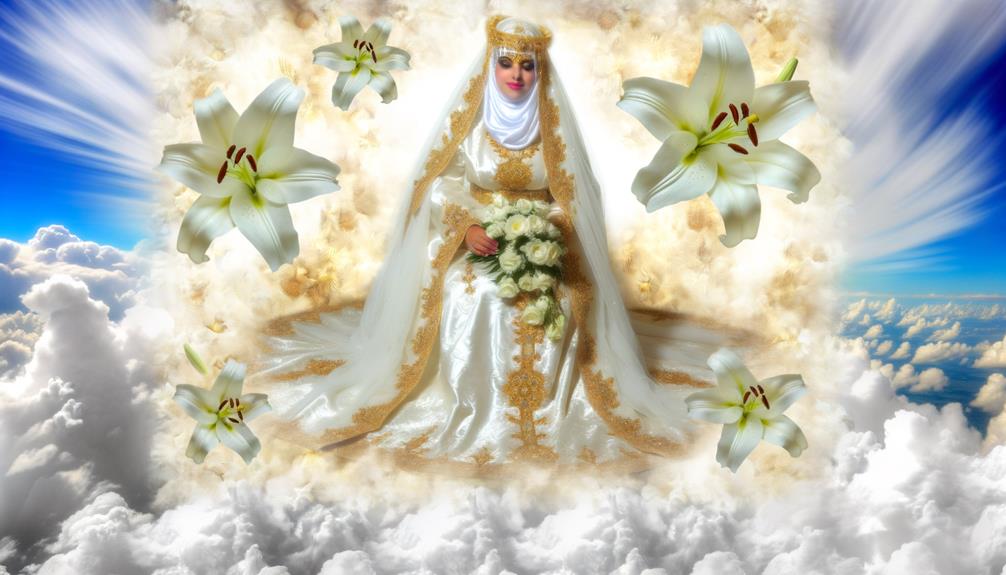
Intriguingly, bridal garments in biblical texts are often rich with symbolic meaning, reflecting themes of purity, covenant, and eschatological hope.
These garments represent the sanctity and faithfulness required in the covenantal relationship between God and His people. The imagery of the bride adorned for her husband symbolizes the Church’s preparation for Christ, emphasizing spiritual readiness and purity.
| Symbolism | Biblical Reference |
|---|---|
| Purity | Ephesians 5:25-27 |
| Covenant | Isaiah 61:10 |
| Eschatological Hope | Revelation 19:7-8 |
In Ephesians, the Church is described as being cleansed to be presented as a radiant church. Isaiah speaks of God clothing His people in garments of salvation. Revelation envisions the ultimate fulfillment of God’s promises, with the Church clothed in fine linen, representing righteous deeds.
Linen Garments in Revelation
Building upon the rich symbolism of bridal garments, linen garments in Revelation further elaborate on the concept of righteousness and divine approval.
In Revelation 19:8, the ‘fine linen, bright and clean’ is identified as the ‘righteous acts of the saints.’ This portrayal signifies a state of purity and sanctity granted by divine grace.
Linen garments symbolize:
- Purity: Linen’s pristine quality evokes the purity required to stand in God’s presence.
- Righteousness: They represent the righteous deeds of believers, reflecting their faith and obedience.
- Divine Favor: Wearing linen signifies being chosen and approved by God, highlighting a special relationship with the divine.
These elements collectively emphasize the spiritual state necessary to partake in the heavenly domain.
Symbolism of Washing Garments

In biblical symbolism, the act of washing garments often represents the process of spiritual purification and repentance. This metaphorical cleansing signifies the removal of sin and the restoration of righteousness.
For instance, in Revelation 7:14, the saints are described as having washed their robes and made them white in the blood of the Lamb, symbolizing their purification through Christ’s sacrifice.
Similarly, the Old Covenant frequently associates the washing of clothes with ceremonial cleanliness, as seen in Exodus 19:10, where the Israelites were instructed to wash their garments before encountering God.
Consequently, the act of washing garments serves as a vivid illustration of the transformative journey toward holiness, emphasizing the necessity of repentance and divine grace for spiritual renewal.
Conclusion
In the tapestry of biblical narratives, garments emerge as profound symbols, weaving together themes of purity, authority, repentance, and divine favor.
From Adam and Eve’s coverings to the priestly vestments, and from Joseph’s multicolored coat to the bridal garments, each attire holds a mirror to the soul’s journey.
The seamless robe of Jesus and the linen garments in Revelation further underscore the sanctity and righteousness bestowed upon the faithful. Like threads in a divine loom, these garments interlace spiritual truths with human experience.