
Spiritual Meaning of Sand in the Bible: Foundations
In the Bible, sand carries profound spiritual symbolism, representing the vastness of God’s creation and His infinite power. It signifies the transient nature of human existence, reminding believers of life’s ephemeral quality.
Sand also denotes God’s promises, as seen in the promise to Abraham concerning countless descendants. In addition, it illustrates the importance of humility and faith amidst uncertainties.
The imagery of sand in scripture underscores themes of divine assurance and the eternal nature of God’s covenant. The multifaceted symbolism invites deeper reflections on faith, existence, and divine promises, enriching one’s spiritual understanding.

Spiritual Meaning of Sand in the Bible: Symbolism and Interpretations
| Symbolism of Sand | Biblical Reference | Spiritual Meaning |
|---|---|---|
| Countless Offspring | Genesis 22:17 | Represents God’s promise to Abraham of innumerable descendants |
| Divine Promises | Genesis 32:12 | Symbol of God’s unbreakable covenant |
| Foundation and Faith | Matthew 7:26 | Warning against building life on weak spiritual foundations |
| Abundance and Blessing | Hosea 1:10 | Sign of spiritual multiplication and blessing |
| Fragility of Man | Psalm 103:14-16 | Reminder of human frailty compared to God’s eternity |
God’s Promise to Abraham
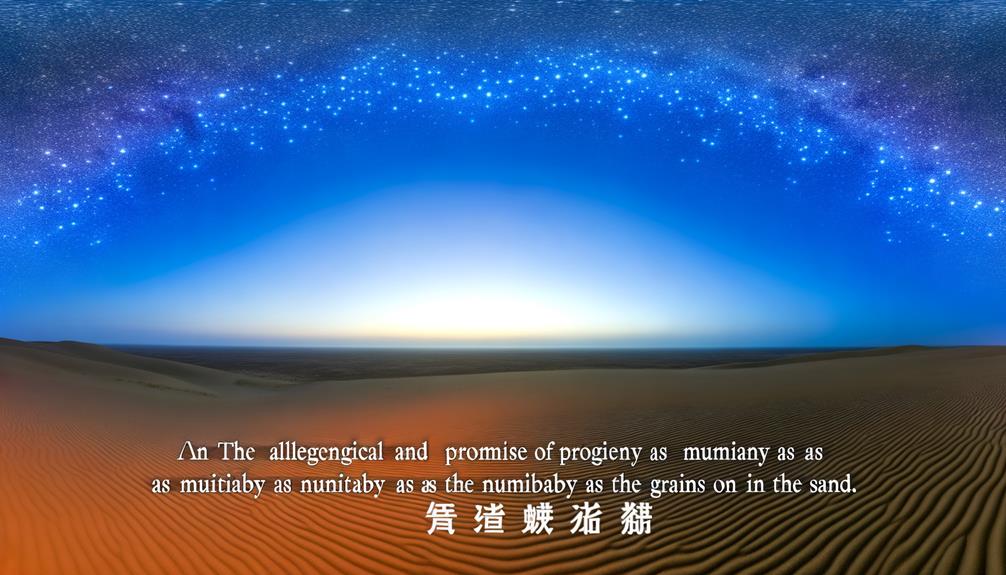
Frequently cited in biblical scholarship, God’s promise to Abraham is a cornerstone of theological discussions about faith and divine covenant in Judeo-Christian traditions.
This divine commitment, delineated in Genesis 12:2-3, 15:5, and 17:4-8, establishes a foundational narrative for understanding God’s relationship with humanity. The promise encompasses land, progeny, and blessings, serving as a pivotal moment where divine intention intersects with human faith.
Theologically, it underscores the themes of trust and obedience, highlighting Abraham’s role as a paragon of faith. Moreover, this covenant initiates a lineage of chosen people, setting the stage for subsequent biblical events.
Analyzing this promise yields profound insights into the nature of divine-human interaction and the enduring significance of covenantal faith.
Symbol of Innumerable Descendants
As a symbol of innumerable descendants, sand serves as a powerful metaphor in the biblical narrative, particularly in God’s promise to Abraham, where it epitomizes the vastness and perpetuity of his lineage.
The imagery of sand conveys the concept of an uncountable multitude, reflecting the divine assurance of a progeny so vast it parallels the grains of sand. This metaphor underscores the boundless nature of divine blessings and the fulfillment of God’s covenant.
| Aspect | Interpretation |
|---|---|
| Vastness | Represents innumerable descendants |
| Perpetuity | Suggests enduring legacy |
| Divine Assurance | Symbolizes God’s covenant fulfillment |
This symbolic use of sand portrays the profound and expansive nature of God’s promise, highlighting its eternal and infinite dimensions.
Transience of Human Life

The imagery of sand in biblical texts often serves as a poignant reminder of the fleeting nature of human existence.
Just as grains of sand slip through one’s fingers, human life is marked by its temporal and transient qualities, underscoring the inevitability of mortality.
Through this symbolism, the Bible poignantly conveys the ephemeral essence of human life in contrast to the eternal divine.
Fleeting Human Existence
In biblical literature, sand often symbolizes the transient nature of human existence, underscoring the fleeting and ephemeral quality of life.
This imagery evokes a sense of impermanence that mirrors human experiences and aspirations. The metaphor of sand in scripture provides a poignant reminder of life’s temporality, inviting reflection on the nature of existence.
- Erosion by wind and water: Just as sand is shaped and carried away by natural forces, human life is continuously influenced and altered by external factors.
- Imprints in the sand: Footprints in the sand vanish with time, illustrating the temporary marks we leave on the world.
Such symbolism encourages a contemplative appreciation of life’s fleeting moments.
Life’s Temporal Nature
Human existence, much like grains of sand, is marked by its inherent transience and susceptibility to the inexorable passage of time.
This temporal nature is profoundly articulated in the Bible, illustrating how human life, although momentarily significant, is ultimately fleeting.
Scriptural metaphors depict life as ephemeral, akin to sand slipping through one’s fingers, emphasizing the brevity of our earthly sojourn.
Psalms 103:15-16 poignantly compares human days to grass that withers and flowers that fade, underscoring the impermanence of mortal life.
Such biblical symbolism serves as a poignant reminder of our temporal existence, urging individuals to live with a sense of urgency and purpose, cognizant of the finite span granted to them by divine providence.
Human Mortality Symbolism
Building upon the metaphor of life’s fleeting nature, biblical references to sand also encapsulate the profound reality of human mortality, emphasizing the transient and delicate nature of human existence.
Sand, in its countless grains and inevitable dispersal, serves as a poignant symbol of the finite span of human life.
This imagery is further enriched through various scriptural allusions:
- Sand slipping through fingers, illustrating how time and life elude human grasp.
- Shifting dunes, representing the ever-changing and ephemeral aspects of our existence.
These vivid metaphors, woven throughout biblical texts, invite contemplation on the impermanence of life and the humility needed to navigate one’s temporal journey.
Divine Steadfastness
Amidst the biblical symbolism, sand emerges as a powerful metaphor for the unwavering and eternal nature of divine promises.
The innumerable grains of sand evoke the boundless and steadfast nature of God’s covenant with humanity, as illustrated in scriptures such as Genesis 22:17, which underscores the assurance of countless descendants.
This metaphor is further reinforced by the persistent presence of sand in the natural world, symbolizing God’s unchanging and perpetual commitment.
| Biblical Reference | Significance |
|---|---|
| Genesis 22:17 | Promise of innumerable descendants |
| Jeremiah 33:22 | Covenant of uncountable blessings |
| Psalm 139:18 | God’s thoughts outnumber the sand |
| Hosea 1:10 | Restoration and multiplication |
Thus, sand stands as an enduring indication of divine steadfastness.
Foundation of Faith

In biblical literature, sand is frequently employed as a metaphor for stability, emblematic of a firm foundation on which faith is built.
This symbolism underscores the intrinsic link between enduring belief and a steadfast base, suggesting that faith, much like a house built on stable ground, requires a solid underpinning.
Examining the scriptural references to sand reveals how foundational elements contribute to the strength and resilience of spiritual convictions.
Symbol of Stability
As a metaphor within the biblical narrative, sand serves to illustrate the concept of a stable foundation upon which one’s faith can securely rest.
This symbolism is rich and multifaceted, conjuring images of:
- Endless grains: Each grain of sand represents the multitude of promises and assurances provided through faith.
- Shorelines: Sand’s presence along coastlines symbolizes the unwavering boundary between divine providence and worldly chaos.
Analyzing these images, one discerns that sand embodies the enduring and steadfast nature of spiritual foundations.
Basis of Belief
Grounded in biblical teachings, the metaphor of sand elucidates the essential qualities that constitute a robust foundation of faith.
In Scripture, sand often symbolizes countlessness and the omnipresence of God’s promises, as seen in God’s covenant with Abraham, where his descendants would be as numerous as the grains of sand (Genesis 22:17). This imagery reinforces the idea that faith must be expansive and deeply rooted.
Furthermore, Jesus’ parable of the wise and foolish builders (Matthew 7:24-27) contrasts the peril of building on sand, emphasizing the necessity of anchoring one’s beliefs on solid ground.
Consequently, sand serves as both a cautionary and reinforcing symbol, guiding believers towards a steadfast, unwavering foundation rooted in divine promises and teachings.
Sand and Wilderness
Biblical references to sand in the context of wilderness often symbolize desolation, testing, and spiritual purification. The imagery of vast, barren deserts filled with sand serves as a metaphor for:
- Desolation: The absence of life and resources, representing spiritual emptiness.
- Testing: Trials faced by figures such as Moses and Jesus, who encountered the wilderness as a proving ground for faith.
In these narratives, the wilderness, characterized by endless expanses of sand, becomes not only a physical landscape but also a spiritual journey.
It is within this harsh environment that individuals are often brought closer to divine truths and personal transformation.
Punishment and Desolation

The imagery of sand in the Bible frequently serves as a powerful symbol of divine punishment and desolation, reflecting the consequences of disobedience and moral failure.
This symbolism is evident in various scriptures where the transformation of lush landscapes into barren deserts underscores the severity of divine judgment. The desolation brought by sand is both literal and metaphorical, highlighting the stark contrast between abundance and barrenness.
| Bible Verse | Interpretation |
|---|---|
| Jeremiah 17:6 | Curse leading to desolation of the land |
| Isaiah 13:19-21 | Babylon’s downfall and transformation into a wasteland |
| Deuteronomy 29:23 | Land of sulfur, salt, and burning as divine punishment |
| Ezekiel 26:4 | Tyre’s destruction and becoming a place for spreading nets |
| Psalms 107:34 | Fruitful land turned into a salty waste due to wickedness |
This biblical use of sand as a symbol of punishment and desolation serves to remind readers of the dire consequences that follow when divine commandments are neglected.
Metaphor for Time
In biblical literature, sand often serves as a profound metaphor for the passage of time, highlighting the ephemeral nature of human existence in contrast to divine timelessness.
The countless grains of sand evoke the inexorable flow of moments, symbolizing how swiftly life can pass and underscoring the transient nature of earthly pursuits.
This juxtaposition not only emphasizes human mortality but also invites contemplation on the eternal and unchanging nature of the divine.
Symbolic Passage of Time
Sand often serves as a profound metaphor for the passage of time in biblical literature, representing both the fleeting and the eternal aspects of existence. This symbolism can be observed in various scriptural contexts:
- Hourglass Imagery: The steady trickle of sand through an hourglass epitomizes the relentless flow of time, suggesting both its constancy and its inexorable progression.
- Shoreline Sands: The countless grains on a beach evocatively illustrate the infinite nature of divine time, contrasting with human limitations.
- Desert Wanderings: The vast expanses of desert sand experienced by the Israelites underscore the trials and tribulations over extended periods, highlighting spiritual perseverance.
Through these images, sand in the Bible serves as a rich symbol, intertwining temporal and eternal dimensions, embodying theological reflections on time itself.
Human Life’s Ephemerality
Human life, much like grains of sand slipping through one’s fingers, epitomizes the transient nature of existence as depicted in biblical texts.
The scriptures often use sand as a metaphor to underscore life’s fleeting moments, highlighting the impermanence of human endeavors. This ephemeral nature is juxtaposed against the eternal, providing a contemplative lens for understanding our limited time on Earth.
| Biblical Reference | Interpretation |
|---|---|
| Psalm 103:15-16 | Life is brief, like a passing flower |
| Job 7:6 | Days are swifter than a weaver’s shuttle |
| James 4:14 | Life is a mist that appears briefly |
Through these passages, the Bible encourages reflection on the value of time, urging individuals to seek purpose and meaning beyond temporal pursuits.
Divine Timelessness Explained
Contrasting with the temporal nature of human life, divine timelessness in the Bible is often illustrated through metaphors that emphasize God’s eternal and unchanging essence.
Sand in the Bible serves as a potent symbol to convey this concept. Just as grains of sand are innumerable, God’s existence transcends time, offering a perspective that is both infinite and immutable.
- Shorelines: Sand on the shore represents the boundary between the temporal and the eternal, continually reshaped by God’s unending presence.
- Deserts: Vast stretches of sand in the desert signify the boundless scope of divine time, which cannot be measured by human standards.
These metaphors invite contemplation on the infinite and perennial nature of the divine.
Sand and the Sea

The biblical juxtaposition of sand and the sea often serves as a profound metaphor for the boundlessness of God’s promises and the immeasurable nature of divine blessings.
This imagery is poignantly illustrated in Genesis 22:17, where God promises Abraham descendants as numerous as the stars and the sand on the seashore.
The sand, with its innumerable grains, symbolizes the inexhaustible and infinite scope of God’s covenant.
In addition, the sea, vast and unending, represents the eternal and uncontainable aspects of divine grace.
Together, sand and the sea encapsulate the expansive and eternal nature of God’s fidelity and abundance, reinforcing the theological concept that divine generosity surpasses human comprehension.
This dual imagery consequently underscores the infinite and eternal dimensions inherent in biblical promises.
Parables and Teachings
Beyond its symbolic representation in natural elements, sand is also utilized in biblical parables and teachings to convey profound spiritual lessons and moral truths.
The parable of the wise and foolish builders, for instance, contrasts the stability of building one’s life on the solid foundation of Christ’s teachings versus the unstable sands of worldly pursuits. Sand also appears in the context of divine promises and judgments, highlighting the transient nature of earthly life.
- The shifting sands under the feet of the foolish builder emphasize the peril of ignoring divine wisdom.
- The countless grains of sand represent the innumerable descendants promised to Abraham, illustrating God’s boundless blessings.
In these ways, sand encapsulates both cautionary and hopeful messages.
Spiritual Reflection and Growth

Engaging in spiritual reflection and growth involves contemplating the metaphor of sand to deepen one’s understanding of faith and personal development.
In biblical texts, sand often symbolizes the countless and the eternal, drawing parallels to the infinite nature of God’s promises and the abundant blessings bestowed upon believers. By meditating on this imagery, individuals can internalize the boundlessness of divine grace and the importance of patience in spiritual maturation.
Additionally, sand’s transformative qualities—shaped by wind and water—mirror the believer’s journey through trials and tribulations, fostering resilience and spiritual refinement.
Consequently, sand serves not merely as a natural element but as a profound metaphor for the continual process of spiritual evolution and the nurturing of an enduring, faith-filled life.
Conclusion
To sum up, the biblical symbolism of sand encompasses various profound themes, including God’s promise to Abraham, the vastness of human descendants, and the transience of life.
The metaphorical use of sand underscores divine steadfastness and the foundational aspects of faith.
Additionally, sand signifies the passage of time and serves as a backdrop in parables and teachings, offering rich material for spiritual reflection and growth.
Examining these layers reveals a complex tapestry of theological and existential insights.