
Spiritual Meaning of Starling Bird: Unity and Communication
When you observe a starling murmuration, you’re seeing a striking display of unity and collective behavior. Each bird’s movement influences its seven nearest neighbors, creating seamless, synchronized patterns.
These behaviors symbolize interconnectedness and messages from a greater cosmic order. Starlings rely on vocalizations and body movements for efficient communication, enhancing group survival and cohesion.
Their adaptability across diverse environments showcases remarkable behavioral plasticity. The subtle non-verbal cues and collective intuition highlight the importance of tuning into shared frequencies and communal actions.
To grasp the deeper significance, consider the intricate dynamics within these graceful flocks.

Spiritual Meaning of Starling Bird: Unity, Communication, and Adaptability
| Starling Bird Encounter | Spiritual Interpretation | Symbolism |
|---|---|---|
| Seeing a murmuration of starlings | Collective strength and unity of purpose | Harmony, teamwork, higher alignment |
| Single starling appearing nearby | A call to express yourself or connect with others | Communication, social energy |
| Starlings nesting near home | Protection and community support | Family, grounding, shared space |
| Repeated sightings in dreams | Need to adapt or go with the flow in life | Flexibility, resilience, intuition |
| Hearing starling song often | Receiving divine messages through sound or thought | Inspiration, clarity, spiritual voice |
| Starling crossing your path | Reminder to align with your soul tribe | Belonging, synchronicity, connection |
Symbolism of Unity
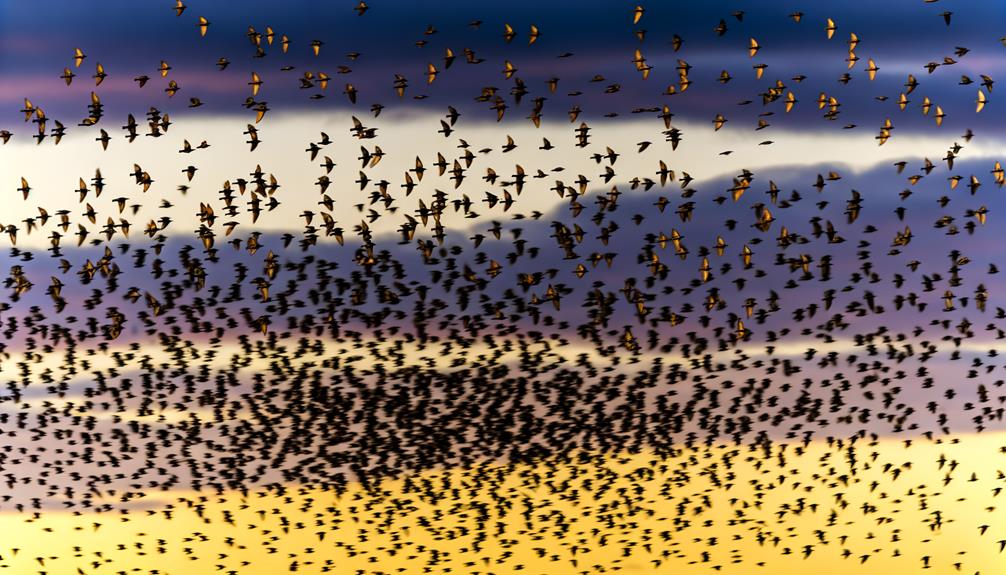
Starlings’ intricate murmuration patterns exhibit a fascinating example of unity, showcasing a collective behavior that relies on precise communication and coordination among individuals.
When you observe a starling murmuration, you’re witnessing a complex dance where each bird responds to its seven nearest neighbors. This decentralized decision-making guarantees that the flock moves as a cohesive unit, avoiding predators and maneuvering around obstacles seamlessly.
The birds’ ability to maintain a consistent distance from each other, while rapidly changing direction, exemplifies an advanced form of group synchronization. Their movements are a form of self-organization, where local interactions produce global patterns.
This behavior not only highlights their unity but also serves as a powerful symbol of how individual actions contribute to the greater whole.
Messages From the Divine
Observing the unity within starling murmurations can lead one to perceive these formations as potential messages from the divine, where the synchronized behavior of the flock might represent a greater cosmic order.
The precise, cohesive movements of thousands of starlings suggest an underlying intelligence orchestrating their flight patterns. Researchers note that each bird’s motion is influenced by its seven nearest neighbors, creating a dynamic, responsive network.
This phenomenon, known as scale-free correlation, implies that changes in one part of the flock affect the entire group instantaneously. You might interpret this as a metaphor for interconnectedness within the universe.
The divine message conveyed could be one of unity, suggesting that individual actions resonate throughout the larger cosmos, emphasizing the importance of harmony and collective consciousness.
Power of Communication

When you observe the intricate vocalizations and coordinated movements within a starling flock, it becomes evident that their sophisticated communication mechanisms play a pivotal role in maintaining the flock’s cohesion and survival.
Starlings use a combination of calls and physical signals to convey critical information about food sources, predators, and flight paths. These complex behaviors can be broken down into specific components:
| Communication Type | Function |
|---|---|
| Vocalizations | Alerting about predators |
| Body Movements | Synchronizing flight paths |
| Chirps | Indicating food locations |
| Flocking Behavior | Enhancing group cohesion |
Embracing Adaptability
You’ll observe that starlings exhibit remarkable adaptability, thriving in diverse environments ranging from urban areas to rural landscapes.
Their behavioral plasticity allows them to navigate various challenges, such as fluctuating food sources and predation pressures.
Thriving Through Change
In the intricate dance of survival, starlings exemplify adaptability through their fluid social structures and dynamic foraging strategies.
You can see this in their ability to thrive in varied habitats, from urban environments to rural landscapes.
Their remarkable adaptability is driven by several key behavioral traits:
- Murmuration dynamics: Starlings form large, synchronized flocks, enhancing predator avoidance and foraging efficiency through collective behavior.
- Dietary flexibility: They consume a wide range of food sources, including insects, fruits, and seeds, allowing them to survive seasonal and habitat changes.
Flexibility in Challenges
Starlings exemplify flexibility in challenges by rapidly adjusting their migration patterns and social behaviors to navigate environmental stressors.
You’ll notice their dynamic flocking behavior, called murmuration, which allows them to evade predators and locate food sources efficiently.
When faced with habitat changes, starlings demonstrate remarkable adaptability, altering their nesting sites and foraging strategies.
They utilize diverse vocalizations to communicate, ensuring cohesive group movements even in chaotic situations.
This behavioral plasticity isn’t just about survival; it’s about thriving in varying conditions. By observing their ability to pivot and adapt, you can appreciate how they embody resilience.
This adaptability highlights the importance of remaining flexible and responsive when confronting your own life’s challenges.
Lessons in Intuition

Observing the intricate flight patterns of starlings, you can glean valuable insights into the power of intuition and collective consciousness. These birds exhibit remarkable synchronization without apparent communication, suggesting an innate ability to anticipate and respond to each other’s movements.
This behavior highlights three key lessons in intuition:
- Non-verbal Communication: Starlings rely on subtle cues and body language, underscoring the importance of perceptive awareness in understanding others.
- Adaptive Response: The birds’ rapid adjustments to environmental changes showcase the necessity of flexibility and quick thinking.
Collective Action and Community
By studying the communal behaviors of starling flocks, you can gain a deeper understanding of the principles behind collective action and the importance of community dynamics.
When starlings engage in murmurations, their synchronized movements aren’t random. They use local interactions and simple rules, such as alignment and cohesion, to create complex, adaptive patterns.
These behaviors highlight how individual actions, when aligned with group objectives, can lead to efficient problem-solving and resource allocation.
Additionally, their flocking behavior minimizes predation risk and optimizes foraging efficiency. Observing these patterns, you’ll see that cooperation and communication are essential.
Starlings model how individual contributions synergize to benefit the community, offering crucial insights into the power of collective action.
Conclusion
In studying the starling bird, you’ve uncovered its symbolism of unity, its messages from the divine, and its power of communication.
You’ve embraced its adaptability, learned lessons in intuition, and witnessed collective action and community.
These insights aren’t just observations; they’re behavioral analyses revealing parallels to our own lives.
So, next time you see a starling, remember its deeper meanings and let it inspire you to connect, adapt, and act within your own community.