
Tree of Life Spiritual Meaning Christianity: Eternal Life
The Tree of Life in Christianity embodies divine wisdom, eternal life, and the interconnectedness of creation. Rooted in Genesis, it symbolizes potential immortality and the ramifications of sin when access to it was denied.
Theological interpretations present the tree as a conduit for divine sustenance and wisdom, bridging humanity with God’s order. It’s also seen as a symbol of resurrection and communion with God, offering hope for eternal life through Christ.
This potent emblem extends its influence to Christian art and culture, fostering spiritual contemplation and growth, thereby inviting explorations of deeper theological insights.
Tree of Life Spiritual Meaning in Christianity: Eternal Life, Divine Connection, and Redemption
| Aspect | Spiritual Meaning in Christianity |
|---|---|
| Eternal Life | Represents immortality and the life given through faith in God |
| Divine Connection | Symbol of unity with God and spiritual nourishment |
| Wisdom and Truth | Reflects God’s eternal truth and the knowledge found in His Word |
| Redemption and Restoration | Linked to the promise of restored paradise through Christ |
| Spiritual Growth | Encourages believers to grow in faith, rooted in God’s love |
Biblical Origins
The Tree of Life, first mentioned in the Book of Genesis, serves as a profound symbol within biblical texts, embodying divine wisdom and eternal life.
Placed in the Garden of Eden alongside the Tree of the Knowledge of Good and Evil, it represents humanity’s potential for immortality and a direct relationship with God.
Its presence in Genesis underscores the thematic elements of temptation, choice, and divine providence.
When Adam and Eve ate from the forbidden tree, they were barred from accessing the Tree of Life, highlighting the consequences of disobedience.
This narrative sets a foundational context for understanding the spiritual and theological implications of the Tree of Life in later biblical passages and Christian thought.
Symbolism in Genesis
In Genesis, the Tree of Life holds profound significance within the Garden of Eden, symbolizing eternal life and divine provision.
The juxtaposition with the Tree of the Knowledge of Good and Evil introduces themes of choice, morality, and human fallibility.
This duality underscores the broader spiritual and ethical implications embedded in humanity’s origins and existential journey.
Garden of Eden Significance
Genesis portrays the Tree of Life as a profound symbol of eternal life and divine wisdom, deeply rooted in the sacred narrative of the Garden of Eden. This tree represents God’s provision for immortality, contrasting with humanity’s finite nature.
It symbolizes the intimate relationship between the Creator and His creation, emphasizing divine sustenance and spiritual nourishment.
The Garden of Eden, a paradise of harmony and abundance, serves as the ideal setting for this profound symbol. Scholars recognize the Tree of Life as a demonstration of God’s original plan for human flourishing.
| Aspect | Significance |
|---|---|
| Eternal Life | Symbolizes immortality granted by God |
| Divine Wisdom | Represents access to God’s knowledge |
| Creator-Creation Bond | Emphasizes intimate relationship |
| Spiritual Nourishment | Highlights divine sustenance |
The Tree of Life remains pivotal in understanding the divine-human relationship in Christian theology.
Knowledge of Good and Evil
Exploring the symbolism of the Tree of Knowledge of Good and Evil reveals profound insights into the human condition and moral autonomy within the Genesis narrative.
This tree represents the pivotal moment of human choice and the dawning of moral consciousness. By eating its fruit, Adam and Eve shift from innocence to moral awareness, signifying humanity’s capacity for ethical discernment.
The act of disobedience underscores the complexity of free will and the inherent tension between divine command and human agency. This narrative element serves as a foundational myth, illustrating the perpetual struggle between good and evil that defines human existence.
It encapsulates the profound theological and philosophical questions about obedience, knowledge, and the inherent consequences of human choices.
Theological Significance

Rooted deeply within various religious doctrines, the Tree of Life symbolizes the interconnectedness of all creation and the divine.
In Christian theology, this tree represents God’s eternal wisdom and providence, serving as a bridge between humanity and the divine order.
The Tree of Life is often interpreted as a manifestation of God’s life-sustaining power, embodying His omnipresence in the natural world.
Its imagery in the Bible, particularly in Genesis and Revelation, suggests a divine plan for harmony and wholeness.
Theologically, it also underscores the idea of divine nourishment and protection, illustrating how God’s grace permeates and supports all life.
Hence, the Tree of Life isn’t just a symbol, but a profound theological assertion of divine care and interconnectedness.
Connection to Eternal Life
The Tree of Life‘s connection to eternal life is deeply embedded in Christian doctrine, symbolizing immortality and divine sustenance.
Biblical references, such as those in Genesis and Revelation, illustrate its role as a source of perpetual life and spiritual nourishment.
Symbolism in Christian Doctrine
In Christian doctrine, the Tree of Life symbolizes not only divine nourishment but also the promise of eternal life, connecting believers to a perpetual state of grace and communion with God.
The Tree of Life serves as a divine emblem, offering a theological framework that underscores the eternal nature of God’s kingdom.
It embodies spiritual sustenance, reflecting God’s provision and the eternal life granted through Christ’s sacrifice. This symbolism enhances the understanding of eternal life as a gift that transcends mortal existence.
| Aspect | Symbolism |
|---|---|
| Divine Nourishment | Spiritual sustenance from God |
| Eternal Life | Promise of perpetual grace |
| Communion with God | Unbroken fellowship |
| Theological Framework | Eternal nature of God’s kingdom |
This analytical perspective enables believers to grasp the profound spiritual implications embedded in the Tree of Life.
Biblical References Explained
Biblical references to the Tree of Life, particularly in Genesis and Revelation, underscore its profound connection to the promise of eternal life and divine communion.
In Genesis, the Tree of Life stands in Eden, symbolizing access to unending life before humanity’s fall. Its presence indicates a direct relationship with God, disrupted by sin.
Revelation, the Bible’s final book, reintroduces the Tree of Life, now in the New Jerusalem. Here, its leaves are for the healing of nations, representing restoration and eternal fellowship with God.
This continuity from Genesis to Revelation highlights a central theological theme: the Tree of Life as a divine promise of redemption, eternal life, and restored communion with the Creator.
Influence on Christian Art
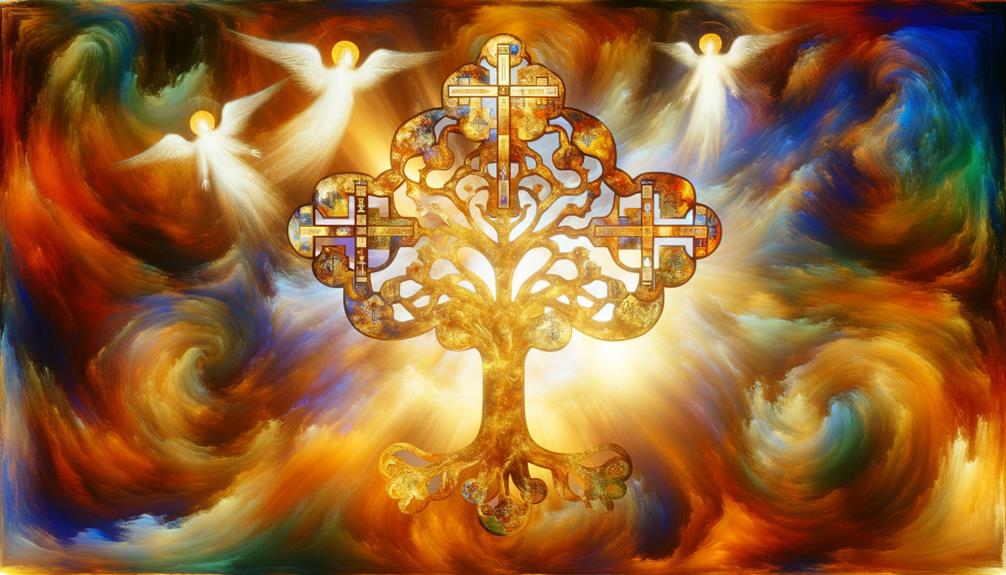
Christian art frequently incorporates the Tree of Life, symbolizing concepts of eternal life, divine wisdom, and the interconnectedness of all creation.
Artists often depict it in stained glass windows, mosaics, and illuminated manuscripts, reflecting its profound theological significance. Through meticulous detail and vibrant color, these artworks convey the Tree’s role as a bridge between heaven and earth.
The imagery evokes Genesis, where the Tree signifies God’s provision and wisdom. Additionally, medieval cathedrals often feature the Tree in their architectural ornamentation, underscoring its omnipresence in divine creation.
As a result, the Tree of Life serves not only as an artistic motif but also as a spiritual symbol, fostering contemplation and reverence among the faithful. This enduring influence highlights its centrality in Christian iconography.
Modern Interpretations
Through contemporary lenses, the Tree of Life continues to resonate, embodying themes of unity, growth, and interconnectedness in various cultural and spiritual contexts. Modern interpretations often highlight its symbolic representation of human progress and spiritual evolution.
Scholars and theologians suggest that it serves as a metaphor for:
- Unity: Emphasizing the interconnectedness of all creation.
- Growth: Symbolizing personal and communal development.
- Resilience: Reflecting the enduring strength to withstand challenges.
- Healing: Representing holistic wellness and restoration.
These interpretations provide a rich, multifaceted understanding of the Tree of Life, demonstrating its enduring relevance.
Conclusion
The Tree of Life, deeply rooted in Genesis, juxtaposes humanity’s fall with the promise of eternal life. Its symbolism weaves through Christian theology, highlighting divine grace and redemption.
In art, it stands as both a historical emblem and a modern metaphor, reflecting evolving interpretations.
By contrasting the temporal with the eternal, the Tree of Life encapsulates the essence of Christian spirituality, inviting believers to contemplate their faith’s profound mysteries and enduring truths.