
Upside Down Christmas Tree Meaning Spiritual: Reversed
The upside-down Christmas tree, originating in medieval Christian traditions, holds profound spiritual significance. It symbolizes the inversion of worldly values, reflecting Christ’s humility and the divine mystery of His incarnation.
This practice, tied to the Holy Trinity, served as an educational tool in faith. Additionally, its roots in pagan customs of Central and Eastern Europe link it to winter solstice celebrations, emphasizing life and resilience.
The tree’s inverted form directs minds towards heavenly aspirations, challenging believers to reconsider established norms and embrace spiritual transformation. Exploring these traditions reveals deeper insights into their enduring spiritual symbolism.

Spiritual Meaning of an Upside Down Christmas Tree: Symbol of Reversal, Reflection, and Divine Perspective
| Symbolism | Spiritual Insight | Interpretation |
|---|---|---|
| Reversal of Norms | Flipped from traditional orientation | Represents breaking free from societal expectations and questioning conventions |
| Spiritual Awakening | Unusual perspective draws attention | Encourages seeing your life path from a higher or more enlightened viewpoint |
| Reflection & Inner Work | Inversion symbolizes looking within | Inspires introspection, shadow work, and internal spiritual realignment |
| Divine Perspective | Points toward the heavens | Suggests spiritual focus, humility, and surrender to higher wisdom |
| Renewal of Faith | Disrupts the ordinary to reveal new meaning | Symbolizes a fresh approach to spirituality and reconnecting with sacred truths |
Historical Origins
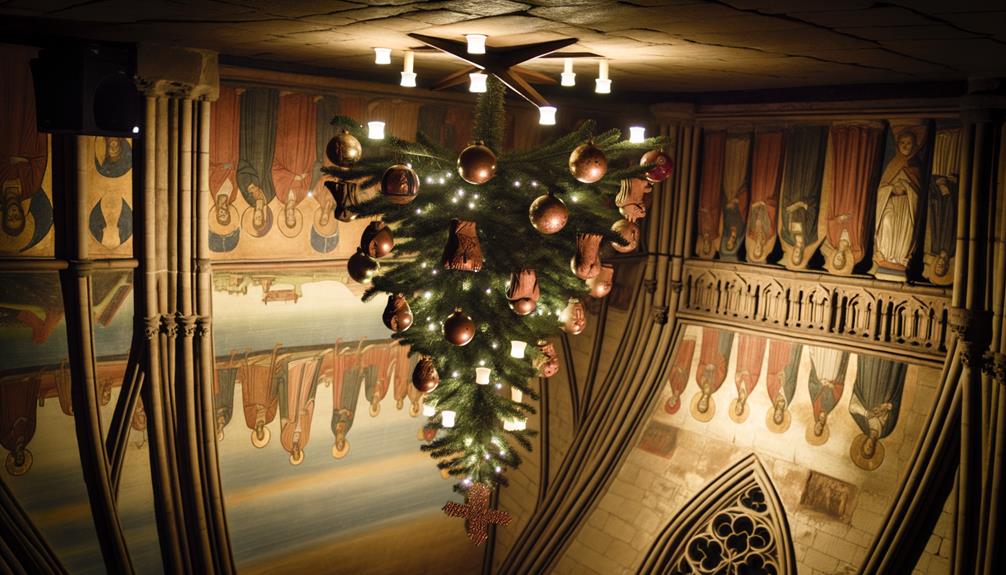
The practice of displaying upside down Christmas trees traces its origins back to the early medieval period, where it was initially adopted by Central and Eastern European Christians.
This tradition can be linked to the region’s unique interpretations of Christian doctrine and the visual representation of the Holy Trinity. By suspending the tree from the ceiling with its tip pointing downward, early Christians aimed to symbolize the inversion of natural order, reflecting the divine mystery of Christ’s incarnation.
Historical records indicate that this custom served not only as a religious emblem but also as an educational tool in teaching the faith.
The practice gradually evolved, influenced by regional variations and theological considerations, shaping its distinct role within the broader spectrum of Christian traditions.
Religious Symbolism
Religious symbolism in the context of upside down Christmas trees often reflects profound theological principles embedded in Christian doctrine.
Historically, the inverted tree signifies the inversion of worldly values in favor of spiritual ones, echoing Christ’s call to humility and selflessness. This orientation also invokes the image of St. Peter, who was crucified upside down, symbolizing ultimate sacrifice and martyrdom.
Key theological aspects include:
- Humility: Reflects Christ’s humble birth and life.
- Sacrifice: Evokes the crucifixion of St. Peter.
- Subversion of Worldly Values: Aligns with the Christian call to prioritize spiritual over material wealth.
- Trinity Symbolism: Three points of the inverted tree can represent the Holy Trinity.
Thus, the upside down Christmas tree carries a rich tapestry of spiritual meanings.
Pagan Influences

Pagan influences on the upside down Christmas tree can be traced back to ancient winter solstice celebrations, where evergreen trees symbolized life and rebirth during the darkest time of the year.
These trees, revered for their enduring greenery, represented the persistence of life through winter’s bleakness.
Ancient pagans believed hanging trees upside down could ward off evil spirits and bring good fortune.
The inverted position was also thought to mimic the shape of icicles, further connecting the tree to the winter season.
Medieval Practices
During the medieval period, the practice of displaying trees upside down became intertwined with symbolic religious imagery.
This presentation often represented the Holy Trinity and served as a visual tool to convey Christian doctrines.
The historical use of inverted trees in churches and homes underscores their significance in medieval religious practices.
Symbolic Religious Imagery
Medieval Christians often employed the upside-down Christmas tree as a symbolic representation of the Holy Trinity and Christ’s crucifixion.
This practice was steeped in rich religious imagery and doctrinal significance.
The inverted tree served multiple symbolic functions:
- Holy Trinity: The three points of the upside-down tree symbolized the Father, Son, and Holy Spirit.
- Crucifixion: The shape resonated with the inverted cross, associated with St. Peter’s martyrdom.
- Humility: It represented the descent of Christ from Heaven to Earth.
- Divine Wisdom: The downward orientation signified the outpouring of divine blessings and wisdom.
Through this lens, the upside-down Christmas tree offered a profound, multifaceted spiritual emblem.
Historical Tree Display
The display practices of medieval Christmas trees often reflected the era’s intricate blend of religious devotion and societal customs.
In medieval Europe, fir trees were sometimes hung upside down from ceilings as a symbol of Christianity, mirroring the Holy Trinity and the crucifixion of Christ. This practice showcased the desire to integrate faith into daily life and festive celebrations.
| Aspect | Description |
|---|---|
| Religious Symbolism | Represented the Holy Trinity and the crucifixion of Christ |
| Tree Orientation | Often hung upside down |
| Societal Customs | Integrated faith with daily and festive life |
| Material Used | Fir trees |
These traditions highlight how medieval society utilized tree displays to embody deep religious meanings, intertwining doctrinal beliefs with cultural rituals.
Modern Interpretations

Modern interpretations of the upside down Christmas tree often focus on its aesthetic appeal and its ability to make a bold, contemporary statement.
This unconventional display challenges traditional norms and offers a fresh perspective on holiday decor. While its historical roots may be steeped in Christian symbolism, today’s renditions frequently emphasize artistic innovation.
- Visual Impact: The unique shape draws immediate attention.
- Space Efficiency: It offers practical benefits in smaller living spaces.
- Conversation Starter: Its distinctiveness sparks dialogue about tradition and modernity.
- Retail Display: Stores use it to maximize product visibility.
- Symbolic Reversal: Some see it as an inversion of conventional values.
These points underline the diverse ways the upside down Christmas tree is reinterpreted in modern contexts.
Cultural Variations
Numerous cultures exhibit unique interpretations and practices surrounding the upside down Christmas tree, each contributing distinctively to its evolving symbolism.
Historically, Central and Eastern European traditions occasionally displayed inverted trees, signifying the Holy Trinity and heavenward aspirations. In Poland, this practice represented an ancient pagan custom later integrated into Christian celebrations.
Contrastingly, in some Western cultures, the inverted tree evoked theological connotations of humility and the inversion of worldly values.
The commercial resurgence in the 21st century added another layer, merging historical reverence with modern aesthetic appeal.
Each cultural variation reflects a synthesis of religious doctrine, historical context, and evolving practices, demonstrating the multifaceted nature of the upside down Christmas tree’s meaning through time and across geographies.
Spiritual Significance

The spiritual significance of the upside down Christmas tree can be traced to its symbolism of inversion, which challenges conventional norms and invites deeper reflection.
Ancient tree traditions often associated trees with sacred and mystical qualities, while modern spiritual interpretations emphasize the reimagining of traditional symbols to foster new perspectives.
Symbolism of Inversion
Inverting a traditional symbol like the Christmas tree can evoke profound spiritual reflections, drawing from historical, religious, and cultural contexts. This act of inversion challenges conventional perceptions and invites deeper contemplation about the nature of sacred symbols.
Throughout history, inversion has been used to signify:
- Subversion of Norms: Reexamining established beliefs and practices.
- Transformation: Symbolizing a shift from one state of being to another.
- Mystical Insight: Encouraging a deeper exploration of hidden truths.
- Paradox: Demonstrating that opposites can coexist harmoniously.
Ancient Tree Traditions
Drawing from diverse ancient cultures, tree traditions have consistently held profound spiritual significance, serving as symbols of life, growth, and connection to the divine.
In Norse mythology, Yggdrasil, the World Tree, embodies the cosmos and links the heavens, earth, and underworld. Similarly, the ancient Celts revered trees, particularly the oak, as sacred entities imbued with divine presence.
The Tree of Life in ancient Mesopotamian lore symbolized eternal life and wisdom. In Hinduism, the Banyan tree represents immortality and shelter.
These traditions reflect a universal recognition of trees as intermediaries between humanity and the divine, encapsulating the essence of existence, liveliness, and spiritual enlightenment.
Such ancient beliefs continue to influence contemporary spiritual practices and symbolisms.
Modern Spiritual Interpretations
Many contemporary spiritual practices interpret the upside down Christmas tree as a symbol challenging traditional perceptions, embodying themes of transformation and subversion of the mundane. This inversion is often seen as a manifestation of breaking free from conventional norms, urging individuals to reconsider their spiritual path.
Historically, turning symbols upside down has been a method to provoke thought and re-evaluate established doctrines.
Key spiritual significances include:
- Transformation: Embodying personal and spiritual growth.
- Subversion: Challenging societal and religious norms.
- Perspective: Encouraging a new way of seeing the world.
- Rebirth: Symbolizing renewal and change.
These interpretations invite a deeper contemplation of the spiritual journey, aligning with broader metaphysical themes.
Contemporary Trends
Amidst the evolving landscape of holiday decorations, the upside-down Christmas tree has emerged as a striking contemporary trend, capturing the attention of both designers and consumers alike. This avant-garde adaptation challenges traditional aesthetics, drawing from historical precedents where inverted trees symbolized the Holy Trinity.
In contemporary settings, it evokes a sense of novelty while offering practical benefits, such as maximizing floor space and enhancing ornament visibility. Retailers have embraced this trend, presenting it as a modern twist on age-old customs.
The upside-down tree, consequently, serves not only as a decorative centerpiece but also as a conversation starter, bridging historical symbolism with contemporary design sensibilities. This trend encapsulates a dynamic interplay between tradition and innovation in holiday decor.
Conclusion
In contemporary times, the upside-down Christmas tree has garnered significant interest, with a 2017 survey revealing that nearly 10% of American households had adopted this unconventional decoration.
This modern trend, rooted in historical and religious contexts, reflects a blend of pagan influences and medieval practices.
The inverted tree’s spiritual significance varies across cultures, symbolizing everything from the Holy Trinity to an inversion of worldly values, thereby continuing to captivate and provoke thought among diverse audiences.