
Spiritual Meaning of Jerusalem in the Bible: Promise
Jerusalem in the Bible embodies profound spiritual meanings, serving as the City of David and the epicenter of Jewish worship through the First and Second Temples. It is a convergence point for Judaism, Christianity, and Islam, symbolizing divine presence and eschatological promises.
Prophecies from Isaiah and Zechariah predict it as the ultimate pilgrimage destination and a paradigm of peace. In Christian texts, Jerusalem appears as the New Jerusalem, representing divine perfection and the culmination of God’s redemptive plan.
As a symbol of faith and divine covenant, its significance continues to inspire and hold deep religious resonance. Further exploration reveals its multi-faceted dimensions.

Spiritual Meaning of Jerusalem in the Bible: God’s Dwelling, Peace, and Spiritual Center
| Aspect | Description | Spiritual Significance |
|---|---|---|
| City of God | Psalm 48:1–2 | Represents God’s chosen dwelling place and sacred space |
| Symbol of Peace | Name means “City of Peace” | Reflects divine harmony and spiritual rest |
| Center of Worship | 2 Chronicles 6:6 | Location of the temple and God’s covenant with Israel |
| Prophetic Fulfillment | Revelation 21:2 | New Jerusalem symbolizes eternal life and restored creation |
| Spiritual Identity | Galatians 4:26 | Represents the heavenly city and true spiritual home of believers |
The City of David

The City of David, an epithet for Jerusalem, signifies its foundational role as the political and spiritual epicenter established by King David, as chronicled in the Hebrew Scriptures.
This designation highlights the city’s transformation from a Jebusite stronghold into the central hub of the united Israelite kingdom.
David’s conquest and subsequent establishment of Jerusalem as his capital marks a pivotal moment, both historically and theologically.
The city’s elevation is essential in understanding its enduring significance; it became not just a political center but also a spiritual focal point for the tribes of Israel.
This foundational act laid the groundwork for Jerusalem’s future prominence, encapsulating its dual role in governance and worship that would shape its identity for millennia.
The Temple Mount
The Temple Mount stands as a cornerstone of Jerusalem’s historical and religious landscape, embodying centuries of spiritual devotion and conflict.
Its historical significance is unparalleled, serving as the site of the First and Second Temples, central to Jewish worship and identity.
In contemporary times, the Temple Mount remains a focal point of religious reverence and geopolitical tension, underscoring its enduring relevance in modern-day discourse.
Historical Significance
Revered as a pivotal religious site, the Temple Mount in Jerusalem stands as a witness to centuries of theological and historical importance.
Historically, it is the location of Solomon’s Temple, destroyed by the Babylonians in 586 BCE, and the Second Temple, later razed by the Romans in 70 CE.
This site has been a focal point for various empires, including the Byzantine, Islamic, and Crusader periods, each leaving an indelible mark on its landscape and significance.
Archaeological finds, such as remnants of ancient walls and artifacts, attest to its continuous occupation and the myriad of cultural influences it has absorbed.
The Temple Mount’s historical layers reveal a complex narrative, underscoring its enduring significance in the annals of history.
Religious Importance
A central locus of religious devotion, the Temple Mount in Jerusalem holds profound significance for Judaism, Christianity, and Islam, each attributing deep spiritual and theological meaning to this hallowed ground.
For Judaism, it is the site of the First and Second Temples, symbolizing divine presence and covenant.
Christianity reveres it as a significant location in the life of Jesus, including his teaching and prophecy.
In Islam, the Temple Mount, home to the Al-Aqsa Mosque and the Dome of the Rock, is esteemed as the third holiest site, where Prophet Muhammad is believed to have ascended to heaven.
This convergence of profound religious narratives underscores the Temple Mount’s unparalleled spiritual gravitas and its pivotal role in the collective religious consciousness.
Modern-Day Relevance
Frequently serving as a focal point of geopolitical tension and interfaith dialogue, the Temple Mount remains a symbol of enduring spiritual significance and contemporary relevance.
Situated in the heart of Jerusalem, this site is revered by Judaism, Christianity, and Islam. Its historical and religious layers contribute to its complex modern-day relevance.
For Jews, it is the location of the First and Second Temples, invoking deep religious heritage. Muslims regard it as the Haram al-Sharif, home to the Al-Aqsa Mosque and the Dome of the Rock, central to Islamic faith. For Christians, its proximity to biblical events holds profound significance.
Consequently, the Temple Mount encapsulates a unique intersection of faith, history, and modern political discourse, rendering it perpetually significant.
Prophecies and Promises
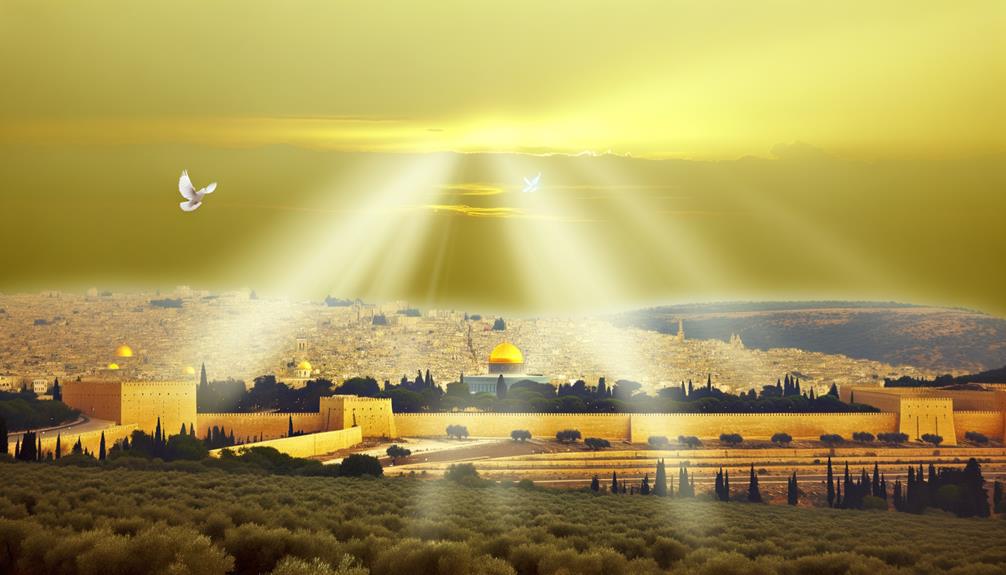
The city of Jerusalem holds a central place in biblical prophecies and promises, symbolizing the fulfillment of divine covenants and eschatological hopes. Throughout the scriptures, Jerusalem is depicted as the focal point of God’s plan for humanity.
Prophets like Isaiah and Zechariah envisioned a future where Jerusalem would be exalted, becoming a hub of peace and divine justice. The prophetic literature often portrays it as the ultimate destination of pilgrimage for all nations, underscoring its role in the Messianic age.
In addition, the promises of restoration and renewal, particularly post-exilic, reflect a divine assurance that Jerusalem would transcend its historical trials.
These prophecies and promises contribute to Jerusalem’s enduring spiritual significance, anchoring it in the collective consciousness of believers.
Jesus and Jerusalem
Jesus’ relationship with Jerusalem is pivotal in understanding his ministry and its theological implications within the Christian tradition. The Gospels depict Jerusalem as the focal point of Jesus’ mission, symbolizing both divine fulfillment and human culmination.
His triumphal entry into the city, as recounted in the Synoptic Gospels, signifies messianic prophecy fulfillment. Additionally, Jerusalem is the backdrop for pivotal events such as the Last Supper, his crucifixion, and resurrection, embedding it deeply in Christian soteriology.
The city’s dual role as a place of worship and conflict underscores its theological significance, reflecting both divine promise and human fallibility. Jesus’ lament over Jerusalem encapsulates his sorrow over its spiritual blindness and foreshadows the city’s integral role in eschatological narratives.
Jerusalem in Revelation
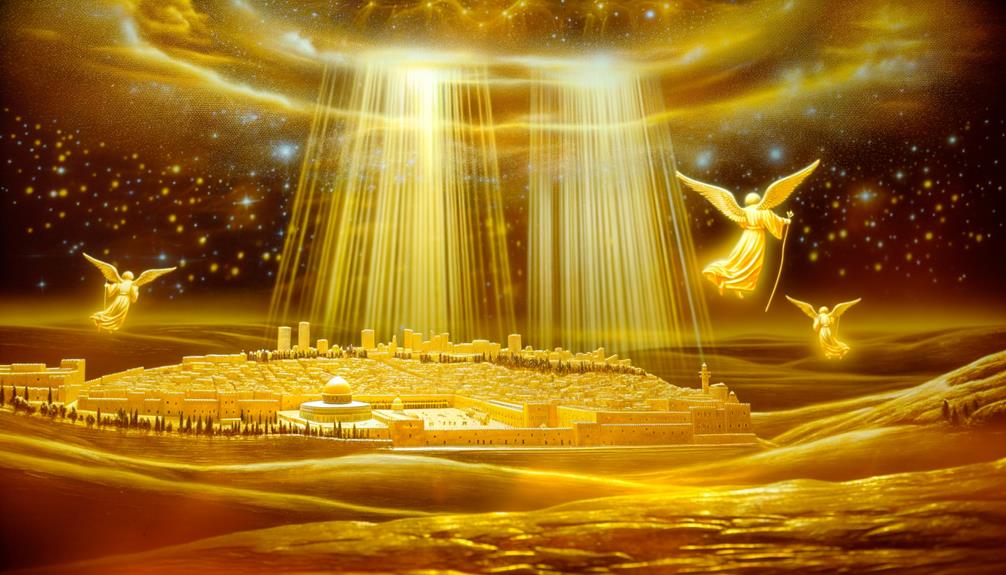
The Book of Revelation presents Jerusalem as the New Jerusalem, a symbol of divine perfection and eternal communion between God and humanity.
This eschatological vision underscores the city’s prophetic role in the culmination of God’s plan, reflecting themes of redemption and ultimate sanctification.
Analyzing the New Jerusalem’s significance provides profound insights into its symbolic representation as the Holy City and its pivotal function in end-time prophecy.
New Jerusalem’s Significance
Revelation’s depiction of the New Jerusalem symbolizes the ultimate fulfillment of God’s promise to restore and renew creation, offering profound theological insights into eschatological hope and divine sovereignty. This vision underscores the culmination of divine justice and peace, presenting the New Jerusalem as a transcendent reality where God’s presence dwells intimately with humanity. Its significance lies in the transformation of a fallen world into a divine kingdom characterized by eternal communion, holiness, and glory.
| Aspect | Significance |
|---|---|
| Divine Presence | God dwelling directly with people |
| Ultimate Restoration | Renewal of creation |
| Eternal Peace | End of suffering and conflict |
The New Jerusalem therefore embodies the eschatological vision of a perfected, harmonious existence, highlighting God’s ultimate plan for humanity and creation.
Symbolism of Holy City
In the Book of Revelation, Jerusalem is symbolically portrayed as the Holy City, representing the ultimate manifestation of God’s eternal kingdom and divine purpose. This depiction underscores the eschatological vision where the Holy City epitomizes divine perfection and harmony.
Revelation 21:2 describes the New Jerusalem descending from heaven, indicating a divine origin and a transformational renewal of creation. The city’s intricate architecture, adorned with precious stones and pure gold, encapsulates theological ideals of purity, holiness, and the intimate presence of God among His people.
Prophetic End-Time Role
Examining the prophetic end-time role of Jerusalem in Revelation requires an exploration of its eschatological significance and its function as the epicenter of divine culmination.
In the Book of Revelation, Jerusalem is depicted as the New Jerusalem, symbolizing the ultimate fulfillment of God’s redemptive plan. This city descends from heaven, representing an eternal dwelling place for the righteous, where God resides among His people (Revelation 21:2-3).
The New Jerusalem embodies the consummation of a renewed creation, free from suffering and death. Its portrayal as the locus of divine presence highlights its spiritual and cosmic importance in the narrative of final judgment and restoration, serving as the ultimate convergence point of divine justice, peace, and glory.
A Symbol of Faith
Jerusalem, as depicted in the Bible, stands as a profound symbol of unwavering faith, deeply rooted in the spiritual journey and covenantal relationship between God and His people.
This city embodies the fulfillment of divine promises, serving as a focal point for the faith that binds the community of believers.
The biblical narrative accentuates Jerusalem as the epicenter of worship, where the Temple signifies God’s abiding presence. It reflects the aspirational faith of a people working towards spiritual completeness.
Additionally, Jerusalem’s portrayal as an enduring city of refuge and hope reinforces its symbolic stature as a witness to God’s steadfastness.
Therefore, Jerusalem is not merely a geographic location but an emblematic cornerstone of faith and divine assurance.
Conclusion
Jerusalem’s spiritual significance in the Bible is profound and multifaceted, encompassing its role as the City of David, the site of the Temple Mount, and its presence in prophecies and promises.
Notably, the city is mentioned over 800 times in the Bible, underscoring its centrality in biblical narratives.
Jerusalem’s connections to Jesus and its depiction in Revelation further solidify its position as a symbol of faith and divine promise, resonating deeply in Christian theology.