
Spiritual Meaning of Gates in the Bible: Access
In the Bible, gates carry multifaceted spiritual symbolism, often reflecting moments of divine encounter and pivotal shifts in one’s faith journey. They serve as metaphors for entering sacred thresholds, representing judgment, divine protection, and the access to righteousness, as seen in the ‘narrow gate‘ of Matthew 7:13-14 and the Eastern Gate in Ezekiel.
Gates also delineate sacred from secular spaces, enabling transformative divine-human interactions, illustrated by Jacob’s vision. In addition, prophetic literature, such as Isaiah 60, highlights gates as symbols of divine promise and eschatological hope.
Exploring these symbolic roles will illuminate deeper theological insights inherent in biblical narratives.

Spiritual Meaning of Gates in the Bible: Access, Authority, and Divine Transition
| Aspect | Description | Spiritual Significance |
|---|---|---|
| Place of Authority | Ruth 4:1–11 | Gates were where leaders made judgments—symbol of decision and covenant |
| Access to God | Psalm 100:4 | Entering His gates with thanksgiving represents worship and divine approach |
| Protection & Security | Nehemiah 3 | Gates reflect boundaries and God’s protection over His people |
| Transition Point | Genesis 28:17 | Gates signify movement between earthly and heavenly realms—portals of divine presence |
| Spiritual Warfare | Matthew 16:18 | “Gates of hell shall not prevail” represents victory over spiritual opposition |
Gates as Points of Transition

In biblical literature, gates often symbolize significant changes, marking the passage from one state or area to another. These shifts are not merely physical but frequently encompass spiritual and moral dimensions.
For instance, the gates of cities like Jerusalem are depicted as entry points to sacred spaces, representing a shift from the secular to the holy. Similarly, the ‘narrow gate‘ mentioned in Matthew 7:13-14 signifies the challenging path to righteousness, contrasting with the ‘wide gate’ leading to destruction.
The symbolism of gates underscores the importance of choices and the transformative nature of spiritual journeys. Consequently, biblical gates serve as metaphors for pivotal decisions, demarcating the thresholds between disparate domains of existence and underscoring the gravity of spiritual shifts.
Gates and Divine Encounters
In biblical narratives, gates often serve as loci for divine encounters, symbolizing gateways to heaven and sacred threshold moments.
These portals are not merely physical structures but are imbued with spiritual significance, marking the juncture between the mundane and the divine.
Through these gates, individuals experience profound revelations and transformative interactions with the divine presence.
Gateways to Heaven
Often depicted as liminal spaces, gates in the Bible frequently serve as symbolic thresholds between the earthly sphere and the divine, facilitating profound encounters with the sacred.
These gateways to heaven not only signify a place of entry but also represent moments of divine revelation. For instance, Jacob’s vision of the ladder at Bethel, where angels ascend and descend, epitomizes this concept, underscoring the gate as a conduit to divine domains.
| Biblical Figure | Encounter at the Gate |
|---|---|
| Jacob | Vision of the ladder (Genesis 28) |
| Peter | Vision of a heavenly gate (Acts 10) |
| Isaiah | Temple vision (Isaiah 6) |
| John | Revelation of heaven’s gate (Rev 4) |
These instances illustrate how gates serve as pivotal points for divine-human interaction, embodying spiritual transition and transformation.
Sacred Threshold Moments
Throughout biblical narratives, gates frequently mark sacred threshold moments, serving as pivotal sites for divine encounters and transformative experiences.
For instance, Jacob’s vision at Bethel, where he perceives a ladder reaching to heaven (Genesis 28:17), underscores the gate as a juncture of earthly and heavenly domains.
Similarly, the Eastern Gate in Ezekiel’s visions (Ezekiel 44:1-3) symbolizes divine entry and presence.
These gates are not mere physical structures but metaphysical thresholds where the mundane intersects with the divine.
They signify moments of spiritual revelation, offering believers a passage to deeper faith and understanding.
Consequently, gates in the biblical context are emblematic of both physical and spiritual shifts, underscoring their integral role in the divine narrative.
Gates in Old Testament
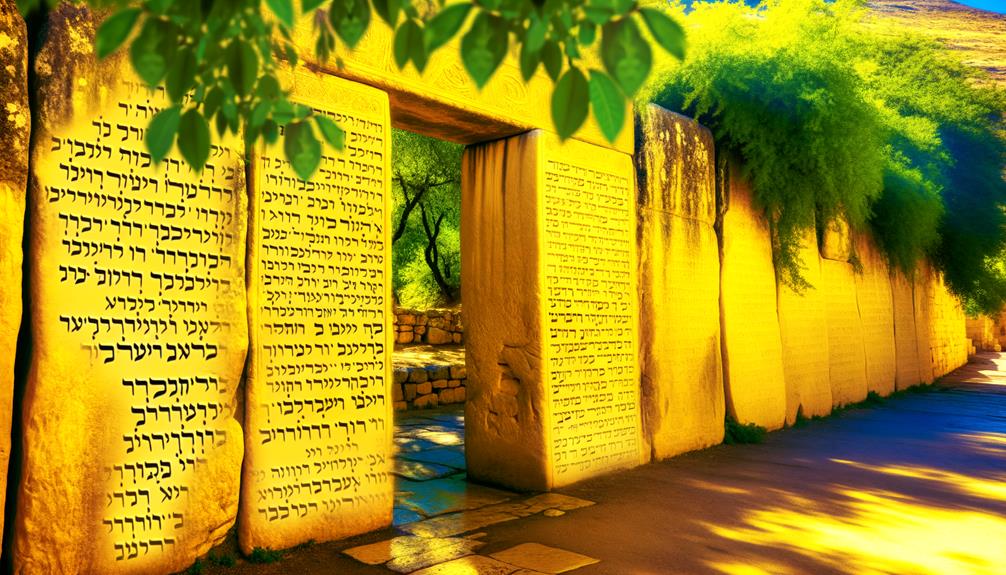
In the Old Scriptures, gates served as symbolic city entrances, representing the threshold between the secular and the sacred.
They were often seen as indicators of divine protection, where God’s presence was invoked to safeguard the inhabitants.
These gates also functioned as places of judgment and communal decision-making, reflecting their integral role in the spiritual and civic life of ancient Israelite society.
Symbolic City Entrances
City gates in the Old Scriptures serve as multifaceted symbols, representing both physical boundaries and spiritual portals to communal life and divine interaction. These gates encapsulate significant theological and societal implications.
- Judicial Functions: Gates were places where elders and judges convened to deliberate and render decisions (Deuteronomy 16:18).
- Commercial Activity: They were bustling centers of trade and commerce, facilitating economic exchanges (2 Kings 7:1).
- Public Announcements: Gates served as venues for proclamations and important public announcements (Jeremiah 17:19).
- Worship and Prophetic Declarations: Prophets often delivered divine messages at city gates, connecting the community to spiritual truths (Amos 5:10).
In essence, city gates in the Old scripture encapsulate a confluence of civic, economic, and spiritual dimensions.
Divine Protection Indicators
Gates in the Old Scriptures often symbolize divine protection, acting as physical and spiritual barriers safeguarding the inhabitants from external threats and malevolent forces.
These gates were not merely architectural features but were imbued with profound theological significance, representing God’s protective power over His people. The following table illustrates key instances of gates as divine protection indicators in the Old canon:
| Scripture Reference | Description | Symbolic Meaning |
|---|---|---|
| Nehemiah 3:1-32 | Reconstruction of Jerusalem’s gates | Restoration and divine favor |
| Psalm 147:13 | Strengthening of gates | God’s protection and blessing |
| Isaiah 26:2 | Open the gates for the righteous | Divine access and security |
These gates underscore the belief that divine providence is both a spiritual and material fortification.
Gates in New Testament
The New Covenant frequently employs the imagery of gates to symbolize spiritual change, access, and divine judgment. Gates serve as metaphors for the shift between the earthly and the divine, as well as for the thresholds of moral and spiritual commitment.
- Narrow Gate (Matthew 7:13-14): Symbolizes the challenging path to salvation, requiring dedication and righteousness.
- Gates of Hades (Matthew 16:18): Represents the powers of death and evil, which will not prevail against the Church.
- Beautiful Gate (Acts 3:2): A site of miraculous healing, signifying divine intervention and grace.
- Heavenly Gates (Revelation 21:12): Depicts the entrance to the New Jerusalem, symbolizing eternal life and divine fellowship.
These examples reflect the multifaceted role of gates in expressing theological concepts in the New Agreement.
Gates of Jerusalem

The gates of Jerusalem hold profound historical significance, serving as both literal and symbolic thresholds in biblical narratives.
These gates are not merely architectural features but are imbued with spiritual meaning, representing divine gateways that lead to deeper truths and higher understanding.
Additionally, they function as protective barriers, embodying the concept of divine safeguarding against external threats and spiritual adversaries.
Historical Significance Unveiled
Revealing the historical significance of Jerusalem’s gates, one uncovers a rich tapestry of cultural, religious, and political narratives that have shaped the city’s legacy throughout millennia.
These gates, integral to Jerusalem’s architectural and spiritual framework, served not only as functional entry points but also as symbols of divine protection and communal identity.
Key historical aspects include:
- Defensive Structures: The gates were pivotal in fortifying the city against invasions.
- Trade and Commerce: They facilitated economic activities by controlling the flow of goods and merchants.
- Judicial and Civic Administration: Gates often hosted public gatherings and legal proceedings.
- Pilgrimage and Worship: They marked the entry for pilgrims, accentuating religious significance.
These characteristics underscore the multifaceted importance of Jerusalem’s gates across various dimensions of life.
Symbolic Spiritual Gateways
Beyond their historical and functional roles, the gates of Jerusalem embody profound symbolic spiritual meanings that resonate deeply within biblical narratives and theological discourse.
Each gate of the ancient city is imbued with unique spiritual significance, representing various aspects of divine interaction and human experience.
For instance, the Sheep Gate symbolizes the sacrificial system and hints at Christ as the Lamb of God. The Fish Gate suggests evangelism, pointing to the calling of disciples as ‘fishers of men.’
Additionally, the Eastern Gate, often associated with messianic prophecies, signifies hope and future redemption.
These gates serve as metaphors for spiritual passages, transformations, and the continuous journey of faith, enriching our understanding of biblical teachings and divine mysteries.
Protective Divine Barriers
In the ancient city of Jerusalem, gates functioned not only as physical entry points but also as potent symbols of divine protection and covenantal security.
These gates, as described in biblical texts, served multiple purposes, each imbued with theological significance:
- Spiritual Guardianship: Gates represented the safeguarding of the holy city, underscoring God’s protective presence.
- Covenantal Boundaries: They delineated the sacred space where God’s covenant with His people was enacted and upheld.
- Judicial Places: Gates often served as sites for legal proceedings, highlighting their role in maintaining social and divine order.
- Prophetic Symbolism: Prophets frequently referenced gates to illustrate messages about divine judgment and redemption.
Thus, the gates of Jerusalem embody multifaceted divine barriers, integral to understanding biblical spirituality and theology.
Gates and Judgment
Throughout the Bible, gates frequently serve as pivotal locations for legal proceedings, symbolizing places of judgment and decision-making.
In ancient Israel, city gates were not merely physical structures but also functioned as communal hubs where elders and officials convened to adjudicate disputes and administer justice. The Book of Ruth illustrates this as Boaz negotiates legal matters at the Bethlehem gate (Ruth 4:1-11).
Similarly, Proverbs 31:23 depicts a virtuous husband who is respected at the city gates, underscoring the gates’ role as sites of social and legal authority.
Consequently, gates represent thresholds of moral discernment and communal governance, embodying the intersection of divine law and human judgment. This multifaceted symbolism underscores their profound significance in biblical narratives.
Symbolism of City Gates

While city gates functioned as arenas for legal judgment, they also carried rich symbolic meaning, representing points of entry, protection, and the demarcation between sacred and profane spaces in biblical contexts.
The multifaceted symbolism of city gates can be explored through several key aspects:
- Points of Entry: Gates served as physical and spiritual entry points, symbolizing new beginnings and changes.
- Protection: They represented security and defense, safeguarding the inhabitants from external threats.
- Community and Governance: Gates were places where leaders met, decisions were made, and communal life was regulated.
- Spiritual Boundaries: They marked the threshold between the holy city and the outside world, delineating spaces of divine presence.
These elements illustrate the profound spiritual and societal significance of city gates in biblical times.
Gates in Prophecy
Biblical prophecies frequently employ the imagery of gates to symbolize pivotal moments of divine intervention and eschatological change. In prophetic literature, gates often represent thresholds between the present world and the forthcoming divine order.
For instance, Isaiah 60:11 envisions gates that ‘shall be open continually,’ symbolizing unrestricted access to God’s eternal kingdom. Similarly, Ezekiel’s vision of the new temple includes gates that signify the restoration and purification of Israel (Ezekiel 40-48).
Gates in prophecy also denote judgment and transformation, as seen in Matthew 7:13-14, where the narrow gate leads to life, contrasting with the broad gate leading to destruction.
These prophetic images underscore the critical shifts and divine purposes inherent in biblical eschatology.
Spiritual Access Through Gates

In extending the prophetic imagery, spiritual access through gates in the Bible signifies the profound connection between humanity and the divine domain, facilitating encounters with God’s presence and blessings. Such gates serve as metaphors for spiritual transformations and divine revelations.
They represent:
- Entry into Sacred Spaces: Gates symbolize the transition from the profane to the holy, allowing believers to enter God’s presence.
- Divine Approval and Provision: Passing through these gates often indicates receiving divine favor and necessary provisions.
- Moral and Ethical Boundaries: Gates highlight the demarcation of spiritual and moral boundaries that guide righteous living.
- Access to Wisdom and Knowledge: Spiritual gates often signify the doorway to divine wisdom, offering insights and understanding.
This understanding underscores the importance of spiritual readiness and purity in approaching the divine.
Heavenly Gates in Revelation
The depiction of heavenly gates in the Book of Revelation serves as a profound symbol of the ultimate communion between believers and the divine in the eschatological vision.
These gates, described as twelve in number and each made of a single pearl (Revelation 21:21), signify the entrance to the holy city, the New Jerusalem. This imagery underscores the purity, majesty, and exclusivity of the divine domain.
Additionally, the gates are never closed (Revelation 21:25), symbolizing the perpetual access to God’s presence and eternal peace.
The twelve gates also correlate with the twelve tribes of Israel, indicating the fulfillment of God’s covenantal promises.
Consequently, the heavenly gates encapsulate the culmination of divine salvation and the eternal fellowship with God.
Conclusion
Gates within the biblical narrative serve as powerful symbols of change, divine encounter, and spiritual access. They delineate sacred spaces, marking passages between the earthly and the divine.
From the fortified gates of Jerusalem to the prophetic visions in Revelation, these portals represent both protection and revelation. City gates embody communal identity and judgment, while heavenly gates signify ultimate redemption and eternal communion with the divine.
Therefore, gates encapsulate the spiritual journey from temporal existence to eternal salvation.