
Spiritual Meaning of Flowers in the Bible: Beauty and Blessing
The Bible richly imbues flowers with profound spiritual meanings, reflecting divine care, beauty, and faith. Lilies of the field symbolize God’s provision and trust in divine sustenance, as highlighted in Matthew 6:28-30.
The Rose of Sharon represents divine presence and love, signifying purity and holiness. Cedars of Lebanon and almond blossoms illustrate strength, eternal life, and God’s vigilant promises.
Olive trees and fig trees serve as emblems of peace, prosperity, and spiritual health or judgment. The metaphorical language in Psalms further deepens theological messages through floral imagery.
To uncover more insights, explore further interpretations and scriptural contexts.
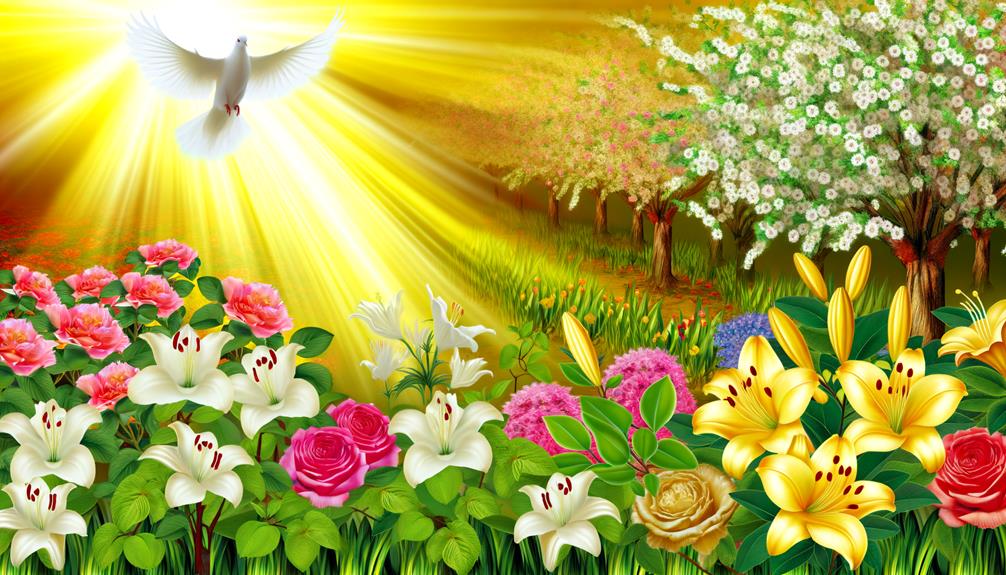
Spiritual Meaning of Flowers in the Bible: Beauty, Fragility, and Divine Glory
| Aspect | Description | Spiritual Significance |
|---|---|---|
| Human Life | Isaiah 40:6–8 | Flowers represent the brevity and fragility of life |
| God’s Provision | Matthew 6:28–30 | God clothes the flowers, symbolizing His care for creation |
| Beauty & Glory | Song of Solomon 2:1 | Flowers reflect divine beauty and love |
| Resurrection & Renewal | Blossoming imagery | Symbolizes new life and spiritual awakening |
| Worship & Praise | Temple decorations and offerings | Flowers used as symbols of honor and devotion to God |
Lilies of the Field

In the Bible, lilies of the field are often employed as powerful symbols of divine provision and beauty, illustrating the care and attention God bestows upon His creation.
Jesus’ reference to these lilies in Matthew 6:28-30 emphasizes their effortless splendor, surpassing even that of King Solomon in his royal attire.
This analogy is meant to reassure believers of God’s unwavering providence, suggesting that if God so meticulously clothes the lilies, He will assuredly provide for human needs.
The lilies exemplify trust in divine provision, underscoring a theological perspective that human anxiety over material needs is unnecessary when one places faith in God’s benevolent care.
Consequently, lilies are emblematic of a profound spiritual truth regarding reliance on divine sustenance.
Rose of Sharon
The ‘Rose of Sharon,’ referenced in the Song of Solomon 2:1, serves as a rich symbol of beauty, love, and the divine presence in biblical literature.
This flower is often interpreted as a metaphor for several key theological and spiritual concepts:
- Beauty: The rose symbolizes the unparalleled beauty of creation and the divine artistry of God.
- Love: It represents the deep, abiding love between God and humanity, reflecting the intimate relationship described in the Song of Solomon.
- Purity: The rose’s pristine nature is indicative of purity and holiness, central themes in biblical teachings.
- Divine Presence: The Rose of Sharon signifies God’s everlasting presence, providing comfort and hope to believers.
These interpretations underscore the multifaceted symbolism of the Rose of Sharon in the Bible.
Cedars of Lebanon

Renowned for their grandeur and resilience, the Cedars of Lebanon hold profound spiritual and symbolic significance in biblical texts. Frequently mentioned in Scripture, these mighty trees symbolize strength, durability, and eternal life.
They were used in the construction of Solomon’s Temple, reflecting divine power and sanctity. Their towering presence and longevity serve as metaphors for God’s unwavering and eternal nature, offering a vivid illustration of spiritual steadfastness and divine protection.
| Biblical Reference | Symbolic Meaning |
|---|---|
| 1 Kings 6:9-10 | Divine craftsmanship |
| Psalm 92:12 | Righteous flourishing |
| Ezekiel 31:3 | Majestic power |
| Isaiah 2:13 | Human pride and downfall |
| Hosea 14:5-6 | Restoration and beauty |
These references imbue the Cedars of Lebanon with a layered spiritual resonance.
Almond Blossoms
Among the diverse flora mentioned in biblical texts, almond blossoms stand out for their rich spiritual symbolism and profound theological implications. Their significance can be understood through various dimensions:
- Early Blooming: Almond blossoms, known for their early blooming, symbolize vigilance and the swift fulfillment of God’s promises.
- Aaron’s Rod: In Numbers 17:8, the miraculous blossoming of Aaron’s rod with almond flowers signifies divine approval and authority.
- Jeremiah’s Vision: In Jeremiah 1:11-12, the almond tree (“shaqed” in Hebrew) is a pun on “shoqed” (watching), underscoring God’s watchfulness over His word.
- Temple Design: The menorah in the Tabernacle, adorned with almond blossoms (Exodus 25:33-34), signifies enlightenment and the light of divine revelation.
Thus, almond blossoms encapsulate a multifaceted theological narrative.
Hyssop and Purification

Hyssop holds profound significance in biblical texts, often symbolizing purification and moral cleansing.
This herb was integral in various ritualistic practices, particularly in the ceremonial cleansing of lepers and the sanctification of sacred spaces.
Such uses underscore hyssop’s embodiment of spiritual renewal and divine purification within Scripture.
Symbolism in Scripture
In biblical scripture, hyssop emerges as a potent symbol of purification and cleansing, deeply embedded within the rituals and spiritual practices of ancient Israel. Its significance can be discerned through various scriptural references:
- Exodus 12:22 – Hyssop was used to apply the Passover lamb’s blood to doorposts, symbolizing divine protection and purification.
- Leviticus 14:4-6 – It is involved in the cleansing rituals for leprosy, representing physical and spiritual purification.
- Psalm 51:7 – The psalmist’s plea, ‘Cleanse me with hyssop,’ underscores its symbolic power in seeking divine forgiveness.
- John 19:29 – Hyssop appears at the crucifixion, linking Old covenant purification to Christ’s redemptive act.
These instances illustrate hyssop’s profound role in conveying theological concepts of purity and atonement.
Ritual Cleansing Practices
Building upon the symbolic significance of hyssop in scripture, its practical application in ritual cleansing practices reveals a deep intertwining of physical and spiritual purification within the religious life of ancient Israel.
Hyssop, frequently mentioned in biblical texts, was employed to sprinkle blood or water during ceremonies aimed at cleansing individuals and sacred spaces (Exodus 12:22; Leviticus 14:4-6). This act symbolized the removal of impurity and the restoration of holiness.
The use of hyssop in purification rites, such as the cleansing of lepers and the sanctification of the temple, underscores its integral role in maintaining the covenantal relationship between God and His people.
Consequently, hyssop serves as a tangible representation of divine mercy and purification.
Olive Tree Symbolism
The olive tree, often revered in biblical texts, symbolizes peace, prosperity, and divine blessing. This symbolism is deeply rooted in the cultural and spiritual landscape of the Bible, where the olive tree serves multiple significant roles:
- Peace: The olive branch, particularly in the story of Noah, represents the cessation of God’s judgment and the restoration of harmony (Genesis 8:11).
- Prosperity: Olive oil, a product of the tree, is frequently associated with abundance and economic well-being (Deuteronomy 8:8).
- Divine Blessing: The anointing oil, derived from olives, signifies God’s favor and consecration (1 Samuel 16:13).
- Endurance: The olive tree’s longevity and resilience symbolize steadfast faith and enduring strength (Psalm 52:8).
This intricate symbolism enriches our understanding of biblical teachings.
Fig Tree Lessons

The fig tree holds profound significance within biblical texts, serving as a multifaceted symbol of Israel, fruitfulness, and divine judgment.
Its presence in scripture invites contemplation on the nation’s spiritual health and the importance of bearing righteous fruit.
Additionally, the fig tree provides critical lessons on faith, particularly through its appearances in the teachings of Jesus.
Symbol of Israel
In biblical literature, the fig tree often serves as a profound symbol of Israel, reflecting both its spiritual importance and its periods of moral decline. This symbolism is intricately woven throughout various scriptural narratives and prophetic passages.
The fig tree embodies several key aspects of Israel’s identity:
- Covenantal Relationship: The fig tree represents the covenant between God and Israel, signifying divine favor and protection.
- Prosperity and Peace: Flourishing fig trees signify times of peace and prosperity within the nation.
- Moral and Spiritual State: The health of the fig tree often parallels Israel’s moral and spiritual condition.
- Divine Expectation: God’s expectations for Israel’s faithfulness and righteousness are symbolized through the fig tree’s productivity.
Such symbolism underscores the profound connection between the fig tree and Israel’s spiritual journey.
Fruitfulness and Judgment
Biblical narratives often utilize the fig tree as a metaphor to convey profound lessons about fruitfulness and divine judgment.
In the Gospels, Jesus’ cursing of the barren fig tree (Mark 11:12-14, 20-21) serves as a poignant example. This act symbolizes God’s expectation of spiritual fruitfulness and the consequences of spiritual barrenness. The fig tree, full of leaves but devoid of fruit, represents a superficial show of faith without genuine substance.
Additionally, the parable of the fig tree (Luke 13:6-9) underscores the patience and mercy of God, who provides opportunities for repentance before final judgment.
These fig tree lessons underscore the biblical principle that outward appearances must align with inner spiritual significance to avoid divine censure.
Lessons on Faith
Lessons on faith emerge profoundly from the fig tree narratives, illustrating the deep spiritual truths embedded within these biblical accounts.
The fig tree, often a symbol of Israel, provides unique insights into the nature of faith and divine expectation. In the Gospels, Jesus uses the fig tree to convey significant lessons:
- Faith and Fruitfulness: The barren fig tree symbolizes the necessity of productive faith.
- Immediate Response: Jesus cursing the fig tree emphasizes the urgency of spiritual responsiveness.
- Visible Signs: The fig tree’s leaves without fruit illustrate the danger of outward religiosity lacking true faith.
- Prophetic Fulfillment: The fig tree’s lesson foreshadows the coming judgment and restoration of Israel.
These narratives compel believers to reflect on the authenticity and essentiality of their faith.
Blossoms of Hope
Throughout the Bible, flowers often symbolize hope and renewal, serving as poignant reminders of God’s promises and the potential for spiritual rebirth.
The blooming of flowers, especially in arid or desolate places, signifies divine intervention and the restoration of life. Isaiah 35:1, for instance, proclaims, ‘The desert shall rejoice and blossom as the rose,’ illustrating the transformative power of God’s grace.
This imagery underscores the belief that, no matter the barrenness of one’s spiritual journey, hope can sprout and flourish through faith.
Such botanical metaphors offer solace and encouragement, teaching that adversity can give way to divine renewal. In this situation, flowers are not mere ornaments but profound symbols of faith’s resilience and God’s unwavering benevolence.
Flowers in Psalms

The Psalms frequently employ the imagery of flowers to convey themes of beauty, transience, and divine providence, reflecting the intricate relationship between nature and spirituality.
This rich metaphorical language serves several purposes:
- Ephemeral Nature: Psalm 103:15-16 likens human life to a flower that flourishes and then is gone, underscoring life’s fleeting nature.
- Divine Care: Psalm 104:14 illustrates God’s provision, stating He causes grass to grow for the cattle and plants for people to cultivate.
- Beauty and Praise: Psalm 96:12 celebrates the fields and all that is in them, expressing joy and reverence.
- Renewal and Hope: Psalm 92:12-14 portrays the righteous as flourishing like a palm tree, symbolizing spiritual importance and renewal.
Such references foster a deeper understanding of the Psalms’ theological messages.
Conclusion
In the tapestry of biblical narratives, flowers emerge as vibrant symbols of divine messages and spiritual truths.
The lilies of the field, Rose of Sharon, and Cedars of Lebanon, among others, weave a fragrant garland of faith, purity, and eternal promises.
These botanical emblems, rich in allegory, are not mere flora but profound vessels of sacred wisdom.
Through their blossoms, the scriptures unfurl deeper insights into human existence and the divine, offering perennial hope and guidance.