
Spiritual Meaning of Wine in the Bible: Joy and Covenant
Wine in the Bible bears rich spiritual significance. It symbolizes joy and divine blessings, as evidenced in Psalm 104:15, and plays an essential role in religious ceremonies, such as Passover and the Last Supper.
Jesus’ transformation of water into wine at Cana underscores divine authority and inaugurates the new covenant, further emphasized by its representation as Christ’s blood in Christian Communion. It signifies material and spiritual abundance, covenantal relationships, and atoning sacrifice.
Understanding wine’s manifold roles offers deeper insights into its theological implications within scriptural contexts and religious traditions. Explore further to appreciate its thorough spiritual symbolism.

Spiritual Meaning of Wine in the Bible: Joy, Covenant, and Spiritual Transformation
| Aspect | Description | Spiritual Significance |
|---|---|---|
| Joy & Celebration | Psalm 104:15 | Wine symbolizes gladness and blessings from God |
| Covenant Symbol | Matthew 26:27–29 | Represents the blood of Christ in the New Covenant |
| Spiritual Abundance | Proverbs 3:10 | Overflowing wine symbolizes divine provision and favor |
| Transformation | John 2:1–11 (Water into wine) | Sign of Jesus’ miraculous power and new beginnings |
| Warning & Moderation | Ephesians 5:18 | Wine reminds believers to seek spiritual fulfillment over excess |
Wine as a Symbol of Joy
In biblical literature, wine frequently emerges as a potent symbol of joy, reflecting divine blessings and human celebration. Scriptural references often intertwine wine with moments of festivity and prosperity, illustrating its role as a harbinger of God’s favor.
For instance, Psalm 104:15 extols wine as that ‘which gladdens human hearts,’ highlighting its capacity to elevate the human spirit. Similarly, Proverbs 3:10 promises that one’s ‘vats will brim over with new wine’ as a reward for honoring the Lord.
The abundance of wine signifies not only material wealth but also spiritual fulfillment, encapsulating the duality of physical and divine joy. Consequently, wine in the Bible is not merely a physical substance but a profound emblem of God’s gracious provision and human rejoicing.
Wine in Ancient Israelite Feasts
During ancient Israelite feasts, wine played a central role in both religious ceremonies and communal gatherings, serving as a tangible expression of covenantal relationships and divine blessings.
Wine was integral to offerings and celebrations, symbolizing abundance and God’s favor. It was used in various feasts, such as Passover and the Feast of Tabernacles, to commemorate pivotal events in Israelite history and foster communal unity.
The ritualistic use of wine in these feasts is deeply rooted in scriptural traditions, enhancing the spiritual experience of participants.
| Feast | Scriptural Reference |
|---|---|
| Passover | Exodus 12:1-14 |
| Feast of Tabernacles | Leviticus 23:33-43 |
| New Moon Festivals | Numbers 28:11-15 |
| Sabbath | Exodus 20:8-11 |
This table highlights key feasts and their scriptural bases, underscoring the significance of wine in these sacred observances.
Jesus’ Miracle at Cana
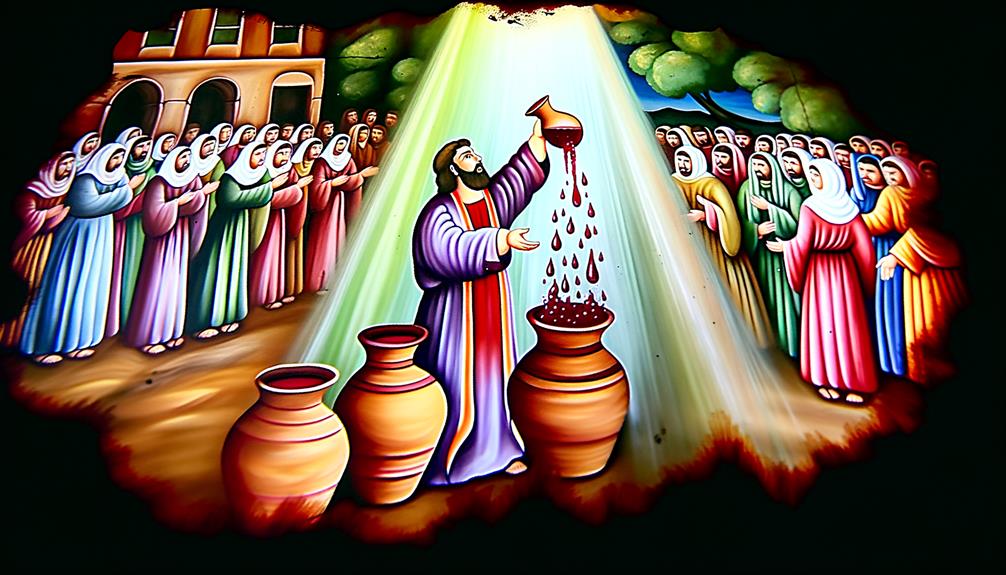
The significance of wine in ancient Israelite feasts finds a profound extension in the New Covenant narrative of Jesus’ miracle at Cana, where He transforms water into wine, highlighting both His divine authority and the inauguration of a new covenant.
This miraculous act, recounted in John 2:1-11, symbolizes the transformative power of Jesus’ ministry and serves as a foretaste of the Messianic age.
The abundance and quality of the wine produced underscore the overflowing nature of divine grace.
In scriptural terms, this event foreshadows the Eucharistic wine, representing Christ’s blood, which would later be poured out for the salvation of humankind.
Consequently, the miracle at Cana is pivotal in understanding the theological and spiritual significance of wine in the Christian tradition.
Wine and Divine Blessing
Wine in the Bible frequently symbolizes divine blessing, encapsulating themes of abundance, covenant, and communion.
Scriptural references, such as Psalm 104:15 which speaks of wine gladdening the heart, emphasize God’s provision and the prosperity He bestows upon His people.
Additionally, wine is integral to the covenantal rituals, particularly in the Last Supper, where it signifies the new covenant in Christ’s blood, fostering a profound spiritual communion with God.
Symbol of Abundance
In biblical scripture, wine frequently emerges as a potent symbol of abundance and divine blessing, encapsulating the prosperity bestowed by God upon His people.
The imagery of wine flowing in abundance often signifies God’s favor, as seen in passages such as Psalm 104:15, where wine ‘gladdens the heart of man.’
Similarly, Proverbs 3:10 promises that honoring the Lord with wealth will result in ‘vats brimming over with new wine.’
The significance of wine extends beyond mere material wealth; it represents the holistic well-being and joy that divine favor brings.
Joel 2:24 illustrates this divine largesse vividly: ‘The threshing floors will be filled with grain; the vats will overflow with new wine and oil.’
This imagery underscores wine’s integral role in symbolizing divine generosity.
Covenant and Communion
Central to the theological framework of the Bible, wine is imbued with profound significance in the context of covenant and communion, symbolizing divine blessing and the sacred bond between God and His people.
In the Old Covenant, wine often accompanies covenantal ceremonies, as seen with Melchizedek and Abraham (Genesis 14:18).
This theme is further echoed in the New Covenant, where Jesus institutes the Eucharist during the Last Supper, declaring, ‘This cup is the new covenant in my blood’ (Luke 22:20).
The use of wine therefore transcends mere ritual; it embodies a divine promise and spiritual communion.
Through these scriptural narratives, wine serves as a tangible representation of God’s enduring grace and fellowship with humanity.
Covenant and Wine
Through the lens of biblical theology, wine emerges as a profound symbol in the context of covenantal relationships, signifying divine promises and human commitments.
In Genesis 9:20-21, Noah’s vineyard and subsequent wine consumption follow God’s covenant with him, marking a new beginning for humanity.
Similarly, in the New Agreement, wine is integral to the Last Supper, where Jesus establishes the New Covenant in Luke 22:20: ‘This cup is the new covenant in my blood, which is poured out for you.’
Here, wine embodies the sacrificial love and eternal covenant between God and believers.
Therefore, wine transcends mere physical sustenance, reflecting a deeper spiritual reality of divine-human communion and irrevocable promises.
Wine in Sacrificial Rituals
In biblical sacrificial rituals, wine holds profound symbolic significance, representing joy, blessing, and the covenantal relationship between God and His people.
The Old Scripture frequently mentions wine as a libation offering, underscoring its role in various religious ceremonies and its integration into the Israelites’ worship practices.
In the New Scripture, wine’s sacrificial symbolism is reinterpreted through the lens of Christ’s sacrificial act, culminating in the Eucharist, which memorializes the new covenant established through His blood.
Symbolism in Offerings
Among the various elements used in biblical sacrificial rituals, wine holds profound symbolic significance as an offering.
Scripturally, wine often represents joy, celebration, and divine blessing, reflecting the covenantal relationship between God and His people. In offerings, wine’s inclusion signifies the completeness of the sacrifice, underscoring themes of communion and divine provision.
As seen in Numbers 15:5-7, wine is poured out in libations, symbolizing the outpouring of one’s self in devotion to God. This ritual act embodies the worshiper’s gratitude and acknowledgment of God’s sovereignty.
Additionally, wine’s inherent qualities of transformation and preservation serve as metaphors for spiritual renewal and the enduring nature of God’s covenant. Consequently, wine in sacrificial rituals encapsulates a multifaceted theological richness.
Old Testament Practices
Frequently, the Old Covenant delineates the use of wine in sacrificial rituals as an integral component of worship practices, reflecting deep theological and covenantal themes.
In Leviticus 23:13, wine accompanies the grain offering, symbolizing joy and thanksgiving. The drink offering, or ‘nesek,’ outlined in Numbers 28:7, involves pouring wine alongside burnt offerings, underscoring the completeness of devotion to God. This ritual act signifies the relinquishment of worldly pleasures in favor of divine allegiance.
Additionally, the stipulations in Exodus 29:40 and Numbers 15:5, 10, emphasize wine’s role in consecration and atonement ceremonies, further embedding it within Israelite religious identity.
Collectively, these practices reveal wine as a multifaceted symbol within the sacrificial system, embodying gratitude, consecration, and covenant fidelity.
New Testament Significance
The New Covenant profoundly reinterprets the role of wine within sacrificial rituals, particularly through the institution of the Eucharist by Jesus Christ.
During the Last Supper, Jesus declares the wine to be ‘my blood of the covenant, which is poured out for many for the forgiveness of sins’ (Matthew 26:28, ESV). This act signifies the shift from the Old Testament sacrificial system to a new, eternal covenant established through Christ’s atoning sacrifice.
The Eucharist, or Holy Communion, therefore becomes a central rite, symbolizing Christ’s blood shed for humanity’s redemption. Within this framework, wine transcends its earlier connotations, embodying the spiritual nourishment and unity of believers with Christ, as emphasized in 1 Corinthians 10:16.
Communion and Wine
In what ways does wine, as used in the practice of Communion, carry profound theological significance within the biblical narrative?
Wine in Communion symbolizes the blood of Christ, as instituted during the Last Supper (Matthew 26:27-28). This sacrament is a covenantal act, recalling the sacrificial death of Jesus and the new covenant between God and humanity.
Scripturally, it signifies purification and redemption, echoing Old Testament sacrifices where blood was integral for atonement (Leviticus 17:11).
Additionally, wine in Communion fosters unity among believers, representing shared participation in Christ’s suffering and resurrection (1 Corinthians 10:16).
Consequently, wine in this situation is not merely a ritual element but a profound reminder of divine grace and communal faith.
Wine and Eternal Life
Within the biblical context, wine emerges as a potent symbol of eternal life, intricately linked to the promises of salvation and the eschatological hope found in Christ.
The imagery of wine is employed to signify the blood of Christ, as epitomized in the Last Supper where Jesus declares, “This is my blood of the covenant, which is poured out for many for the forgiveness of sins” (Matthew 26:28).
This sacramental use underscores the transformative power of Christ’s sacrifice, promising believers eternal communion with God.
| Symbol | Meaning |
|---|---|
| Wine | Eternal Life |
| Blood of Christ | New Covenant |
| Last Supper | Promise of Salvation |
| Transformation | Forgiveness of Sins |
| Communion | Eschatological Hope |
This symbology invites a deeper reflection on the profound theological implications of wine in Scripture.
Conclusion
In biblical texts, wine serves multifaceted symbolic purposes, from representing joy and divine blessings to signifying covenantal relationships and eternal life.
For instance, the miracle at Cana, where Jesus transforms water into wine, epitomizes the transformative power of divine intervention and the ushering in of a new covenant.
Such instances underscore the theological richness and multifaceted roles of wine in biblical narratives, highlighting its deep-rooted spiritual significance across various contexts and rituals.