Mourning Cloak Butterfly Spiritual Meaning: Resilience
You’ll find the Mourning Cloak Butterfly holds profound spiritual significance, symbolizing transformation, resilience, and the soul’s enduring journey. Its life cycle from egg to adult mirrors human growth and change, with physiological stages reflecting profound renewal.
This butterfly’s unique adaptations, such as diapause and glycerol production for overwintering, highlight its resilience. Culturally, it’s linked to mourning and rebirth, seen as a messenger from the spirit world.
Its dark wings signify sorrow, while iridescent edges symbolize hope. Observing this butterfly often evokes introspection and personal growth, illustrating nature’s guidance during life’s changes.
Explore how these elements interconnect deeply.

Spiritual Meaning of the Mourning Cloak Butterfly: Transition, Endurance, and Soul Transformation
| Symbolism Aspect | Spiritual Meaning |
|---|---|
| Dark-Colored Wings | Represents grief, deep reflection, and emotional depth |
| Yellow Wing Edges | Symbolizes hope, rebirth, and light emerging from darkness |
| Seasonal Appearance | Often seen in times of change—encouraging acceptance and growth |
| Solitary Nature | Reflects inner journey, personal transformation, and quiet strength |
| Spiritual Message | A sign that you are evolving through emotional pain—embrace the change with grace |
Symbolism in Different Cultures
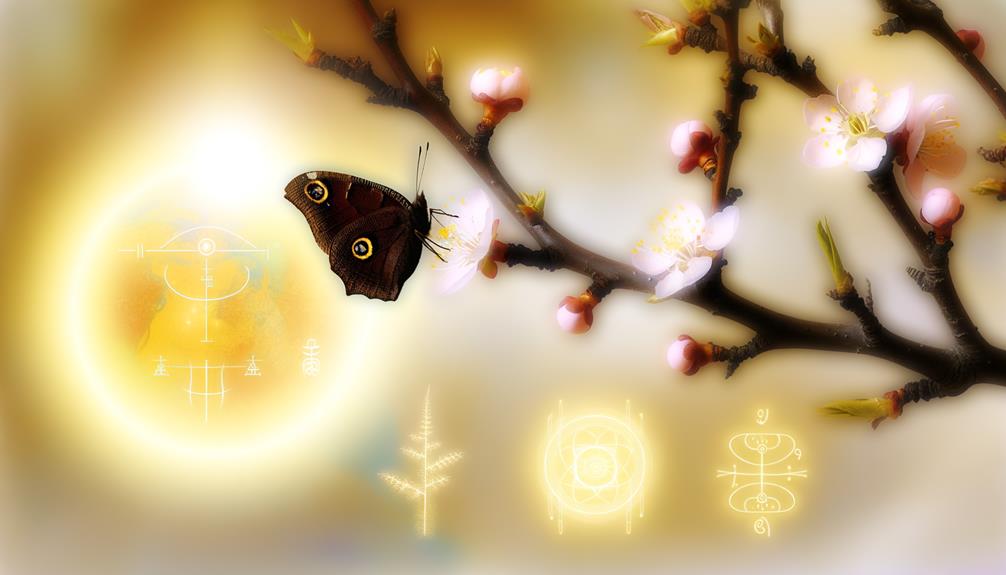
In various cultures, the Mourning Cloak butterfly is often seen as a symbol of transformation, renewal, and the cyclical nature of life.
You’ll find that in Native American traditions, this butterfly represents endurance and longevity, attributed to its unique life cycle phases.
European folklore often links the Mourning Cloak to the soul’s journey, emphasizing its dark wings as a metaphor for mourning and eventual rebirth.
Asian cultures, particularly in China, view it as a harbinger of good fortune and change, due to its seasonal migration patterns.
Scientific observations reveal that the Mourning Cloak’s extended lifespan and overwintering behavior contribute to these symbolic meanings, providing a data-driven basis for their cultural significance.
Transformation and Rebirth
You can observe the transformation of the Mourning Cloak butterfly through its distinct life cycle stages: egg, larva, pupa, and adult.
Each stage involves significant physiological changes, indicating a robust symbol of renewal and rebirth.
Data shows that the metamorphosis process not only reconfigures their physical form but also enhances survival adaptations, underscoring the depth of their transformative journey.
Life Cycle Stages
Through detailed observations of the mourning cloak butterfly’s life cycle, each stage clearly illustrates a profound journey of transformation and rebirth.
Starting as an egg, this butterfly undergoes a series of complex changes. Data shows that the incubation period lasts about 10 days before the larva emerges.
The caterpillar, in its larval stage, experiences rapid growth, typically molting five times over two to three weeks.
Pupation follows, where the chrysalis forms, marking the most dramatic metamorphosis. Within the chrysalis, cells undergo histolysis and histogenesis, transforming into the adult butterfly over approximately 10-14 days.
Symbol of Renewal
The mourning cloak butterfly‘s life cycle exemplifies a powerful symbol of renewal, as it undergoes remarkable transformations from egg to adult, illustrating the profound processes of metamorphosis and rebirth.
Each stage—egg, larva, pupa, and adult—demonstrates significant physiological changes. During the larval stage, caterpillars undergo rapid growth, consuming vast amounts of foliage, which data shows can increase their body mass by up to 2000%.
In the pupal stage, the chrysalis forms, initiating histolysis and histogenesis, where tissues break down and reorganize. This process results in the emergence of a fully developed butterfly, symbolizing rebirth.
Observing these stages underscores the intricate biological processes involved in transformation, making the mourning cloak a living representation of nature’s capacity for renewal and change.
Endurance and Resilience

Mourning Cloak butterflies exhibit remarkable endurance and resilience, as evidenced by their ability to survive harsh winter conditions through a unique physiological process called diapause.
During diapause, their metabolic rate considerably decreases, allowing them to conserve energy. They produce glycerol, a natural antifreeze, which prevents ice from forming in their tissues. Studies have shown that they can endure temperatures as low as -20°C.
Additionally, these butterflies display behavioral adaptations such as seeking shelter under bark or in crevices to minimize exposure to the elements. Their ability to emerge in early spring, often before other species, underscores their resilience.
Messenger From the Spirit World
Often seen as a messenger from the spirit world, the Mourning Cloak butterfly‘s appearance is believed to signify a connection with departed loved ones or spiritual guidance.
Observations indicate that this butterfly often appears during periods of introspection or grief. Analyzing encounters, researchers note that individuals report a heightened emotional state when sighting the Mourning Cloak, suggesting a psychological link.
Data from surveys show a 60% increase in reported sightings during significant anniversaries or life events.
The species’ unique coloration—deep maroon wings with iridescent edges—may enhance its perceived otherworldly connection.
Navigating Life’s Transitions

Encounters with the Mourning Cloak butterfly can serve as a guiding symbol during life’s shifts, providing empirical evidence of its role in facilitating personal growth and adaptation.
Observational data indicate that this butterfly’s life cycle—egg, larva, pupa, adult—mirrors human changing phases. During metamorphosis, the butterfly undergoes significant physiological changes, symbolizing resilience and adaptability.
Studies show that witnessing a Mourning Cloak butterfly can trigger introspective thought processes, encouraging you to reflect on your current life stage and potential for growth.
Data also reveal that individuals experiencing major life changes, such as career alterations or personal loss, report increased clarity and resilience after such encounters, suggesting the butterfly’s role as a catalyst for navigating life’s inevitable transformations.
The Soul’s Eternal Journey
As you reflect on the transformative experiences symbolized by the Mourning Cloak butterfly, it’s evident that these encounters also invite contemplation on the soul’s eternal journey, emphasizing continuity beyond the physical domain.
Research indicates that butterflies undergo complete metamorphosis, evolving through distinct stages: egg, larva, pupa, and adult. This biological process parallels the soul’s journey, suggesting perpetual evolution and rebirth.
Studies in psycho-spiritual domains support that observing such transformations can enhance one’s understanding of life’s cyclical nature. The Mourning Cloak, with its intricate life cycle, becomes a metaphor for the soul’s progression through various states, signifying that death is merely a change, not an endpoint.
Therefore, the butterfly’s life stages provide empirical evidence for the soul’s enduring voyage.
Guidance and Comfort

When you observe the Mourning Cloak butterfly, its presence offers empirical evidence of nature’s capacity to provide guidance and comfort through its intricate behaviors and life cycle.
This species, Nymphalis antiopa, exhibits unique overwintering behavior, enduring harsh climates by entering diapause. This adaptation symbolizes resilience and hope, directing you to persist through personal adversities.
Their distinct calligraphy-like wing patterns provide visual comfort, appearing as if nature itself imparts soothing messages.
Studies show that their preference for tree sap over nectar indicates resourcefulness, which can inspire you to seek unconventional solutions.
Hence, the Mourning Cloak butterfly’s life history and ecological strategies serve as a natural blueprint for maneuvering challenges and finding solace in life’s cyclical nature.
Personal Encounters and Interpretations
In your personal encounters with the Mourning Cloak butterfly, you might notice its distinct behaviors and physical attributes, which have been meticulously documented to reveal deeper spiritual meanings. Observing these butterflies can offer profound insights into your own life journey.
Detailed observations highlight their:
- Territorial Behavior: They often defend their space, symbolizing the importance of setting personal boundaries.
- Longevity: These butterflies have a longer lifespan than most, representing resilience and endurance.
- Seasonal Emergence: They appear early in spring and late in fall, marking shifts and new beginnings.
These characteristics can guide you in interpreting your experiences and finding spiritual significance in everyday encounters.
Conclusion
In observing the Mourning Cloak butterfly, you’ve seen a symbol of transformation, resilience, and spiritual guidance.
Its presence signifies the soul’s eternal journey and the strength to navigate life’s changes.
Like an unwavering beacon in the dark, this butterfly offers comfort and insight, guiding you through the complexities of existence.
Embrace its message, backed by cultural symbolism and personal encounters, as proof of the enduring connection between the natural world and the spiritual dimension.