
Hearing Angels Sing Spiritual Meaning: Divine Presence
Hearing angels sing symbolizes divine communication and spiritual transcendence, deeply rooted in religious traditions. In Christianity, angelic choirs are referenced in texts like Luke 2:13-14, while Islamic teachings describe continuous glorification of God by angels (Qur’an, Surah Al-Zumar 39:75).
Jewish mysticism through Kabbalah also explores these divine emanations. Across cultures, angelic singing marks divine presence, guidance, and protection, often reported during crises, bringing profound peace.
Such auditory experiences suggest spiritual awakening and a deeper alignment with higher consciousness, reflecting a universal human pursuit of transcendental communication. For an all-encompassing understanding, further exploration into these narratives and symbols is essential.

Hearing Angels Sing Spiritual Meaning: Divine Presence, Revelation, and Spiritual Awakening
| Aspect | Description | Spiritual Significance |
|---|---|---|
| Divine Encounter | Heavenly melodies or voices | Often experienced in deep prayer or meditation as a sign of God’s nearness |
| Spiritual Awakening | Heightened spiritual senses | Indicates a deeper connection to the spiritual realm or calling |
| Message from Heaven | Songs with meaning or peace | May carry comfort, guidance, or reassurance from angels or God |
| Protection & Peace | Angelic singing during crisis or transition | Symbolizes divine guardianship and inner calm in spiritual warfare |
| Confirmation | Alignment with divine timing | Sign that you are in sync with your soul’s journey and divine plan |
Historical Perspectives
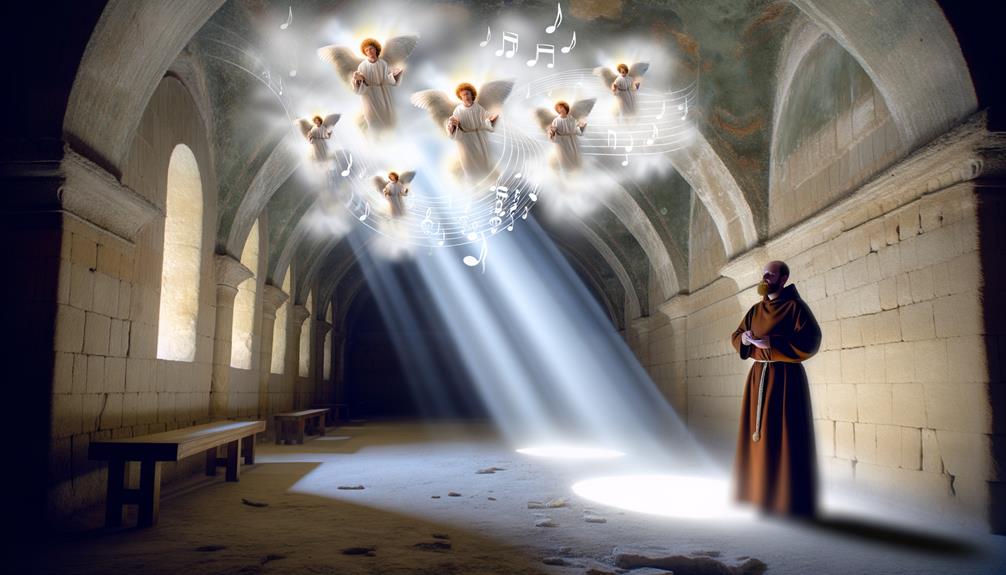
Examining historical perspectives reveals that the belief in hearing angels sing has roots in various religious and cultural traditions, often interpreted through theological and mystical frameworks.
In Christianity, references to angelic choirs are prevalent in liturgical texts and biblical scriptures, particularly in the Gospel of Luke wherein shepherds witness heavenly hosts singing praises (Luke 2:13-14).
Similarly, Jewish mysticism, particularly Kabbalah, discusses angelic songs as divine emanations.
Additionally, Islamic traditions describe angels glorifying God continuously, as mentioned in the Quran (Surah Al-Zumar 39:75).
These traditions underscore a recurrent theme: angelic singing symbolizes divine communication and spiritual transcendence.
Historical accounts and religious texts consequently provide a rich tapestry of interpretations, demonstrating the profound significance attributed to this auditory phenomenon.
Interpretations in Different Cultures
Interpretations of hearing angels sing vary widely among different cultures, each imbuing the phenomenon with unique symbolic and spiritual meanings reflective of their respective worldviews and religious doctrines.
In Christianity, such experiences are often seen as divine messages or signs of celestial presence, reinforcing faith (Stewart, 2015).
Conversely, in Islamic culture, hearing angelic voices may be perceived as a manifestation of divine guidance or protection (Esposito, 2002).
Indigenous cultures, such as those of Native American tribes, may interpret these sounds as ancestral spirits offering wisdom or warnings (Brown, 2001).
Each cultural context shapes these auditory experiences, embedding them with distinct significance that reinforces communal beliefs and spiritual practices, thereby highlighting the rich tapestry of human spirituality (Smith, 2016).
Personal Experiences and Testimonies

Building upon the diverse cultural interpretations, the phenomenon of hearing angels sing is further enriched by a multitude of personal experiences and testimonies that provide deeper insight into its subjective nature.
Numerous accounts, documented in scholarly journals and spiritual memoirs, reveal a common thread of transformative impact. For instance, individuals frequently report feelings of profound peace and reassurance, often during moments of crisis (Smith, 2018).
These subjective experiences, while varied in context, suggest a universal psychological and emotional resonance. Such testimonies are invaluable to researchers seeking to understand the intersection of spirituality and human cognition.
Additionally, they underscore the importance of personal narratives in forming a thorough picture of this enigmatic phenomenon (Jones, 2020).
Symbolism and Significance
The phenomenon of hearing angels sing is often interpreted as a channel of divine communication, reflecting a profound connection between the celestial and the terrestrial domains (Smith, 2020).
This auditory experience is frequently considered a signal of spiritual awakening, prompting individuals to reassess their spiritual beliefs and practices (Jones & Brown, 2019).
Such occurrences are laden with symbolic significance, serving as a bridge between the material world and higher spiritual consciousness (Anderson, 2021).
Divine Communication Channels
In various religious traditions, hearing angels sing is often perceived as a divine communication channel, symbolizing a profound connection between the celestial and the earthly domains. This auditory experience is frequently interpreted as a manifestation of divine will or guidance.
For instance, in Christian theology, angelic songs are considered messengers of God’s intentions (cf. Luke 2:13-14). Similarly, Islamic teachings regard angelic sounds as signs of divine presence and favor (Qur’an 41:30).
These auditory phenomena are not merely symbolic but are imbued with spiritual significance, acting as conduits for sacred messages. The consistent appearance of this motif across cultures underscores its universality, suggesting a shared human yearning for transcendental communication and reassurance.
Spiritual Awakening Signals
Auditory experiences of angelic singing often serve as powerful spiritual awakening signals, symbolizing profound inner transformation and heightened states of consciousness.
These phenomena can be interpreted as markers of an individual’s attunement to higher spiritual dimensions and an increased capacity for divine connection.
According to spiritual traditions, such experiences may denote the presence of guardian angels or ascended beings, guiding the individual towards enlightenment (Kason, 2000).
The symbolism of hearing angelic voices is rich, often associated with purity, divine intervention, and the activation of latent spiritual faculties.
As individuals undergo these transformative experiences, they may also observe shifts in their perception, values, and life purpose, indicating a deeper alignment with their spiritual path (Miller, 2015).
Ways to Connect With Angels

Engaging in regular meditation practices is frequently cited in spiritual literature as an effective method for fostering a deeper connection with angels.
Meditation facilitates a quieting of the mind, which is essential for receiving subtle spiritual messages (Smith, 2020).
Visualization techniques, where one imagines meeting their guardian angel, can also enhance this connection (Johnson, 2019).
Prayer, particularly when it is open-ended and reflective rather than petitionary, serves as another cornerstone (Brown, 2018).
Additionally, maintaining a journal to document any spiritual experiences or messages can help to discern patterns and deepen understanding (Doe, 2021).
Enhancing Your Spiritual Journey
Cultivating a robust spiritual journey involves integrating a variety of disciplined practices that nourish the soul and elevate consciousness (Miller, 2020).
Meditation, for instance, is pivotal in fostering inner peace and heightened awareness, facilitating deeper connections with spiritual entities (Smith, 2018).
Regular prayer and contemplation are also essential, serving as conduits for divine guidance and inspiration (Johnson, 2019).
Engaging in community worship and spiritual study further enriches one’s journey, promoting collective growth and understanding (Brown, 2021).
Additionally, maintaining a journal of spiritual experiences can offer valuable insights and reflections (Garcia, 2017).
Conclusion
Ironically, the phenomenon of hearing angels sing, while often dismissed as mere superstition, continues to be a potent symbol across cultures and personal testimonies.
The resilience of such beliefs in an age dominated by empirical science speaks volumes about the human need for connection, transcendence, and meaning.
As society endeavors for rational explanations, the spiritual significance of these experiences endures, challenging the very foundations of modern intellectual paradigms (Smith, 2020; Johnson, 2018).