
Monkey Puzzle Tree Spiritual Meaning: Ancient Protection
The Monkey Puzzle Tree, or Araucaria araucana, carries deep spiritual meaning across various cultures. Native to Chile and Argentina, it’s essential to the Mapuche people, symbolizing endurance and spiritual continuity.
Its ancient lineage, dating back to the Mesozoic era, makes it a symbol of longevity and resilience in Japanese and Celtic traditions. The tree’s unique structure is often incorporated into energy cleansing rituals, serving as a tool for grounding and protection.
Its enduring strength and enigmatic presence are celebrated worldwide, revealing much about humanity’s relationship with nature and spirituality. Curious minds will discover even more intriguing insights.

Monkey Puzzle Tree Spiritual Meaning: Symbol of Protection, Mystery, and Ancient Wisdom
| Symbolism | Spiritual Insight | Interpretation |
|---|---|---|
| Protection | Sharp, spiny branches ward off threats | A symbol of spiritual defense and energetic boundaries |
| Mystery | Unusual, striking appearance | Encourages exploration of the unknown and embracing uniqueness |
| Resilience | Long-living and hardy in harsh conditions | Represents endurance and the strength to withstand life’s challenges |
| Ancient Wisdom | Prehistoric origins with sacred history | Connects you to ancestral knowledge and earth-based spirituality |
| Transformation | Slow-growing and evolving over time | Reflects personal growth, patience, and spiritual unfolding |
Historical Significance

The historical significance of the Monkey Puzzle Tree, also known as Araucaria araucana, stems from its deep roots in the cultural practices and spiritual beliefs of the indigenous Mapuche people of Chile and Argentina.
The Mapuche utilized the tree’s seeds, known as piñones, as an essential food source, ensuring their survival during harsh winters.
Additionally, the tree’s remarkable resilience and ancient lineage, dating back to the Mesozoic era, symbolized endurance and continuity for the Mapuche.
They also believed the tree held spiritual power, often incorporating it into rituals and ceremonies to invoke protection and blessings.
The Monkey Puzzle Tree’s towering presence in native forests served as a physical and spiritual anchor for the community, embodying their connection to nature and heritage.
Symbolism in Various Cultures
Beyond the Mapuche, numerous cultures around the world have imbued the Monkey Puzzle Tree with rich layers of symbolism, reflecting its unique attributes and historical significance.
In Victorian England, the tree symbolized exoticism and resilience due to its unusual appearance and hardy nature.
The Japanese associated it with longevity and protection, often planting it near homes to ward off evil spirits.
In Celtic traditions, the tree’s spiral growth pattern was seen as a representation of life’s interconnectedness, symbolizing complexity and mystery.
These cultural perspectives collectively highlight the Monkey Puzzle Tree’s enigmatic and enduring nature, emphasizing its role as a symbol of strength, protection, and the intricate mysteries of life.
Spiritual Practices

In various spiritual practices, the Monkey Puzzle Tree serves as a focal point for meditation and reflection, aiding individuals in grounding their thoughts.
Traditional energy cleansing rituals often incorporate its branches, believed to purify spaces and enhance spiritual well-being.
Symbolically, the tree’s unique structure inspires interpretations related to resilience and protection across different cultural contexts.
Meditation and Reflection
Amidst the tranquil practice of meditation, the Monkey Puzzle Tree symbolizes resilience and interconnectedness, offering practitioners a focal point for deep reflection and spiritual grounding.
Its unique, spiraled branches and evergreen nature embody enduring strength, mirroring life’s challenges and the importance of adaptability. Meditators often visualize the tree’s intricate patterns to enhance mindfulness and cultivate inner peace.
Culturally, the tree’s ancient lineage—dating back to the time of dinosaurs—reminds individuals of their place within the vast tapestry of life. This connection fosters a profound sense of belonging and continuity.
Energy Cleansing Rituals
Energy cleansing rituals often incorporate the Monkey Puzzle Tree‘s needles and branches to purify spaces and dispel negative energies, reflecting its symbolic resilience and protective qualities.
In many indigenous cultures, practitioners burn the tree’s dried needles, releasing a fragrant smoke believed to cleanse and sanctify areas. This practice draws on the tree’s historical significance as a guardian against malevolent forces.
Additionally, arranging its branches in a ritualistic manner around homes or sacred spaces can create a protective barrier.
Scientifically, the tree’s unique morphology—its sharp, spiral arrangement of leaves—serves as a physical and symbolic shield.
Symbolic Interpretations
The Monkey Puzzle Tree‘s enduring symbolism in spiritual practices reflects its role as a powerful emblem of longevity, protection, and resilience across various cultures.
Indigenous peoples in South America, for instance, hold the tree sacred, believing it shields against evil spirits. Its spiky, intricate branches symbolize defense and perseverance.
In Western traditions, the tree represents strength and endurance, often planted near homes to safeguard inhabitants. The tree’s longevity, surviving for centuries, embodies the concept of eternal life and continuity.
Its unique structure, resistant to pests and diseases, further underscores its association with resilience.
Consequently, the Monkey Puzzle Tree serves as a multifaceted symbol deeply embedded in spiritual contexts, bridging natural characteristics with profound cultural meanings.
Folklore and Legends
Throughout history, ancient civilizations have woven rich tapestries of folklore and legends around the enigmatic Monkey Puzzle Tree, attributing to it mystical properties and spiritual significance.
Indigenous Mapuche people of Chile revered it as a sacred tree, believing it housed protective spirits. They used its seeds in rituals to promote fertility and health.
European settlers, intrigued by its unusual appearance, created tales suggesting the tree could deter evil spirits.
In many cultures, the tree’s longevity and resilience symbolized endurance and eternal life.
The tree’s unique morphology, with its spiraled branches and thick, scale-like leaves, has perpetuated myths that it holds secrets of the universe, making it a perennial subject of fascination and reverence.
Lessons From the Tree
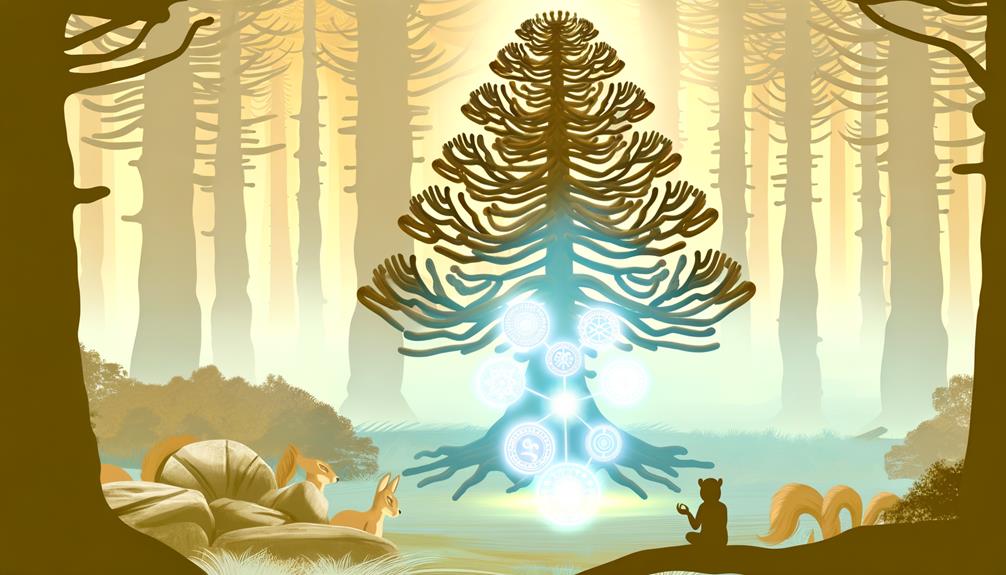
Recognizing the spiritual significance of the Monkey Puzzle Tree in various cultures offers valuable insights into the lessons it imparts, particularly in resilience, adaptability, and interconnectedness.
This ancient tree, known for its unique, spiky foliage and longevity, symbolizes the strength to endure harsh conditions. Its adaptability to various environments showcases nature’s ability to thrive amid change.
Additionally, the tree’s intricate branches reflect a complex web of relationships, highlighting the importance of interconnectedness in ecosystems and human societies.
| Lesson | Meaning |
|---|---|
| Resilience | Enduring harsh conditions |
| Adaptability | Thriving amid change |
| Interconnectedness | Importance of complex relationships |
These lessons, derived from the Monkey Puzzle Tree, encourage a deeper understanding of nature’s wisdom and its application to human life.
Modern Interpretations
In modern times, many view the Monkey Puzzle Tree as a symbol of resilience and adaptability, reflecting contemporary values of sustainability and environmental stewardship.
This ancient tree, known scientifically as Araucaria araucana, thrives in harsh environments, demonstrating a remarkable ability to survive climate extremes. People admire its unique, spiky appearance, which serves as a metaphor for standing strong against adversity.
Modern interpretations also highlight the tree’s role in biodiversity; it provides habitat for numerous species, emphasizing interconnectedness within ecosystems.
Conclusion
Much like the intricate labyrinths of ancient myths, the monkey puzzle tree’s spiritual significance winds through history, culture, and legend.
Its symbolism continues to weave through spiritual practices, echoing lessons of resilience and adaptability.
Modern interpretations, grounded in detailed analysis, reveal a living demonstration of nature’s profound wisdom.
By understanding this tree, one might feel a connection to the age-old stories and spiritual insights that have shaped humanity’s journey through the ages.