
Spiritual Meaning of Pomegranate Tree: Fertility and Abundance
The pomegranate tree’s spiritual meaning spans numerous cultures, symbolizing fertility with its abundant seeds and prosperity with its fruit’s richness. Ancient myths, such as those from Egypt and Greece, link it to life cycles and rebirth, while religious texts see it as a beacon of eternal life and divine blessings.
Persian traditions celebrate its beauty and divine essence, reflecting its deep-rooted symbolism in human existence. The tree’s connections to community and interconnectedness further emphasize its spiritual importance.
There’s much more to uncover about how this remarkable tree intertwines with various cultural and spiritual narratives.

Spiritual Meaning of Pomegranate Tree: Symbol of Fertility, Abundance, and Sacred Wisdom
| Symbolism | Spiritual Insight | Interpretation |
|---|---|---|
| Fertility & Creation | Filled with many seeds, linked to birth and life | Represents new beginnings, creativity, and the power of creation |
| Abundance & Prosperity | Symbol of wealth and blessings in many traditions | A sign that spiritual or material abundance is flowing toward you |
| Sacred Feminine | Connected to goddesses and feminine energy | Embodies nurturing, intuition, and divine feminine power |
| Wisdom & Mystery | Hidden seeds within complex structure | Encourages inner exploration and unlocking spiritual truths |
| Eternal Life & Rebirth | Featured in myths of resurrection and cycles | Reflects transformation, spiritual awakening, and immortality of the soul |
Historical Significance
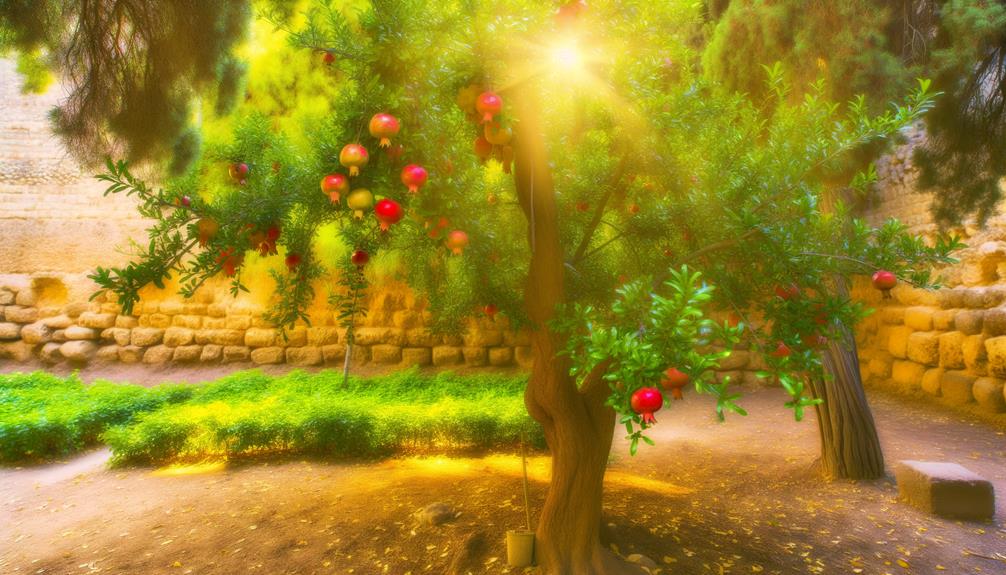
Throughout history, the pomegranate tree has held profound symbolic and cultural significance across various civilizations.
Ancient Egyptians considered it a symbol of prosperity and ambition, frequently including it in their tomb paintings and mythology. In Greek mythology, it’s tied to the story of Persephone, symbolizing the cycle of life and death.
The fruit’s abundant seeds have also made it a symbol of unity and eternal life in various religious texts.
In Persian culture, the pomegranate appears in poetry and art, representing beauty and the divine.
Symbol of Fertility
The pomegranate tree, with its multitude of seeds, has long been revered as a potent symbol of fertility and abundance in various cultures. This association stems from the tree’s capacity to produce numerous seeds within a single fruit, symbolizing prolificacy and the potential for new life.
In ancient Greek mythology, the pomegranate was linked to the goddess Persephone and her cyclical return to the Earth, representing seasonal renewal and growth. Similarly, in Hindu traditions, the pomegranate is considered auspicious for marriage and childbirth, embodying the promise of progeny.
Representation of Prosperity

Celebrating the pomegranate tree as a symbol of prosperity, many cultures have embraced its lush fruits as harbingers of wealth and success. The tree’s abundant seeds represent not just literal bounty but also the potential for growth and multiplication.
Historically, civilizations from ancient Egypt to Greece revered the pomegranate for its promise of financial and material abundance. This reverence manifests in rituals and art, where the fruit often appears as a motif for prosperity.
The pomegranate’s ability to thrive in various climates further underscores its role as a symbol of resilience and enduring wealth. By recognizing the pomegranate tree’s spiritual and material significance, one gains a deeper understanding of its place in cultural narratives of affluence.
Connection to Eternal Life
Intertwining with themes of mortality and rebirth, the pomegranate tree often symbolizes eternal life in various spiritual traditions.
Its seeds, numerous and encased in a resilient outer skin, are seen as metaphors for the soul’s journey through life, death, and beyond.
The fruit’s ability to regenerate through its seeds exemplifies the belief in life’s continuity and the soul’s immortality.
In religious texts, pomegranates are frequently mentioned in contexts that highlight divine promise and perpetual existence.
Spiritual seekers view the tree as embodying the cycle of life, death, and rebirth, underscoring the idea that life transcends physical existence.
This symbolism invites deep reflection on the interconnectedness of all life forms and the enduring nature of the human spirit.
Cultural Myths and Legends

Throughout history, the pomegranate tree has been a potent symbol in various cultural myths and legends.
It often represents ancient symbolism, appearing in mythological stories as a symbol of fertility, prosperity, and rebirth.
Reflecting its deep cultural significance, the pomegranate’s presence in folklore offers a rich tapestry of meaning that transcends time and geography.
Ancient Symbolism
In many ancient cultures, the pomegranate tree holds profound symbolic significance, often representing fertility, abundance, and the cycle of life and death. This symbolism arises from the tree’s vibrant red seeds, which seem to encapsulate the essence of energy and renewal.
In ancient Greece, pomegranates were sacred to Hera, the goddess of marriage and childbirth, underscoring their link to fertility. Meanwhile, in Persian culture, the pomegranate symbolized fertility and immortality, reflecting the fruit’s enduring presence in life’s cyclical nature.
The tree’s ability to bear numerous seeds also made it an emblem of prosperity and abundance. Such rich symbolism has imbued the pomegranate with a deep, spiritual resonance that transcends mere physical nourishment, reflecting humanity’s quest for meaning and continuity.
Mythological Stories
Ancient mythological stories often elevate the pomegranate tree to a sacred status, weaving it into narratives that explore themes of love, rebirth, and the divine.
In Greek mythology, Persephone’s consumption of pomegranate seeds binds her to the underworld, symbolizing the cycle of life and death. Similarly, in Persian lore, the pomegranate appears as a divine fruit, linked with the deity Mithra and representing eternal life.
Biblical tales also reference pomegranates, associating them with fertility and abundance.
These rich mythological contexts reflect humanity’s deep-seated reverence for the pomegranate, recognizing it as a potent symbol of life’s cyclical nature and transcendent qualities. Its mythological presence underscores its spiritual significance across various ancient cultures.
Cultural Significance
Beyond mythological stories, the pomegranate tree’s cultural significance extends into various legends and customs, highlighting its role in symbolizing prosperity, unity, and the sacred across different societies.
In ancient Persia, the pomegranate was a symbol of fertility and invincibility, often associated with the goddess Anahita.
Meanwhile, in Jewish tradition, the fruit’s 613 seeds are said to correspond to the 613 commandments of the Torah, underscoring themes of righteousness and moral completeness.
In Chinese culture, pomegranates are commonly featured in weddings as symbols of abundant offspring and good fortune.
Each cultural narrative, though distinct, reflects a shared reverence for the pomegranate’s life-giving properties, suggesting a universal recognition of its profound spiritual and cultural resonance.
Religious Symbolism
Religious symbolism of the pomegranate tree is rich and multifaceted, often appearing in biblical references and sacred rituals.
It frequently symbolizes fertility, abundance, and divine favor, weaving its way through various religious texts and ceremonies.
Biblical References
The pomegranate tree frequently appears in biblical writings, symbolizing prosperity, righteousness, and divine favor. In the Old scripture, the tree is often depicted in descriptions of the Promised Land, highlighting its abundance and fertility.
For example, in Deuteronomy 8:8, the land is described as one of wheat, barley, vines, and pomegranates. Additionally, the intricate designs of pomegranates were used in the temple’s construction, as seen in 1 Kings 7:18-20, where they adorned the pillars.
These references underscore the tree’s association with God’s blessings and the flourishing of His people. The pomegranate’s many seeds further symbolize fruitfulness and the potential for growth, reflecting deeply held spiritual values within the biblical narrative.
Sacred Rituals
Pomegranates have long held a revered place in sacred rituals, often symbolizing life, fertility, and the eternal cycle of rebirth. Their presence in religious ceremonies underscores their profound spiritual significance.
For instance:
- Judaism: Pomegranates adorn the robes of the High Priest and symbolize the 613 commandments of the Torah.
- Christianity: The fruit often appears in religious art, representing resurrection and eternal life.
- Islam: Pomegranates are mentioned in the Quran as fruits of Paradise, signifying divine bounty.
Lessons of Interconnectedness
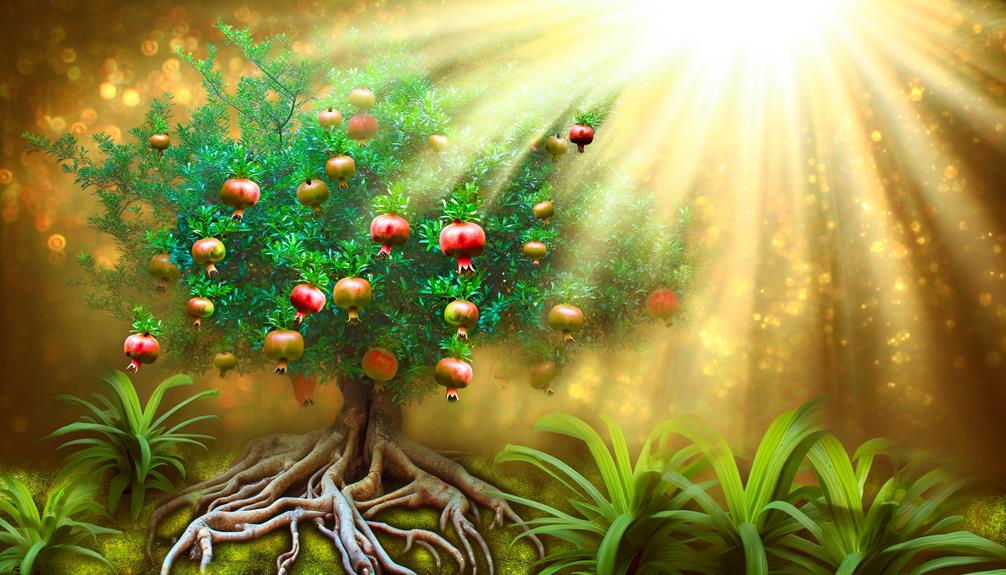
In the intricate web of life, the pomegranate tree serves as a profound symbol of interconnectedness, reminding us that every element in nature is intertwined.
Its roots explore deeply into the soil, drawing nutrients that support not only its own growth but also the ecosystem around it.
The tree’s vibrant fruit, filled with numerous seeds, symbolizes the multitude of connections that bind us all. Each seed represents a potential new beginning, emphasizing that individual actions can have far-reaching effects.
By observing the pomegranate tree, one can reflect on the importance of nurturing relationships and communities.
This interconnectedness is a lesson in how mutual support and shared existence are essential for the flourishing of both nature and human society.
Conclusion
In sum, the pomegranate tree weaves a rich tapestry of spiritual meanings, from fertility and prosperity to eternal life and interconnectedness.
Its presence in cultural myths and religious symbolism underscores a timeless wisdom: ‘As above, so below.’
By reflecting on these layers of significance, one gains a deeper understanding of how ancient beliefs continue to resonate, reminding us that the spiritual and material worlds are profoundly intertwined.