
Spiritual Meaning of Bed in the Bible: Rest and Revelation
In biblical scripture, the bed symbolizes a profound spiritual landscape, embodying divine encounters, revelations, rest, and morality. Instances such as Jacob’s ladder dream (Genesis 28:12) and Samuel’s prophetic call (1 Samuel 3:3-10) highlight the bed as a conduit for divine communication.
Furthermore, it signifies spiritual renewal and rest, as seen in Psalm 23:2 and Jesus’ invitation to rest (Matthew 11:28-30). The bed also reflects moral integrity, particularly within the sanctity of marriage (Hebrews 13:4).
Through its multifaceted symbolism, the bed in the Bible provides deep insights into spiritual vulnerability and divine interaction, offering more dimensions upon further exploration.
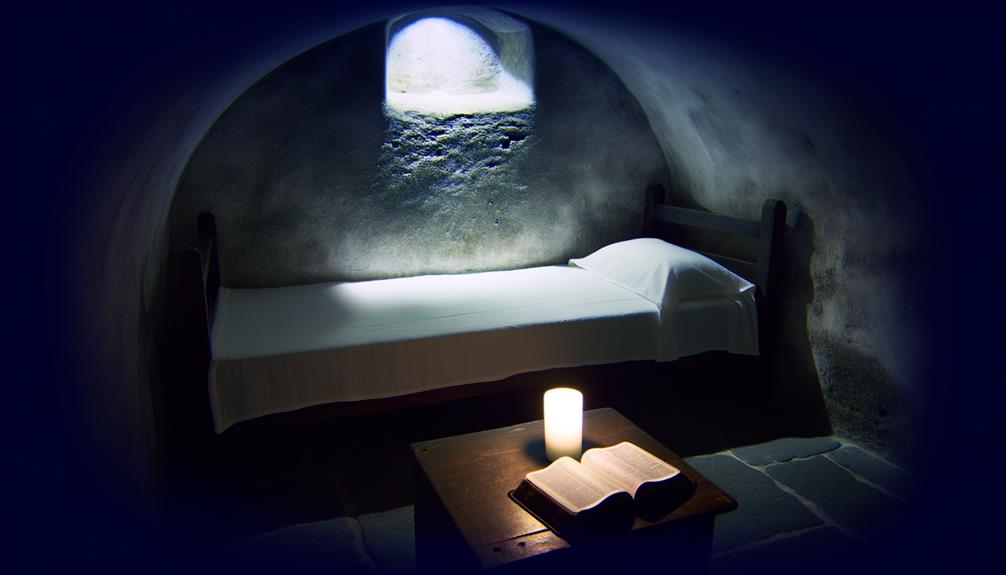
Spiritual Meaning of Bed in the Bible: Rest, Healing, and Divine Presence
| Aspect | Details | Spiritual Significance |
|---|---|---|
| Symbol of Rest | Psalm 4:8 | Represents peace and safety under God’s protection |
| Place of Healing | Mark 2:4–12 | Where the sick are healed through faith |
| Spiritual Reflection | Job 33:15 | Bed as a place where God speaks through dreams |
| Vulnerability | 2 Kings 20:1–5 | Symbolizes human weakness and need for God’s mercy |
| Transition | Acts 9:33–34 | Represents transformation and new spiritual beginnings |
Divine Encounters and Revelations

Throughout the Bible, beds often serve as significant settings for divine encounters and revelations, illustrating moments where God communicates profound truths to His people.
For instance, in Genesis 28:12, Jacob’s dream at Bethel occurs as he lies on a bed of stones, marking a pivotal divine promise of land and descendants. Similarly, in 1 Samuel 3:3-10, young Samuel hears God’s call while lying in bed, signifying his prophetic future.
These instances underscore the bed as a symbol of vulnerability and receptivity, where human beings are most open to divine instruction.
The biblical narrative consequently uses the bed to highlight the intimate and personal nature of God’s revelations, emphasizing His desire to guide and instruct His followers.
Dreams and Prophetic Visions
The Bible frequently associates beds with dreams and prophetic visions, serving as conduits for divine messages and spiritual insights.
In Genesis 28:12, Jacob’s dream of a ladder reaching heaven, experienced while resting, symbolizes divine revelation and covenant. Similarly, Daniel 7:1 recounts visions received upon his bed, revealing profound eschatological truths.
Beds, in these contexts, transcend mere physical rest, becoming sacred spaces where God communicates His will. Solomon’s wisdom in 1 Kings 3:5 was also imparted through a dream while he slept.
Such instances illustrate that nocturnal visions and dreams are not mere mental phenomena but are imbued with divine purpose, guiding, warning, and prophesying events, thereby affirming the bed’s pivotal role in spiritual discourse.
Rest and Spiritual Renewal

The concept of rest in the Bible frequently symbolizes a divine state of peace and comfort, as seen in Psalm 23:2 where God ‘makes me lie down in green pastures.’
This metaphor extends to the bed as a place of spiritual rejuvenation, reflecting practices that foster a deeper connection with the divine.
Analyzing these themes reveals how rest is not merely physical but also an essential component of spiritual renewal.
Biblical Rest Symbolism
In biblical literature, rest is often depicted as a divine gift that facilitates spiritual renewal and deeper communion with God. This concept is vividly illustrated in Genesis 2:2-3, where God Himself rests on the seventh day, sanctifying it as holy.
The Sabbath rest, as ordained in Exodus 20:8-11, underscores a rhythm of work and rest essential for spiritual well-being. Psalms 23:2-3 further elucidates this by portraying God as a shepherd who leads His flock beside still waters, restoring their souls.
The imagery of rest extends into the New Covenant, where Jesus invites the weary to find rest in Him (Matthew 11:28-30). Consequently, rest in the Bible is intrinsically linked to spiritual rejuvenation and divine fellowship.
Divine Peace and Comfort
Divine peace and comfort are profoundly illustrated in the Bible as essential components of rest and spiritual renewal, offering believers a sanctuary for their souls amidst life’s tribulations.
Psalm 4:8 states, ‘In peace I will lie down and sleep, for you alone, Lord, make me dwell in safety,’ emphasizing the divine assurance of rest. The bed, thus, becomes more than a physical space; it symbolizes God’s provision of tranquility and security.
Additionally, Matthew 11:28-30 invites the weary to find rest in Christ, underscoring the spiritual rejuvenation inherent in divine peace.
These scriptural references collectively affirm that true rest is intertwined with spiritual renewal, facilitating a profound connection with the divine that transcends mere physical repose.
Spiritual Rejuvenation Practices
Recognizing the profound connection between divine peace and rest, it becomes crucial to explore various practices that facilitate spiritual rejuvenation and renewal.
Biblical scriptures often emphasize rest as a divine mandate, exemplified by the Sabbath (Exodus 20:8-11). This period of rest provides an essential opportunity for spiritual reflection and communion with God.
Prayer, meditation on scriptures, and quiet contemplation are fundamental practices that aid in aligning one’s spirit with divine purpose.
Additionally, Jesus’ invitation in Matthew 11:28-30 underscores the importance of coming to Him for rest, offering a model for spiritual renewal.
Such rejuvenation practices not only restore physical energy but also deepen one’s spiritual awareness, fostering a harmonious relationship with the divine.
Moral Integrity and Purity
In biblical literature, the bed often functions as a metaphor for moral integrity and purity, where one’s commitment to virtue is examined (Hebrews 13:4).
This symbolism is evident in rest, reflecting a state of spiritual cleanliness and ethical living.
Additionally, personal sanctification practices associated with the bed underscore the importance of maintaining purity in one’s private and public life.
Commitment to Virtue
The symbolism of the bed in biblical texts often underscores the necessity for unwavering commitment to moral integrity and purity, reflecting the broader divine mandates for virtuous living.
Scriptural references, such as Hebrews 13:4, emphasize that the marriage bed should remain undefiled, hence advocating for sexual purity and fidelity.
Moreover, passages like Proverbs 6:23-24 warn against the seductions that can lead one astray from righteousness.
The bed, consequently, serves as a metaphorical space where one’s commitment to virtue is tested and demonstrated.
This symbolism reinforces the biblical call to uphold ethical standards, illustrating how personal sanctity in private domains aligns with the larger, spiritual pursuit of holiness and moral uprightness before God.
Symbolism in Rest
While the bed symbolizes a space for demonstrating moral integrity and purity through commitment to virtue, it also represents a place of rest where these values are reflected in the tranquility granted by a clear conscience and alignment with divine principles.
In biblical scripture, rest is often depicted as a divine gift, an oasis from life’s tribulations. Psalm 4:8 states, ‘In peace I will lie down and sleep, for you alone, Lord, make me dwell in safety.’
This verse underscores the intertwining of physical rest and spiritual purity. The bed, hence, becomes a sanctified space where one’s moral integrity manifests in peaceful repose, symbolizing the soul’s alignment with God’s will and the resultant inner peace.
Personal Sanctification Practices
To achieve personal sanctification, individuals are called to cultivate moral integrity and purity through adherence to scriptural teachings and a steadfast commitment to living in accordance with divine commandments.
The Bible emphasizes the importance of maintaining a pure heart and mind, as reflected in Psalm 24:3-4, which states, ‘Who may ascend the mountain of the Lord? Who may stand in his holy place? The one who has clean hands and a pure heart.’
Personal sanctification involves rejecting sinful behaviors and embracing virtues such as honesty, humility, and love.
Ephesians 4:22-24 implores believers to ‘put off your old self… and to put on the new self, created to be like God in true righteousness and holiness.’
Illness and Human Weakness

In biblical narratives, the bed often symbolizes the frailty of human health and the reality of physical suffering. For instance, Psalm 41:3 states, ‘The Lord sustains him on his sickbed; in his illness you restore him to full health.’ Here, the bed becomes a tangible representation of vulnerability and divine intervention.
Similarly, in John 5:8, Jesus commands a paralytic to ‘rise, take up your bed, and walk,’ signifying both the acknowledgment of human weakness and the transformative power of faith.
The bed, consequently, is not merely a place of rest but a poignant emblem of human dependency on God’s healing grace. This underscores the biblical theme of God’s compassion amidst human fragility and illness.
Symbol of Intimacy
Beyond its association with human frailty and divine healing, the bed in biblical texts also emerges as a profound symbol of intimacy, particularly within the sanctity of marital relationships.
This symbolism is deeply rooted in scripture, where the bed serves not only as a physical space but also as a metaphor for the covenantal bond between husband and wife.
- Genesis 2:24 underscores the unity achieved through marital intimacy, stating that ‘a man shall leave his father and mother and be joined to his wife.’
- Song of Solomon poetically celebrates the bed as a place of mutual affection and exclusive love.
- Hebrews 13:4 emphasizes that the marriage bed should be honored and kept pure.
- Proverbs 5:18-19 extols the joy and satisfaction found in marital fidelity.
Sites of Reflection and Prayer

The bed in biblical literature often functions as a profound locus for reflection and prayer, serving as a private sanctuary where individuals engage deeply with their faith and spirituality.
Within the Psalms, David frequently refers to his bed as a place of introspection and communion with God: ‘I remember You upon my bed, and meditate on You in the watches of the night’ (Psalm 63:6, ESV).
This scriptural imagery encapsulates the bed as a metaphorical altar, where one’s innermost thoughts and prayers ascend to the divine.
Furthermore, such intimate settings allow for a heightened sense of divine presence and personal revelation, underscoring the bed’s significance as a spiritual site for contemplation and earnest supplication.
Covenant and Faithfulness
In biblical texts, the bed often symbolizes the covenant between God and His people, reflecting themes of fidelity and divine promise.
This sacred space becomes a tangible representation of God’s unwavering commitment, as seen in passages where the bed serves as a locus for divine revelation and covenantal renewal.
Analyzing these scriptural instances elucidates the profound connection between physical spaces and spiritual truths in the context of faithfulness.
Symbolism of Covenant
Within biblical literature, the bed often serves as a profound symbol of the covenant relationship between God and His people, embodying themes of faithfulness, intimacy, and divine promise. This symbolism is deeply rooted in several scriptural narratives and theological concepts.
The bed represents:
- Intimacy with God: Reflecting the personal and close relationship expected in the covenant.
- Rest and Peace: Signifying the spiritual rest and peace found in a faithful relationship with God.
- Commitment: Illustrating the steadfast commitment between God and His people.
Analyzing these elements reveals how the bed serves not merely as a physical object but as a metaphor for the sacred bond and enduring faithfulness between the divine and humanity.
Bed as Sacred Space
A bed, in its representation as a sacred space, encapsulates the profound spiritual dimensions of covenant and faithfulness central to biblical theology.
The bed, often depicted in scriptural narratives, serves as a locus for divine-human interaction and covenantal intimacy.
For example, the conjugal bed symbolizes the sanctity of marital union, reflecting the covenantal relationship between God and His people (Ephesians 5:31-32).
Additionally, the faithfulness exhibited within this sacred space mirrors the unwavering fidelity God expects from His followers. In Psalm 63:6, the psalmist meditates on God during the night, suggesting the bed as a place of spiritual introspection and covenantal remembrance.
Consequently, the bed transcends its physical function, embodying a spiritual sanctum of covenant and faithfulness.
Judgment and Consequences

Often symbolizing divine retribution, the bed in biblical narratives serves as a potent metaphor for the judgment and consequences that befall individuals.
In various scriptures, the bed becomes a place where one reaps the results of their actions, highlighting the inexorable link between deed and consequence.
This symbolism is especially evident in passages where sin or disobedience leads to suffering or divine punishment.
- Psalm 41:3: The bed as a place of divine judgment, connoting affliction due to sin.
- Proverbs 7:17-27: The adulterous bed as a symbol of moral and spiritual downfall.
- Revelation 2:22: Jezebel’s bed as a place of tribulation for her and her followers.
Symbol of Comfort and Peace
In biblical literature, the bed frequently emerges as a symbol of comfort and peace, representing divine provision and rest for the faithful.
Scriptural references such as Psalm 4:8, ‘In peace I will lie down and sleep, for you alone, Lord, make me dwell in safety,’ illustrate this notion. Here, the bed serves as a metaphor for God’s protective care and tranquil assurance.
Additionally, the Song of Solomon 3:7 speaks of Solomon’s bed surrounded by mighty warriors, underscoring the security and peace bestowed upon the beloved. Such imagery is emblematic of a spiritual sanctuary where divine refuge is assured.
Consequently, in the biblical context, the bed transcends its physical function to embody a profound spiritual promise of divine peace and comfort.
Conclusion
In summation, the biblical bed serves as a multifaceted symbol encompassing divine encounters, dreams, spiritual renewal, moral integrity, human frailty, and sites of profound reflection.
This symbol also embodies concepts of covenant faithfulness, judgment, and ultimate peace.
Much like Jacob’s ladder, it connects the earthly to the divine, offering a space where the sacred and the mundane intertwine, guiding believers toward a deeper understanding of their spiritual journey and moral responsibilities.