
Spiritual Meaning of Nicholas in the Bible
The name Nicholas, derived from the Greek ‘Nikolaos’ meaning ‘victory of the people,’ embodies themes of communal triumph and spiritual resilience. In the Bible, Nicholas of Antioch represents moral fortitude and unity, serving as a deacon in Acts.
His legacy is further cemented by St. Nicholas of Myra, renowned for his charity and miraculous deeds, reflecting the virtues of Christian benevolence and divine favor.
These connotations of overcoming adversity and fostering collective strength through faith offer profound insights into the spiritual dimensions of the name and its lasting impact on Christian traditions and values. To uncover more, one can explore its historical and cultural resonances.

Spiritual Meaning of Nicholas in the Bible: Victory of the People and Faithful Leadership
| Aspect | Spiritual Meaning |
|---|---|
| Name Origin | From Greek Nikolaos, meaning “victory of the people” |
| Biblical Reference | Mentioned in Acts 6:5 as Nicholas of Antioch, one of the seven chosen |
| Leadership and Service | Reflects a calling to serve others with humility and faithfulness |
| Spiritual Victory | Symbolizes triumph in faith, endurance, and divine purpose |
| Community and Unity | Encourages strengthening and uniting the people of God |
Origins of the Name Nicholas

The name Nicholas, derived from the Greek name Nikolaos, finds its origins in ancient Greek civilization, where it was composed of the elements ‘nikē,’ meaning ‘victory,’ and ‘laos,’ meaning ‘people.’ This etymological construction suggests a designation of triumph and communal strength.
In historical context, the name Nicholas was borne by several prominent figures, including saints and military leaders, further embedding its association with leadership and success.
The adoption of this name in various cultures underscores its enduring appeal and significance. Its transmission into early Christian contexts likely facilitated its integration into biblical narratives, where names often carried profound symbolic weight.
Consequently, understanding the origins of Nicholas provides foundational insight into its spiritual and cultural resonance.
Meaning of Nikolaos
The name ‘Nikolaos,’ rooted in Greek etymology, translates to ‘victory of the people,’ encapsulating notions of triumph and communal strength.
Its usage in scripture often connotes divine favor and moral fortitude, reflecting the character traits esteemed in biblical narratives.
Historically, ‘Nikolaos’ has been a prevalent name, signifying its enduring resonance and spiritual significance across various cultures and epochs.
Greek Name Origins
Rooted in ancient Greek, the name Nikolaos (Νικόλαος) combines the elements ‘nikē’ meaning victory, and ‘laos’ meaning people, thereby conveying the notion of ‘victory of the people.’
This etymology underscores a collective triumph, reflecting a social unity achieved through overcoming obstacles.
The name’s resonance with communal success speaks to the values held by ancient Greek society, where individual achievements were often celebrated within the context of their contribution to the greater good.
In addition, this name’s linguistic components highlight the importance of collective identity and shared successes.
Understanding the Greek origins of Nikolaos provides valuable insight into the cultural and philosophical underpinnings that shaped its significance, making it a name imbued with historical and social depth.
Connotations in Scripture
In biblical texts, the name Nicholas carries significant connotations that reflect its Greek origins, symbolizing triumph and communal strength within Christian teachings.
Derived from the Greek name Nikolaos, meaning ‘victory of the people,’ Nicholas encapsulates themes of overcoming adversity and fostering unity. This is particularly resonant in the Book of Acts, where Nicholas of Antioch is mentioned as one of the seven deacons chosen to serve the early Christian community (Acts 6:5).
His selection underscores the emphasis on spiritual victory through service and communal harmony. Consequently, the name Nicholas is imbued with a sense of purpose and collective triumph, aligning with broader scriptural narratives of faith, resilience, and the power of unity in the Christian ethos.
Historical Name Usage
Etymologically, the name Nikolaos, stemming from the Greek words ‘nikē’ (victory) and ‘laos’ (people), inherently conveys a powerful message of collective triumph and societal strength.
Historically, the name has been borne by numerous notable figures, most prominently Saint Nicholas of Myra, a 4th-century bishop whose generosity inspired the modern Santa Claus. In early Christian communities, the name symbolized both divine favor and communal success, reflecting the virtues of leadership and benevolence.
Its continued usage throughout centuries underscores its enduring appeal, resonating with themes of victory and the welfare of the people.
Consequently, Nikolaos remains a significant name within both ecclesiastical history and broader cultural contexts, embodying a legacy of altruism and communal prosperity.
Nicholas in Early Christianity

The figure of Nicholas in early Christianity embodies the synthesis of historical tradition and theological significance, manifesting as both a venerated saint and a symbol of divine virtue. His emergence during this formative period was essential for the development of Christian communal identity.
Nicholas was often invoked as an exemplar of charity, humility, and piety, qualities that resonated deeply with early Christian values. His legacy served as a moral compass, guiding believers in their spiritual and communal lives.
In addition, Nicholas’s role in early doctrinal debates reflected the dynamic interplay between emerging Christian orthodoxy and heterodox beliefs. Consequently, Nicholas contributed not only to the spiritual formation of individuals but also to the broader theological foundations of early Christianity.
St. Nicholas of Myra
St. Nicholas of Myra stands as a seminal figure whose life and reputed miracles have left an indelible mark on Christian hagiography.
His role as the patron of children underscores his enduring legacy and influence, which extends beyond religious boundaries into cultural and societal domains.
This analysis aims to explore the multifaceted aspects of his life, his miraculous acts, and the enduring impact of his patronage.
Life and Miracles
Renowned for his unwavering faith and compassion, Nicholas of Myra’s life is punctuated by numerous miracles that have solidified his legacy within Christian tradition. His miracles often manifested as acts of mercy and justice, reflecting his deep theological insights and moral convictions.
Among the most notable is the resurrection of three children who had been murdered, a profound indication of his sanctity and divine favor. Additionally, he is credited with providing dowries for impoverished maidens, thereby preventing their descent into slavery or prostitution.
These acts are not mere folklore but are rooted in historical accounts and ecclesiastical writings, underscoring his pivotal role in early Christianity. Nicholas’s miracles function as didactic tools, embodying the principles of charity, faith, and divine intercession.
Patron of Children
Embracing the role of protector and benefactor, Nicholas of Myra’s legacy as the patron of children is deeply embedded in both religious tradition and cultural practices.
His benevolence is exemplified through numerous acts of kindness, where he provided for the needs of the young and vulnerable. These charitable acts have been integral in shaping his revered status.
Key aspects of his patronage include:
- Protection: Known for saving children from dire situations and ensuring their safety.
- Generosity: Secretly providing dowries for impoverished girls, preventing their exploitation.
- Miracles: Accounts of reviving children and other miraculous interventions.
These elements collectively underscore Nicholas’s enduring role as a guardian and advocate for children.
Legacy and Influence
Nicholas of Myra’s legacy and influence extend far beyond his lifetime, encompassing profound religious, cultural, and historical dimensions.
Canonized as a saint, he became a symbol of Christian charity and generosity. His deeds, particularly his secret gift-giving, inspired traditions that evolved into the modern figure of Santa Claus.
Historically, his veneration spread across Europe, influencing religious practices and local customs.
Culturally, he is celebrated in various forms, from art and literature to festivals. His role as a protector of children, sailors, and the oppressed underlines his widespread appeal.
The enduring impact of Nicholas of Myra reflects a synthesis of faith and folklore, illustrating how a historical figure can transcend time to embody universal virtues.
Historical Significance

The historical significance of the name Nicholas in biblical contexts can be traced back to its Greek origins, where it was derived from ‘Nikolaos,’ meaning ‘victory of the people.’
This name holds substantial historical weight, as evidenced by its presence and influence across various epochs and cultures. Nicholas has been a name of choice for notable figures, contributing to its enduring legacy.
- Greek Origins: Derived from ‘Nike’ (victory) and ‘Laos’ (people), reflecting a triumphant connotation.
- Early Christianity: Associated with early Christian martyrs and saints.
- Historical Figures: Carried by emperors, scholars, and philosophers.
Such associations underline Nicholas’s profound historical resonance.
Nicholas and Christian Traditions
Within Christian traditions, the name Nicholas is entwined with a rich tapestry of religious and cultural narratives that highlight its spiritual significance and enduring influence.
St. Nicholas of Myra, revered as a foundational figure, exemplifies Christian virtues of charity, humility, and piety. Celebrated on December 6th, his feast day underscores his role as a protector of children and sailors, and his legendary acts of generosity have inspired the modern-day figure of Santa Claus.
Beyond this, the name Nicholas is associated with theological steadfastness, as reflected by St. Nicholas’ participation in the First Council of Nicaea, where he defended orthodox Christian doctrines.
Consequently, Nicholas remains a potent symbol of faith and moral integrity within the Christian tradition.
Symbolism of Victory
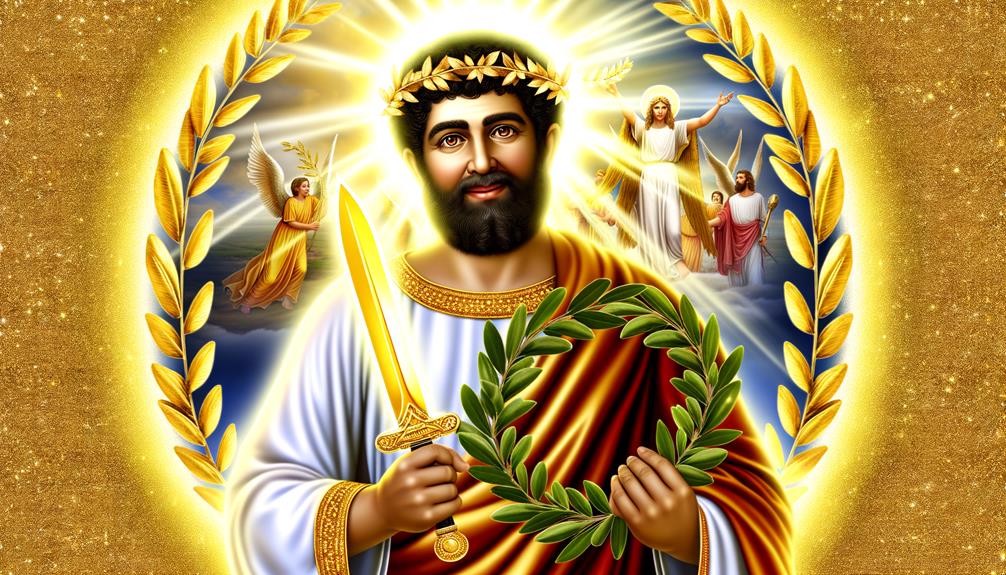
How does the name Nicholas encapsulate the symbolism of victory in both spiritual and historical contexts?
The name Nicholas is derived from the Greek name ‘Nikolaos,’ which translates to ‘victory of the people.’ This etymology sets a foundational tone for its symbolic resonance:
- Spiritual Triumph: Reflects overcoming spiritual challenges and achieving divine favor.
- Historical Conquests: Tied to historical figures who were victorious in battles, emphasizing leadership and strength.
- Moral Victory: Represents the triumph of good over evil, a core biblical theme.
Communal Success: Embodies collective achievement and the upliftment of communities through faith.
The multifaceted dimensions of victory associated with Nicholas underscore its enduring significance across various domains, both sacred and secular.
Nicholas’s Influence on Faith
Through examining the legacy and stories associated with Saint Nicholas, one can discern a profound impact on the development and expression of Christian faith.
Renowned for his benevolence, Nicholas’s actions exemplified Christian virtues, such as charity and humility, which have been integral in shaping theological understandings and practices.
His legendary acts of giving, particularly to the impoverished, echo the Biblical imperative to love one’s neighbor, thereby reinforcing communal bonds within the faith.
In addition, his veneration as a saint underscores the significance of righteous living and intercession, imbuing believers with a model of sanctity.
Hence, Nicholas’s influence extends beyond mere historical figure; he embodies the living principles of Christianity, catalyzing spiritual growth and devotion across generations.
Conclusion
The name Nicholas, derived from the Greek Nikolaos, holds significant historical and spiritual weight in Christian traditions.
St. Nicholas of Myra, a key figure in early Christianity, exemplified virtues that deeply influenced Christian faith. Symbolizing victory and protection, Nicholas’s legacy endures through various traditions.
Significantly, St. Nicholas’s impact is reflected in the widespread celebration of his feast day, with over 500 million people globally observing it annually. This underscores his enduring influence on Christian culture and spirituality.