Palm Tree Symbolism Spiritual Meaning: Resilience
Palm trees embody profound spiritual symbolism, representing victory, peace, and eternal life across diverse cultures. They evoke resilience by thriving in harsh conditions, reminding individuals of their inner strength and potential for new beginnings.
Ancient Egyptians saw palms as symbols of immortality, while Greeks and Romans associated them with triumph and honor. In Christianity, palm branches signify spiritual victory and lasting serenity.
Modern interpretations link palms to relaxation and paradise, blending past reverence with present aspirations. Their graceful form and enduring nature encourage a deeper reflection on life’s journey and spiritual growth.
Discover the timeless wisdom these iconic trees offer.

Palm Tree Symbolism Spiritual Meaning: Strength, Victory, and Spiritual Resilience
| Aspect | Spiritual Meaning |
|---|---|
| Strength and Resilience | Represents the ability to bend without breaking in life’s storms |
| Victory and Triumph | Ancient symbol of overcoming obstacles and achieving success |
| Peace and Rest | Associated with spiritual peace, calm, and divine shelter |
| Eternal Life | In some traditions, symbolizes immortality and the soul’s journey |
| Fertility and Growth | Reflects abundance, spiritual growth, and life energy |
Historical Significance

Tracing back through the annals of human history, palm trees have consistently symbolized victory, peace, and eternal life across various cultures.
Ancient Egyptians revered the palm as a representation of immortality, often featuring it in their art and architecture.
In Mesopotamia, palm trees depicted abundance and fertility, mirroring their life-giving presence in arid landscapes.
The Greeks and Romans saw the palm as a token of triumph and honor, often awarding palm branches to victors of games and battles.
As Christianity spread, the palm became a sign of spiritual victory and eternal peace.
Symbol of Victory
Why have palm trees, with their graceful fronds, consistently been chosen as enduring symbols of victory across various cultures?
The answer lies in their resilience and ability to thrive in harsh environments.
In ancient Rome, victorious gladiators were awarded palm branches as tokens of their triumph. Similarly, in early Christian art, martyrs were often depicted holding palm fronds as emblems of spiritual victory over death.
The palm’s towering presence and unwavering strength inspire individuals to rise above challenges. Its leaves, reaching skyward, symbolize aspiration and the fulfillment of great endeavors.
Across time and space, the palm tree stands as a powerful reminder that victory isn’t merely about conquest but also about enduring through life’s adversities with grace.
Representation of Peace

Beyond its association with victory, the palm tree also embodies a profound sense of peace, offering a tranquil presence that has been revered across numerous cultures.
Its tall, graceful stature and gently swaying fronds evoke a sense of calm and serenity. In many traditions, it symbolizes a haven from the tumult of daily life, providing a soothing respite.
Consider these aspects of the palm tree’s peaceful representation:
- Meditative Symbol: Many find the gentle motion of palm leaves in the wind to be meditative, promoting inner peace.
- Sacred Spaces: Palms often adorn sacred sites, enhancing the feeling of tranquility and spiritual connection.
- Resilient Tranquility: Despite harsh environments, palms thrive, symbolizing enduring peace amidst adversity.
Reflect on how the palm tree’s serene presence can inspire a peaceful mind and heart.
Eternal Life
The palm tree’s evergreen nature has long symbolized eternal life, reminding us of nature’s unending cycle and the enduring spirit.
Its constant green leaves throughout the seasons serve as a powerful emblem of life that transcends time. This symbolism is deeply rooted in various cultures and religions, where the palm is seen as a bridge between the earthly and the divine.
Consider the following aspects of the palm tree’s eternal symbolism:
| Aspect | Description | Significance |
|---|---|---|
| Evergreen Leaves | Constantly green throughout seasons | Representation of life’s continuity |
| Cultural Symbol | Found in religious texts and art | Connection between earth and divine |
| Life Cycle | Year-round significance | Nature’s unending cycle |
The palm tree inspires reflections on life’s unceasing flow and the spirit’s everlasting journey.
Resilience and Strength

Though often swayed by powerful winds, the palm tree stands tall, embodying resilience and strength through its ability to bend without breaking.
This remarkable tree symbolizes the human spirit’s capacity to endure life’s storms. Observing its flexible trunk and deep roots, one can reflect on the importance of staying grounded while adapting to change.
Palm trees offer three profound lessons:
- Adaptability: They thrive in diverse environments, teaching us to embrace change.
- Endurance: Their ability to withstand harsh conditions highlights the power of perseverance.
- Renewal: They continually grow new fronds, reminding us of the potential for new beginnings.
These qualities make the palm tree a powerful emblem of strength, urging individuals to remain steadfast yet flexible in their own lives.
Connection to the Divine
Palm trees often stand as sacred symbols, representing a bridge between the earthly and the divine.
Their towering presence can evoke a sense of divine proximity, reflecting humanity’s spiritual aspirations.
In many cultures, they embody spiritual growth and enlightenment, guiding individuals toward a higher state of being.
Sacred Tree Significance
In many cultures, a palm tree’s towering presence is seen as a living bridge between the earthly and the divine. These majestic trees often symbolize sacredness and spiritual growth, standing tall and unwavering, much like the human spirit reaching for higher understanding.
Reflecting on their significance, one can find:
- Connection to the Cosmos: The palm’s height and elegance make it a symbol of reaching towards the heavens.
- Life and Renewal: Palms are evergreen, representing immortality and the eternal cycle of life.
- Shelter and Provision: Historically, they provided essential resources like food and shelter, symbolizing divine care and sustenance.
Their sacred significance resonates deeply, reminding individuals of their own spiritual journey and the divine connection inherent in all life.
Divine Presence Indicator
The palm tree stands as a profound indicator of divine presence, its graceful form inspiring a sense of spiritual reverence and connection.
Rising towards the heavens, the palm evokes an image of reaching out to the divine, serving as a bridge between the earthly and the sacred. Its unwavering strength amidst harsh conditions reflects the endurance of the soul on its spiritual journey.
| Aspect of Palm Tree | Spiritual Connection |
|---|---|
| Tall, upright form | Connection to the divine |
| Resilience | Endurance of the soul |
| Graceful leaves | Spiritual reverence |
Reflecting on the palm tree’s beauty and resilience, one finds a deeper connection to the divine, feeling a sense of peace and spiritual fulfillment.
Spiritual Growth Symbolism
One can’t overlook how the palm tree’s upward growth symbolizes the soul’s continual ascent towards spiritual enlightenment.
This towering tree, with its roots grounded and its fronds reaching for the sky, reflects a deep connection to the divine. The palm tree’s journey is a metaphor for spiritual growth, illustrating how one can rise above earthly challenges to attain higher wisdom.
To better understand this symbolism, consider the following:
- Resilience: Despite harsh conditions, the palm tree thrives, symbolizing spiritual fortitude.
- Elevation: Its height represents the elevation of one’s spirit towards divine truths.
- Renewal: The palm’s cyclical shedding of old fronds signifies spiritual renewal and growth.
In these ways, the palm tree invites reflection on one’s own spiritual path.
Cultural Interpretations
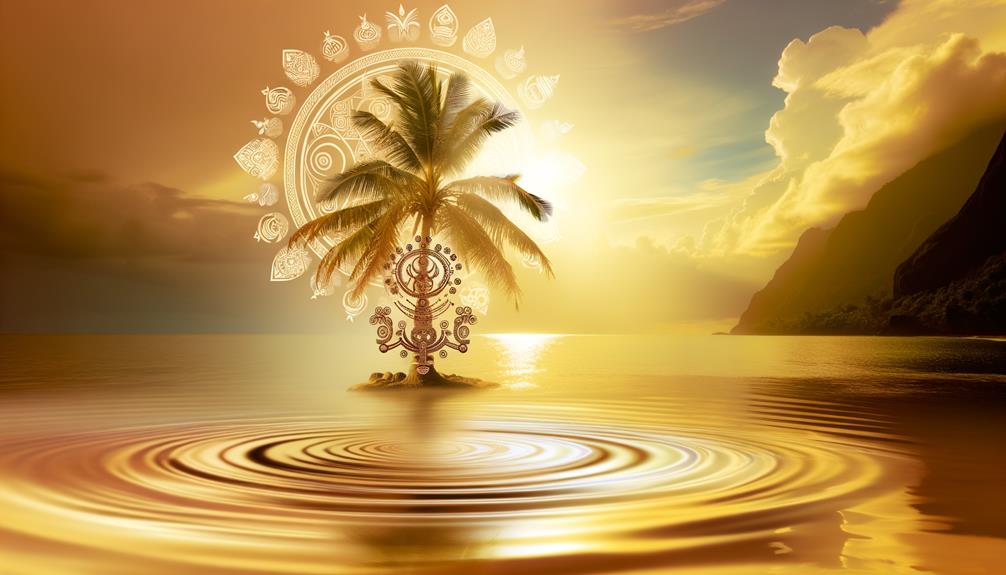
Throughout history, palm trees have held profound significance in various cultures, from ancient religious rituals to contemporary symbolism.
They’ve been revered as sacred in many ancient traditions, representing life and victory.
Today, palm trees continue to symbolize relaxation and paradise, bridging the past with the present in a seamless thread of cultural reverence.
Ancient Religious Significance
From ancient Mesopotamia to Egypt, palm trees have held deep spiritual significance, symbolizing life, victory, and divine presence.
These majestic trees were more than just flora; they were sacred emblems in various cultures, deeply embedded in religious practices and mythologies.
- Mesopotamia: Here, palm trees were associated with the goddess Inanna, representing fertility and eternal life.
- Egypt: In Egyptian culture, palms symbolized immortality and resurrection, often depicted in tombs and temples.
- Greece and Rome: In these ancient civilizations, the palm tree stood for triumph and honor, frequently awarded to victors of games and battles.
The reverence for palm trees in these ancient societies reveals their profound spiritual and cultural importance, transcending mere physical beauty.
Modern Cultural Symbolism
Today, the palm tree continues to evoke powerful imagery, symbolizing peace, paradise, and resilience in diverse cultural contexts around the world.
In modern times, it’s often associated with tropical vacations, serving as an emblem of escape and relaxation. For many, palm trees symbolize a serene retreat from the hustle and bustle of daily life, embodying an idealized vision of tranquility.
In urban environments, they stand as reminders of nature’s beauty and an enduring spirit, even amidst concrete jungles. Additionally, palm trees frequently appear in art, fashion, and media, representing an aspiration toward balance and harmony.
Their ability to thrive in harsh conditions inspires people to remain steadfast and hopeful, no matter the challenges they face.
Religious Symbolism
In many religions, palm trees symbolize peace, victory, and eternal life. These majestic trees often appear in sacred texts and rituals, representing deeper spiritual truths.
- Christianity: Palm branches were laid at Jesus’ feet during his triumphant entry into Jerusalem, symbolizing victory and peace. Palm Sunday commemorates this event, reflecting hope and renewal.
- Islam: The palm tree is frequently mentioned in the Quran, symbolizing rest and hospitality. It’s seen as a divine blessing, embodying sustenance and generosity.
- Judaism: During the festival of Sukkot, palm fronds are used in the ritual of the Four Species, symbolizing unity and God’s providence.
Across these faiths, the palm tree stands as a symbol of spiritual resilience and divine connection.
Palm Trees in Mythology

As religious texts imbue palm trees with spiritual significance, ancient mythologies also weave these trees into their tales, portraying them as symbols of life, resurrection, and divine favor.
In Greek mythology, the palm tree is linked to Apollo, representing victory and eternal life. The ancient Egyptians saw it as a symbol of immortality, often depicting palms in tombs to guide souls to the afterlife.
In Mesopotamian myths, the Tree of Life is sometimes depicted as a palm, emphasizing its role in creation and sustenance.
These mythological narratives reflect a deep, abiding reverence for the palm tree, seeing it not just as a natural wonder but as a bridge between the mortal and the divine, the earthly and the eternal.
Modern Spiritual Practices
In modern spiritual practices, palm trees often play an essential role in enhancing meditation and grounding rituals.
Their serene presence and symbolic strength remind individuals to connect with their inner peace and resilience.
Whether used as focal points in meditation sessions or sacred elements in rituals, palm trees inspire a deeper connection to the self and the natural world.
Meditation and Palm Trees
Amidst the tranquility of rustling fronds, palm trees provide a serene backdrop for modern spiritual practices like meditation. Their towering presence and gentle sway offer a calming influence, which helps individuals enter a state of mindfulness and inner peace.
Meditating near palm trees can enhance spiritual experiences by connecting one to nature’s rhythm and fostering a deeper sense of grounding.
Here are three ways palm trees can enhance meditation:
- Natural Ambiance: The sound of leaves rustling in the breeze creates a soothing environment.
- Symbolic Presence: Palm trees symbolize resilience and growth, inspiring meditators to cultivate these qualities.
- Visual Focus: Their tall, slender trunks and graceful leaves provide a natural focal point, aiding concentration.
Incorporating palm trees into meditation can elevate the practice, promoting spiritual well-being.
Palm Trees in Rituals
Palm trees often play a pivotal role in modern spiritual rituals, symbolizing resilience, peace, and connection to nature.
In many contemporary practices, palm leaves are used during cleansing ceremonies, where their gentle swaying is believed to sweep away negative energies.
Ritualists might incorporate palm oil in anointing rites, seeing it as a conduit for grounding and spiritual fortification.
Additionally, palm fronds are sometimes woven into intricate shapes, each design carrying its own unique intention and prayer.
Whether adorning altars or being carried in processions, palm trees invite a serene, yet powerful, energy.
They remind practitioners to stand tall through adversity and to stay rooted in their spiritual journey, fostering a deeper connection to the natural world.
Conclusion
While palm trees sway gently in the tropical breeze, they stand as powerful symbols of peace and victory, resilience and eternal life.
Ancient cultures revered them, while modern spiritual practices still find inspiration in their strength.
The juxtaposition of their delicate fronds with their robust trunks encapsulates life’s paradoxes—softness and strength, fleeting moments and endless endurance.
In every leaf and shadow, palm trees remind us of our own potential for growth and unwavering spirit.